“Real Wealth” a Year-and-a-Half On

In the Winter 2009 issue of Arts and Craft Homes and the Revival I published an essay called “Real Wealth: The Value of Art and Craft in a Debased Economy.” (You’ll find a link to a pdf on this page.) In it I expressed my hopes for the sustenance — or even revival — of appreciation for handcrafts as the bedrock of an economy we might begin rebuilding on the restored foundation of manufacturing and agriculture. Needless to say, a year-and-a-half later we still have quite a ways to go. But in any case, I thought I’d throw out a few footnotes to the piece, and some further thoughts.

First, the entire Walt Whitman poem, “I hear America Singing,” from Leaves of Grass (1900), in which, by simply describing Americans of his day, the poet reminds us how we were once a nation of makers:

I HEAR America singing, the varied carols I hear;
Those of mechanics—each one singing his, as it should be, blithe and strong;
The carpenter singing his, as he measures his plank or beam,
The mason singing his, as he makes ready for work, or leaves off work;
The boatman singing what belongs to him in his boat—the deckhand singing on the steamboat deck;
The shoemaker singing as he sits on his bench—the hatter singing as he stands;
The wood-cutter’s song—the ploughboy’s, on his way in the morning, or at the noon intermission, or at sundown;
The delicious singing of the mother—or of the young wife at work—or of the girl sewing or washing—Each singing what belongs to her, and to none else;
The day what belongs to the day—At night, the party of young fellows, robust, friendly,
Singing, with open mouths, their strong melodious songs.

Peter Schjeldahl’s New Yorker Magazine review of the 2006 Art Basel Miami Beach was the where I got the bit about “the crumpled Camel cigarette pack suspended on a fishing line selling for $160,000″— not that that’s likely to shock or surprise anyone, but the article is illuminating from the standpoint of the place of art in our culture today, as art fairs seize the market from galleries and take the commercialization of the art world one step further.


Holton Studio Landscape Show—A Heaven in the Eye


The opening for the current landscape show at Holton Studio, A Heaven in the Eye, took place last Saturday, Nov. 14th. The show features 7 Northern California landscape painters: Kevin Courter, Christin Coy, Mark Farina, Paul Kratter, Terry Miura, Robin Moore, and Brian Mark Taylor. Tim Holton has assembled a strong show of landscape paintings, all beautifully framed in his Craftsman style frames, each one custom built to suit the painting it surrounds. The gallery is open daily and is located in Emeryville

The show’s title is taken from the exuberant 1984 memoir of artist, bon vivant and deckhand Clyde Rice who colorfully recounts life on and around San Francisco Bay in the early decades of the century.


Cold Weather Painting, by Paul Kratter

In late February I spent a couple of days at Silver Lake just south of Lake Tahoe. A recent storm left a fresh layer of snow and cooler temperatures. I had a chance to do some sketching (I’ll write about that later) and did one painting.
Winter painting offers some unique challenges, mainly staying warm. The obvious extremite to keep warm is your hands, but most of the time I’m able to paint glove-free. My feet always get cold standing in one spot and the freezing temperatures seem to slowly crawl up from my snow boots. Temperatures started at 18 degrees in the morning, but quickly rose as the sun warmed up the area.
Snow offers a unique color range from soft pinks to blues and purples. I saw this beautiful grove of pines standing out against the cool mountains in the background. The light and shadow patterns of the snow offset the strong graphic nature of the pines. I’m happy to sacrifice some cold feet in exchange for a chance to paint such a beautiful scene.

Terry Miura

Made another big step in this year’s plan to grow the theme of the picture gallery as contemporary paintings of the local and northern California landscape: Sacramento painter Terry Miura recently delivered his first batch of paintings. They are a real privilege to have here, and I look forward to framing them and displaying them. Terry, who’s a friend of Paul Kratter, is also a graduate of the Art Center in Pasadena and has a professional commercial art background, having worked in New York as a freelance illustrator for magazines and newspapers. Originally from San Diego, while in the Big Apple his paintings naturally focused on cityscapes, but now he’s delving into the rural landscapes of his native state. He’s got a wonderful tonalist palette, reflecting his gentle vision of rustic California as well as a humbler approach to the role of painting as just one of the arts that create an architectural interior.
Terry will be included in the group show coming up next fall, “A Heaven In the Eye,” in which he’ll have new work capturing the Sacramento Delta. (Christin Coy, Paul Kratter, Kevin Courter and possibly another artist will join him.)

Wedding Gifts


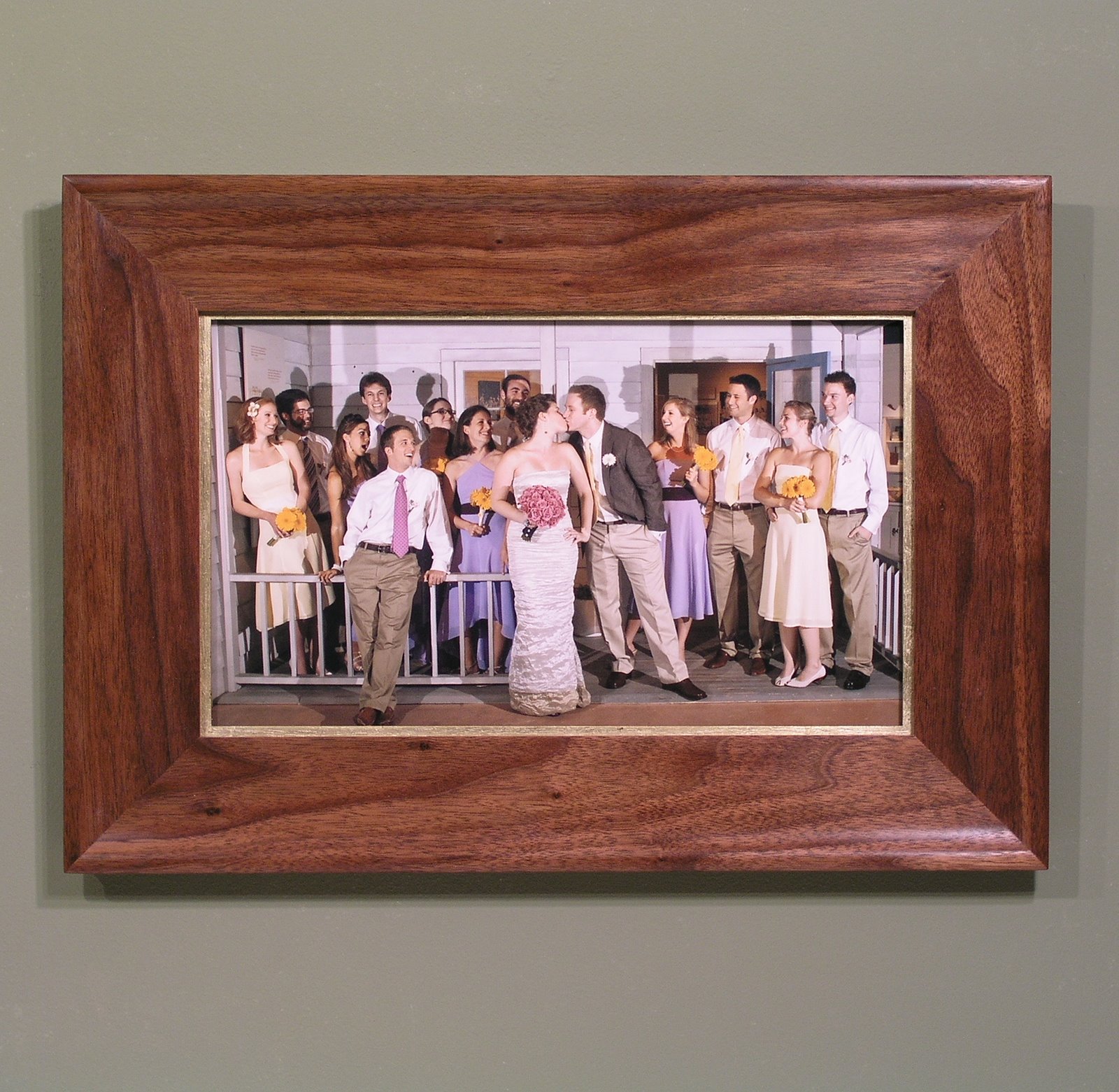
With wedding season approaching I thought I’d put out a couple of examples of pieces we’ve recently done as wedding gifts. This picture’s framed close in a simple walnut “Hudson” frame with a gilt slip. Walnut, which is a tight-grained wood, has a smooth finish which suits the finish of the photo. The form gives a picture some space but has a graceful shape that suits the figurative subject matter. I think we struck the right balance between the formality of the image and occasion and the informality of the rustic porch (it’s actually a kind of stage set at the Museum of the New South in Charlotte, NC).

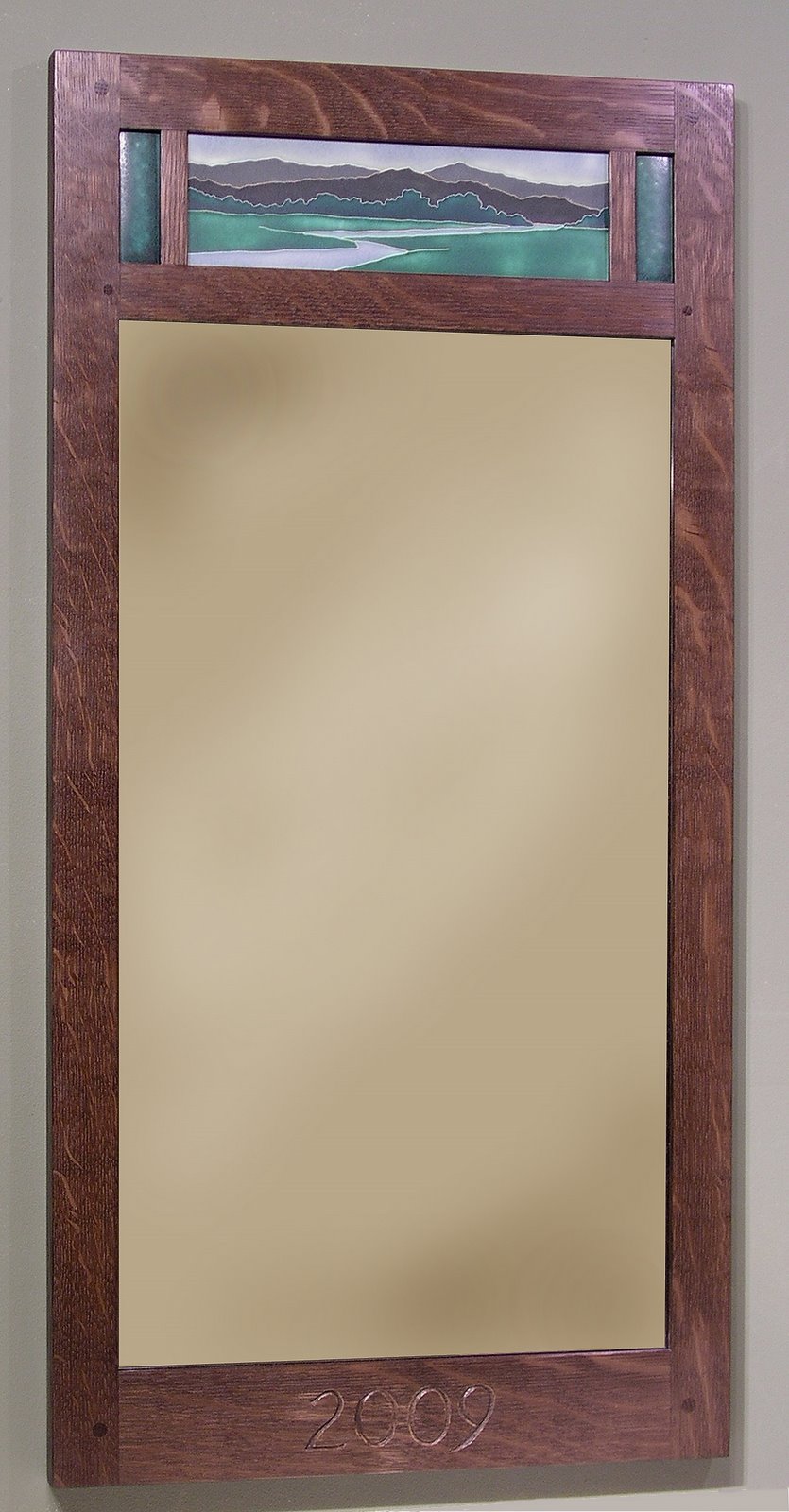
The second example is a mirror made for a customer who found an image in tile that she liked as an appropriate image for newlyweds, and wanted it integrated into a mirror to give as a wedding gift. (Mirrors make great wedding gifts, because when you get married you have to watch yourself.) I also carved the year of the wedding, 2009, into the bottom. The tiles are by Motawi Tileworks (the two on either side of the landscape tile are actually glaze samples). Made in quartersawn white oak (Weathered Oak stain) it measures about 38″ x 18-1/2″.

Carved Walnut

Of all the woods we use, we tend to emphasize quartersawn white oak. But walnut has always been a big favorite too, especially for carving. In preparing for the Paul Kratter show in June, the painting we decided to use for the publicity suggested walnut. Here’s a corner detail of the frame, which is a compound design, meaning it’s composed of more than one molding. This one has a cap molding as well as a liner. The liner has pale gold leaf laid directly on the walnut so the grain comes through.

The color of walnut harmonizes well with many pieces because it’s rich without being too intense. We typically stain it – this one has a light stain – to mute it even further.

We use walnut frequently for drawing frames (i.e., narrow profiles), but it’s often great on paintings and other items.


Jean Sanchirico website

Jean Sanchirico, who we started representing last fall, has launched her website, www.jeansanchirico.com. You can preview the ones we have, which we’ve framed, at Jean’s page on my site.
6/15/10 update: Jean is no longer represented by us, but is still a great friend (and the best neighbor!), and I urge you to follow her on her site. Her work is shown in our Portfolio, here.

Tom Killion

Was up at Pt Reyes this weekend and had a frame to drop off for Tom Killion, a wonderful printmaker who lives and works up there. If you don’t know Tom’s work, you’re in for a treat. He works in the tradition of Japanese woodblock printmaking, but has been at it long enough to have evolved his own very distinctive style. Tom’s extraordinarily well-traveled, and his work reflects his travels. But in recent years it seems he’s focused more on California, having produced a book on the High Sierra, The High Sierra of California, and most recently, Mt Tamalpais in Marin County, California. Titled Tamalpais Walking,it’s written with the poet Gary Snyder and published by Heyday Books. Tom was generous enough to give me a copy of the book, and it is very beautiful. Check him out at www.TomKillion.com. (You can find examples of how we’ve framed Tom’s prints in the “Prints and Works on Paper” section of the Portfolio.)

Mural Feeling

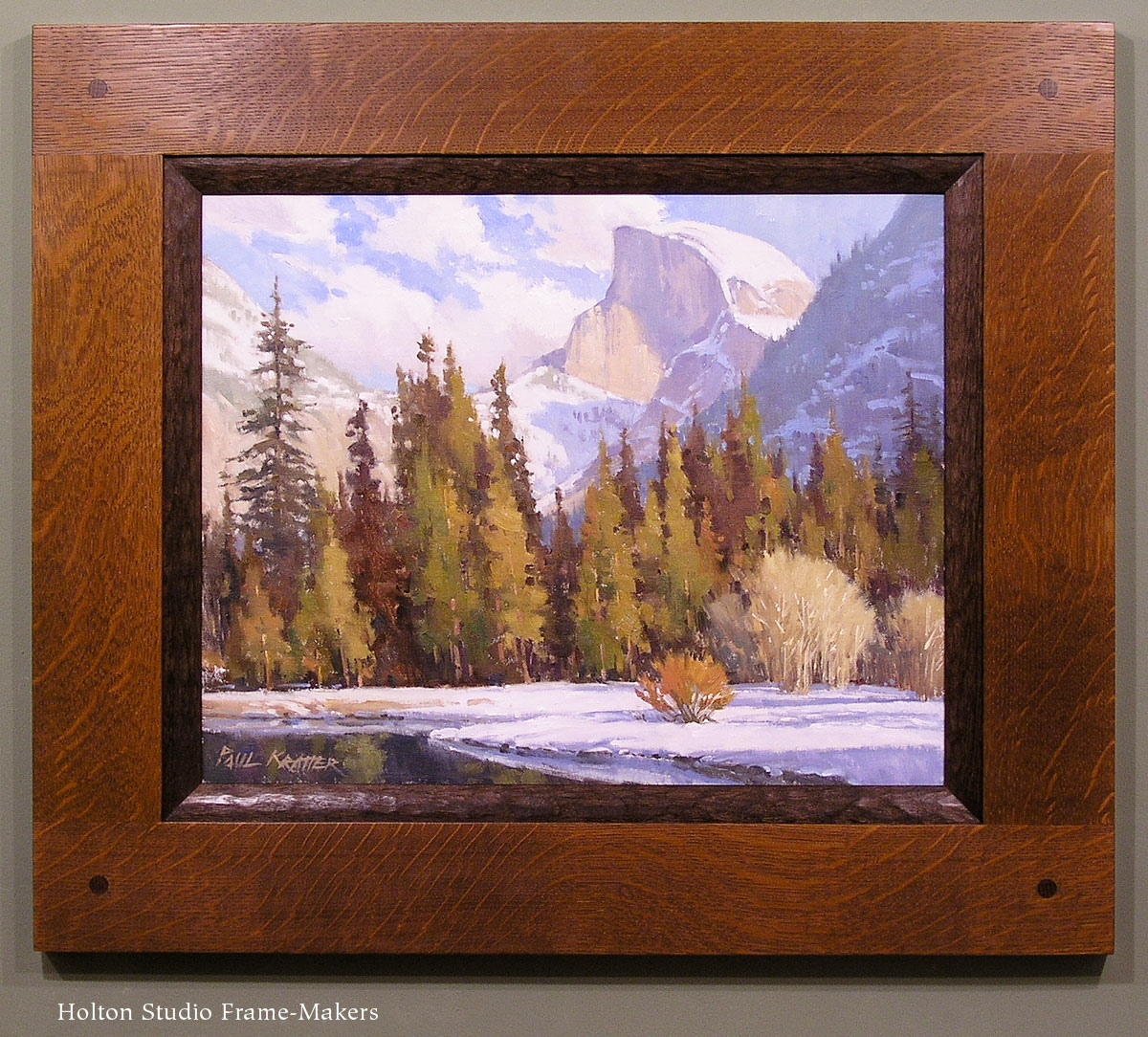
We recently framed this Paul Kratter painting for a couple in Washington State, and I wanted to share one aspect in particular that we’re emphasizing more and more. It’s what Walter Crane, the first president of the Arts and Crafts Exhibition Society, called “mural feeling”—the effect of an easel painting framed and hung to feel like a part of the wall. Paul Kratter painting

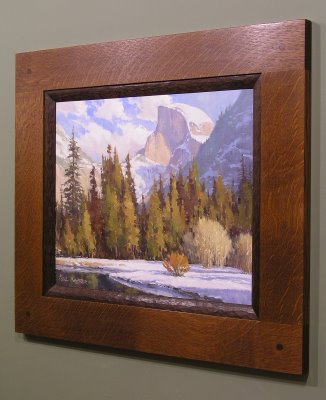
As Crane wrote, “The easel picture, properly considered and placed in its right relationship to its surroundings, by judicious treatment and hanging, and above all by a certain mural feeling, may be the acme of decoration. Its relation to a scheme of decoration may be like that of a jewel in a dress.” Two keys to achieving this effect are demonstrated by this piece: first, and more obviously, the very architectural feeling of the mortise-and-tenon frame; and second, the hanging system which allows the frame to hang right up against the wall with no gap, and especially importantly, without leaning forward and down the way pictures usually do when hung with a wire. The way we do this is to cut recesses on the back (the “reverse,” in framer’s parlance) of the frame and attach D-rings in the recesses. There’s no wire; the picture hooks are carefully located on the wall so the D-rings hang directly off the hooks. With the D-rings and the picture hooks both in the recesses there’s nothing to push the picture and frame away from the wall.

What’s so important about this is the effect of unity and the aim of restoring the primal unity of all the arts, but in particular the most divided arts historically speaking, which are painting and architecture.

One other thing about this frame that I particularly like is the flush through tenons, shown here: