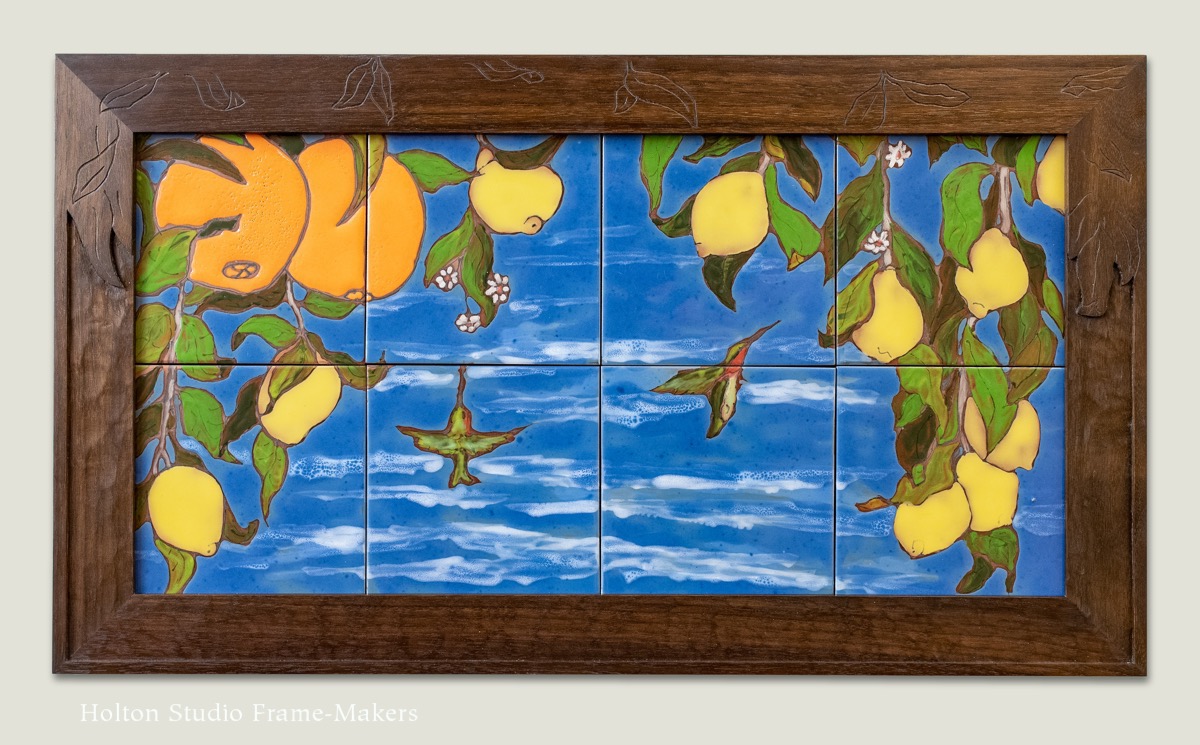
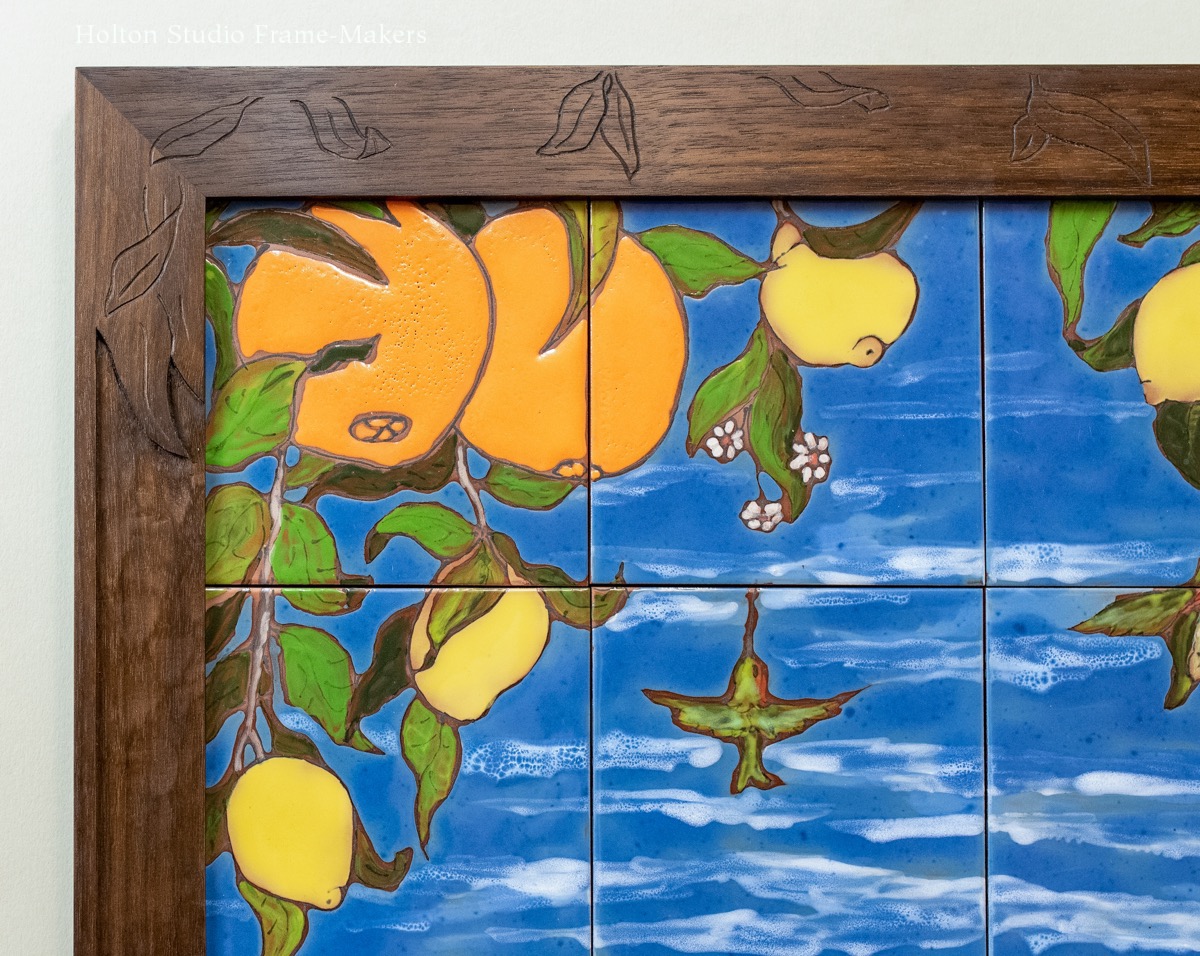
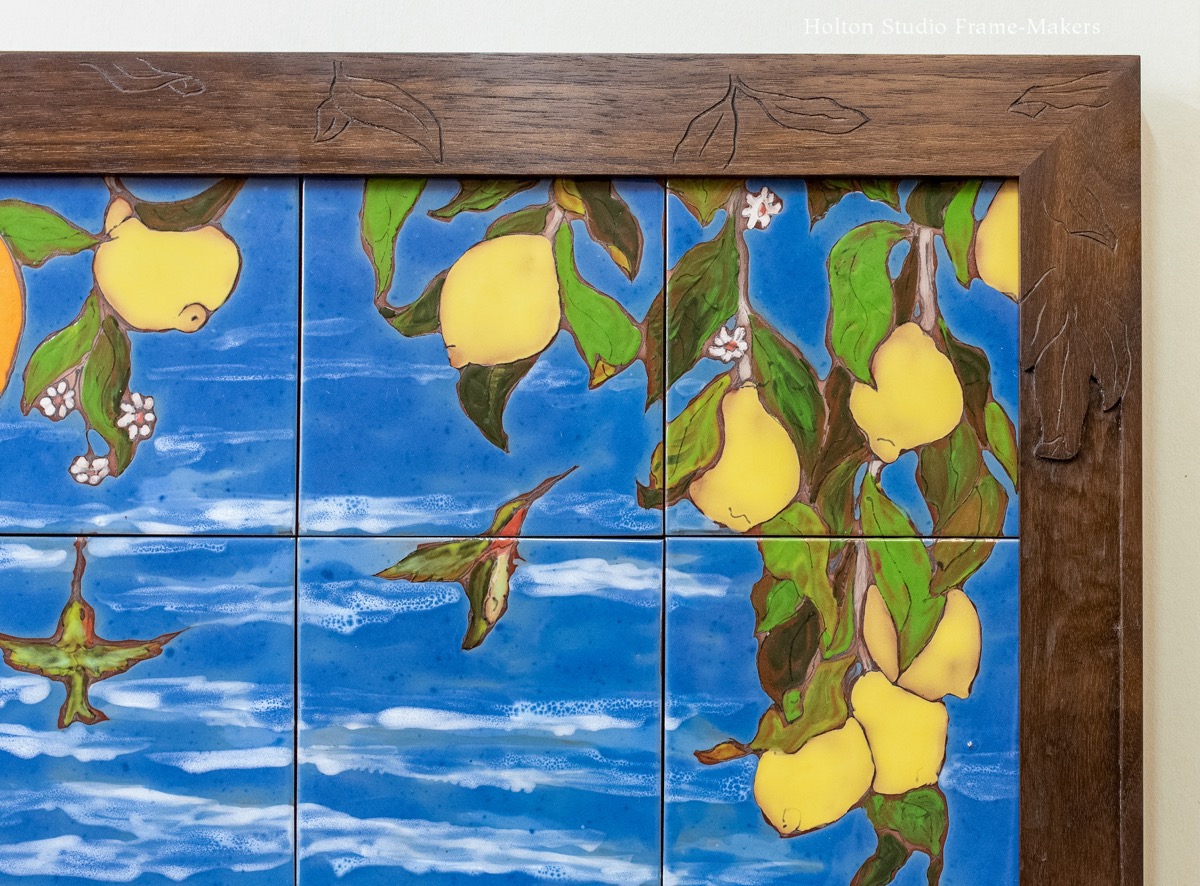
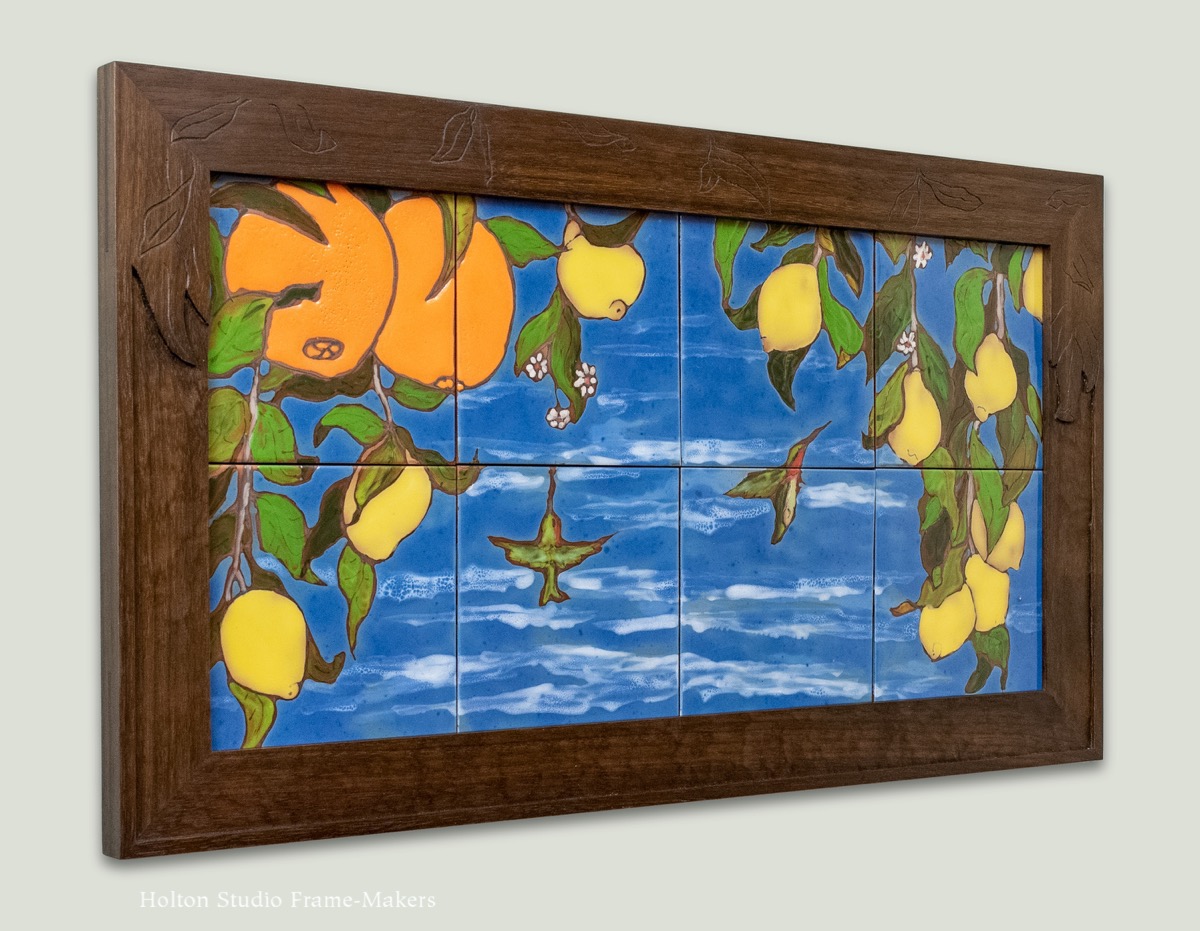
This is a set of contemporary Italian tiles in another example of what I’m calling, for lack of a better term, a sheltering frame, a bit like the one discussed in my last post on framing a William Rice print. Each tile is 6″ x 6″, so the whole set of eight is about 12″ x 24″. The 2″ wide carved frame is walnut, lightly stained. I designed the frame to expand on the sense of sitting under, and being sheltered by, a pair of citrus trees. To do that, I channeled the tilemaker’s rendering of the leaves, simply carving them in outline, and using the sheltering approach—making the top part of the frame heavier.
Archives
The Light Falls: Framing William Seltzer Rice
I’ve written before (in this post, for example) about the unique opportunity for harmony that exists  between a block print and a wooden frame: the carving of the face of the frame can create not only an effective profile for the presentation of the print but can actually mimic the carving of the woodblock (or linoleum) used to print the picture. A simple example of that is our frame for the print at right, “Nightfall,” by William Seltzer Rice (1873-1963).
The frame for another William Rice print we recently had come through, “Mountain Cascade” (n.d., ca. 9″ x 12″), below, also follows that principle, but adds to it a framing approach I find effective for entirely different reasons: a kind of sheltering effect that draws on and underscores the frame’s protective function. In this case, an added benefit is the way the frame design has that feel of a waterfall’s gravity.

 In the print, a canopy of tree branches shelters a cascade. The 1″ wide walnut frame echoes that by keeping the top part of the frame “heavier” with foliage, that density of leaves suggested by simple cuts in an otherwise plain, flat face. Those cuts if made in a printing block would leave spots of uninked paper and the effect of “light holes” in a tree canopy. Descending from the canopy, as it were, the density of leaves decreases, leaving a smattering of hanging leaves part way down the sides of the frame. Below those hanging leaves the lower part of the frame is a simple carved profile with raised straps on the inside and outside—our No. 14 profile. All in all, the frame is not only echoing the way the tree canopy shelters the waterfall but satisfies our instinctive desire to feel that the frame is sheltering the print.
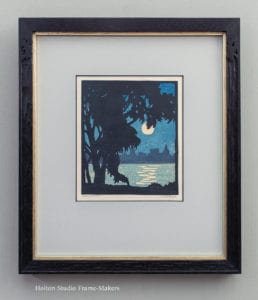
WS Rice, “Lake Merritt”
I first played with that idea in framing another Rice print, shown at right and posted about here.
Like N.C. Wyeth, who was the subject of my last post, William Rice also studied under the great American illustrator and teacher, Howard Pyle (1853-1911). Pyle influenced Rice not only as an artist but in his choice to become a teacher—which Rice did at grade school through college levels. This earlier post on framing another block print (as well as a Rice watercolor) also discusses Rice’s instructive book, Block Prints: How to Make Them. In any case, nearly 60 years after the artist’s passing, not only are Rice’s block prints still widely admired but they go on teaching close observers and students, including this frame maker, the art of woodblock printing—or at least the art of woodblock carving.

Re-Framing N.C. Wyeth
Here’s a feather in our cap—or our cowboy hat. We had the honor this month of getting to make a frame for a painting by N.C. Wyeth (American, 1882-1945). The oil on canvas, titled “Ahead Rode a Keen-Eyed Man,” 11″ x 36″, was made in 1908 for The Saturday Evening Post as a headpiece illustration for a fictional story. Trevor Davis made the 2-1/2″ wide quartersawn white oak frame (Light Medieval Oak stain). It’s a Compound Aurora. The cap molding is carved with simple geometric arrow patterns at the corners and the center of the top and bottom. The chamfered flat has mortise and tenon joints with diagonal square plugs over the dowels pinning the joints. The 5/16″ wide chamfered liner has a carved corner pattern of Trevor’s design, and is leafed with pale gold.
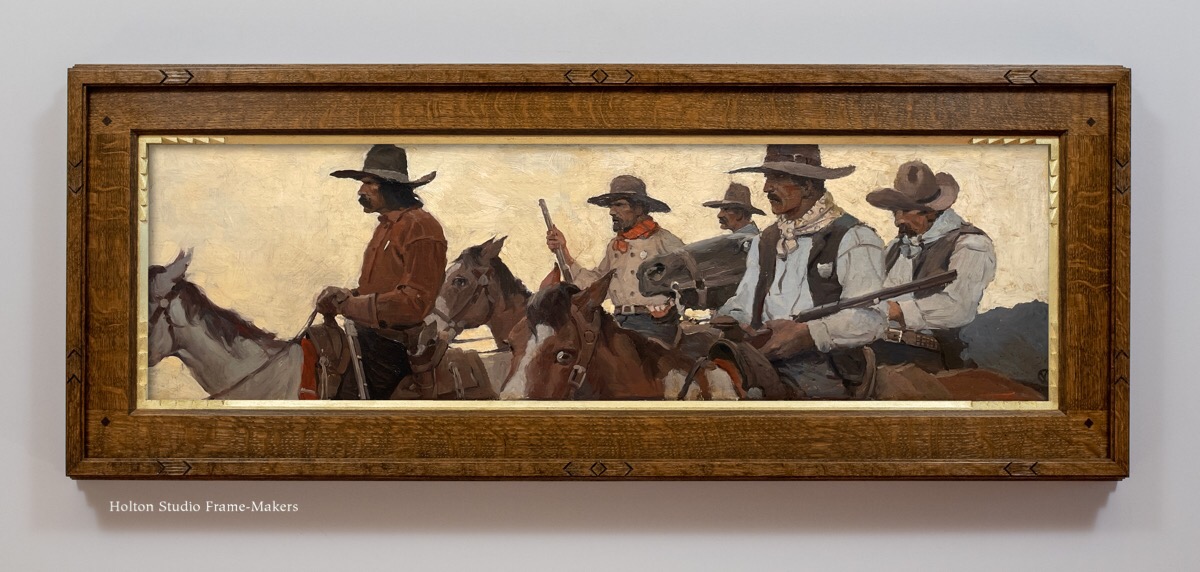
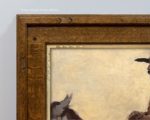
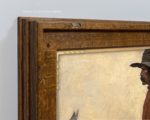
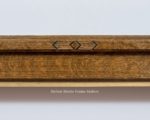
Here’s how it was framed before. But don’t get me started.

N.C. Wyeth
Born and raised in Massachusetts, N.C. Wyeth moved to Wilmington, Delaware and the Brandywine Valley to study with the most admired illustrator of the time, Howard Pyle. On his blog, Lines and Color, Charley Parker writes that
While Pyle brought a new level of dynamics and drama to previously staid and theatrical approaches to illustration, Wyeth took his teacher’s mastery of drama and cranked it up to 11, placing the viewer on the edge of impending action or danger.
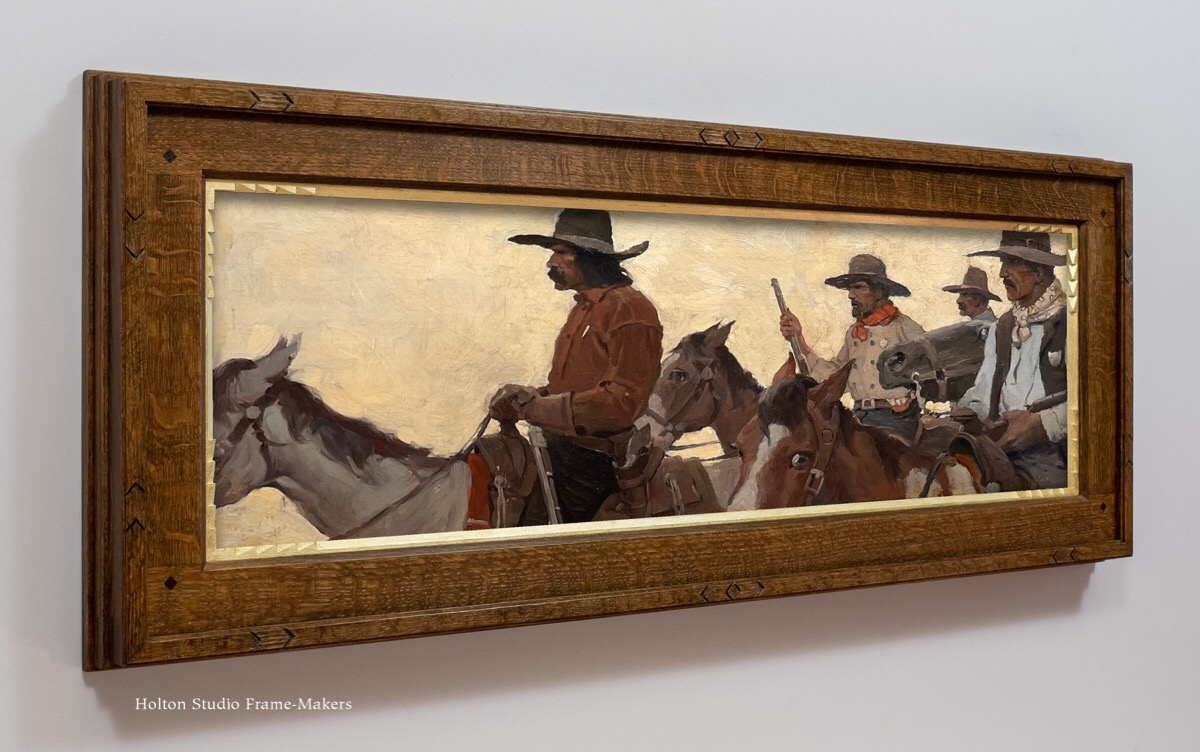 That dramatic feeling is certainly present in this piece. And, along with a genius for color, figure, landscape and still life, it would lead to the creation of a powerful body of work for Wyeth, not only for magazines but for the publisher Charles Scribner and Sons’s editions of classics like Robin Hood, The Boy’s King Arthur, Kidnapped, and, perhaps most famously, Treasure Island.
 While Wyeth’s artistic achievements are more than enough to secure his place in the pantheon of American illustrators, his role as the head of one of America’s great artistic families (father of Andrew Wyeth and grandfather of Jamie Wyeth, and that’s just for starters) is also notable.
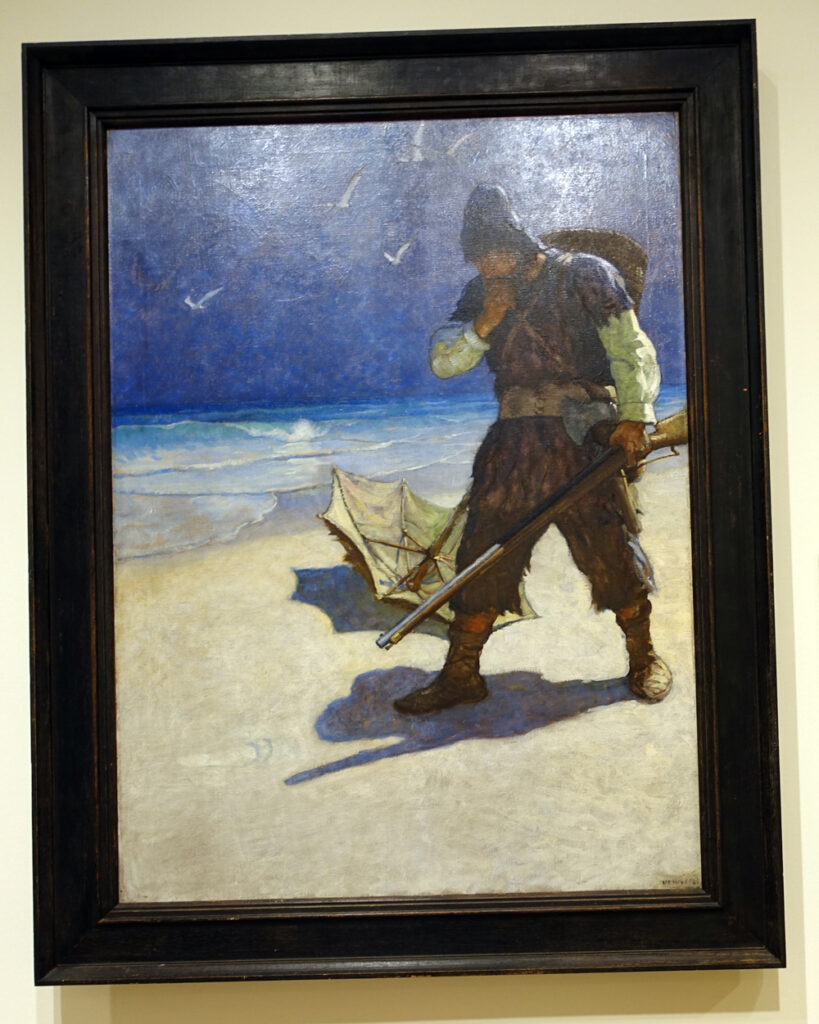
Enjoy learning more about N.C. Wyeth with a visit to the webpage for the Brandywine River Museum of Art‘s recent exhibition “N.C. Wyeth: New Perspectives.” I like Dianne L. Durante’s personal write-up of that show. She shares her own pictures of the paintings including their frames—like this 1920 painting for Robinson Crusoe, at right, in what appears to be its original dark quartersawn white oak frame.
An “O” for Odetta
A little rounding off can make a frame a kind of “O,” so it seemed clear how this poster, “O is for Odetta,” should be framed. The 21″ x 15″ silkscreen is by long time Berkeley High School art teacher Miriam Klein Stahl, and is one of her illustrations for the children’s book “Rad American Women, A-Z” written by Kate Schatz. The frame is walnut stained black. I found Ms Stahl’s bold graphic handling of form rather wonderful, and so shaped the frame in appreciation.

Speaking of appreciation, Bob Dylan once told an interviewer that, “The first thing that turned me on to folk singing was Odetta.” Often called “the voice of the civil rights movement” and proclaimed by Martin Luther King, Jr. the queen of American folk music, Odetta sang at the historic 1963 March on Washington where King delivered his “I Have a Dream Speech.”
 “Odetta Holmes was born in Birmingham, Ala., on Dec. 31, 1930, in the depths of the Depression,” according to her December 2008 obituary in the New York Times. “The music of that time and place,” the Times wrote, ”particularly prison songs and work songs recorded in the fields of the Deep South, shaped her life.” Odetta herself once framed the significance of those songs to her life and career in words that today, in the wake of the murder of George Floyd, are haunting:
“They were liberation songs. You’re walking down life’s road, society’s foot is on your throat, every which way you turn you can’t get from under that foot. And you reach a fork in the road and you can either lie down and die or insist upon your life.”
See Odetta in a 1964 concert for television here…
Framing Angel Espoy
Two thirds of the Earth is ocean, so as land animals, our lives as humans are framed by the sea. Angel Espoy (Spain and California, 1879-1963) was a sailor and merchant marine and even a ship’s captain, and so knew his subject for this painting well. Not only that, but while a young man in his native Spain, he studied painting with the incomparable Joaquin Sorolla, who knew a thing or two about painting the sea. Espoy’s colorful life included sojourns to Cuba (where he painted furniture) and the Philippines (where his father had tobacco interests), New York and, finally, in 1914, San Francisco, where he went into animation with the Animated Film Corporation. In his spare time, he painted with pals Manuel Valencia, Carl Jonnevold and John Califano. This 30″ x 40″ untitled oil was painted in the 1920’s, so presumably portrays a beach on our Northern California coast.
We made it a 4-1/4″ wide quartersawn white oak frame stained a cool Medieval Oak, with 1/4″ liner in quartersawn white oak gilt with 18 kt gold. The carved profile is a straightforward scoop with a back-beveled back edge (which is not carved, in contrast to the carved cove of the face) and coved back (visible in the image below). At writing, this excellent work is available from California Historical Design.
Framing a Norbertine von Bresslern-Roth Linocut
This is a linoleum block print by Norbertine von Bresslern-Roth (Austria, 1891-1978), who some regard as the greatest twentieth century European animal artist.
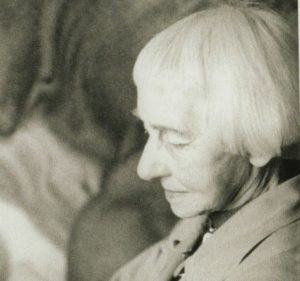
Norbertine von Bresslern-Roth (Austria, 1891-1978)
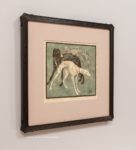
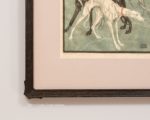
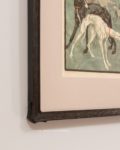
The untitled 8″ x 9-1/8″ linocut of three greyhounds is dated 1926. Bresslern-Roth beautifully captures the distinctive and characteristic visible bone structure of these creatures, and I enjoyed shaping the frame’s corners, which also have shaped proud splines, to echo that. I’d never thought about the opportunity for harmony between a picture frame and a picture of a skeletal frame (I guess I haven’t framed many skeletons). The 7/8″ wide frame is in walnut stained black. Its basic profile is our No. 14, which I often use with block prints in order to take advantage of another opportunity for harmony: the No. 14 profile is made the same way the printing block is made, with a good portion of the surface carved back to leave raised lines to ink the paper.
Scroll down to see more animal prints by Bresslern-Roth.
Process—


More animal linocuts by Bresslern-Roth
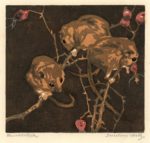
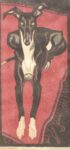
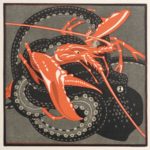
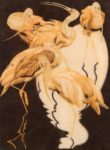
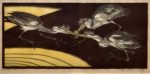
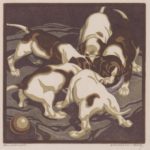
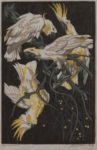
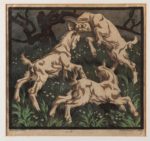
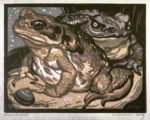
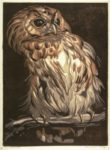
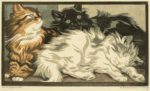
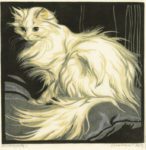
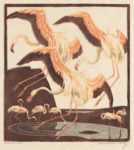
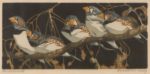
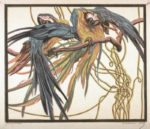
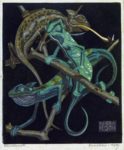
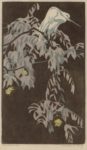
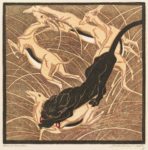
Below is a sampling of animal linocuts by this artist. These I found at at Invaluable.com and at the Fine Arts Museums of San Francisco, which I encourage you to visit to find more work by the artist in this particular style she mastered, as well as Bresslern-Roth’s paintings and drawings. Learn more about Norbertine Bresslern-Roth here…
Framing an Antique Textile
Not much is known about this stitched piece, but it was clearly made in the early twentieth century. It came to us with a raw edge, so evidently never saw any use or enjoyed presentation of any kind. We had it stretched and gave the 21″ x 20″ work a 3″ cherry frame stained a deep red-brown that felt right with the intense red and purple. The dark surround enhances the bright colors. The gilt slip picks out the gold thread. The design is simple—a plain slope profile (our No. 2) with two carved radiating lines near the corners. That’s all this abstract pattern needs—the right frame to finish it, after all these years.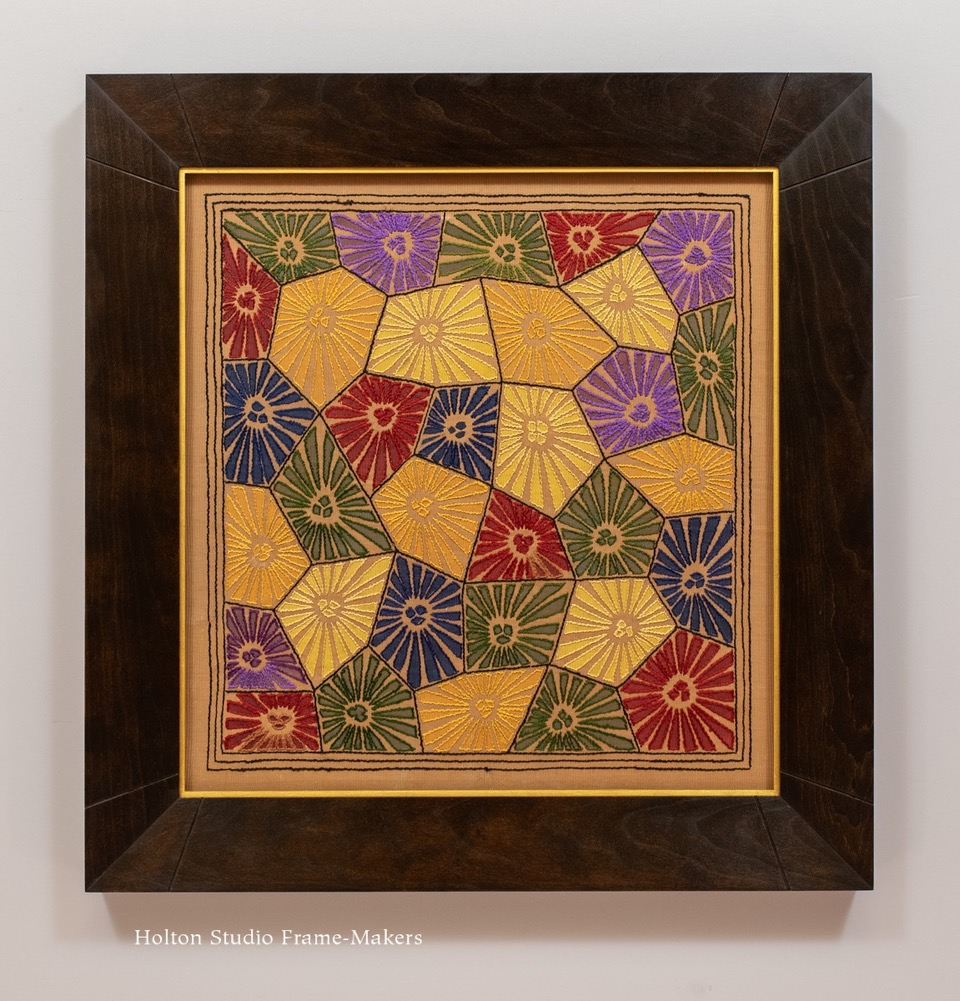

Framing Paul Roehl’s “Overcast Sky”
As part of our current gallery showcase of larger paintings, “The Mighty Earth,” we’ve framed Paul Roehl‘s beautifully moody “Overcast” (oil on board, 20″ x 24″). The quartersawn white oak frame, made by Trevor Davis, is a simple cushion profile. Trevor carved the whole face of the frame to complete the frame’s harmony with key forms of the painting: the hills, shrubbery, oak trees, and clouds of the overcast sky. The texture of tooling also sustains the texture of the painting’s surface. The 3″ wide face steps out at the back, so that the whole profile is 3-1/2″ wide, plus a 3/8″ carved and gilt liner. The frame is stained Dark Weathered Oak, giving it a shadow tone and value in complement to the quiet fading sunlight imbuing this work with its still, reflective mood.
I hope you’ll stop by to see the show, which runs through August 27.
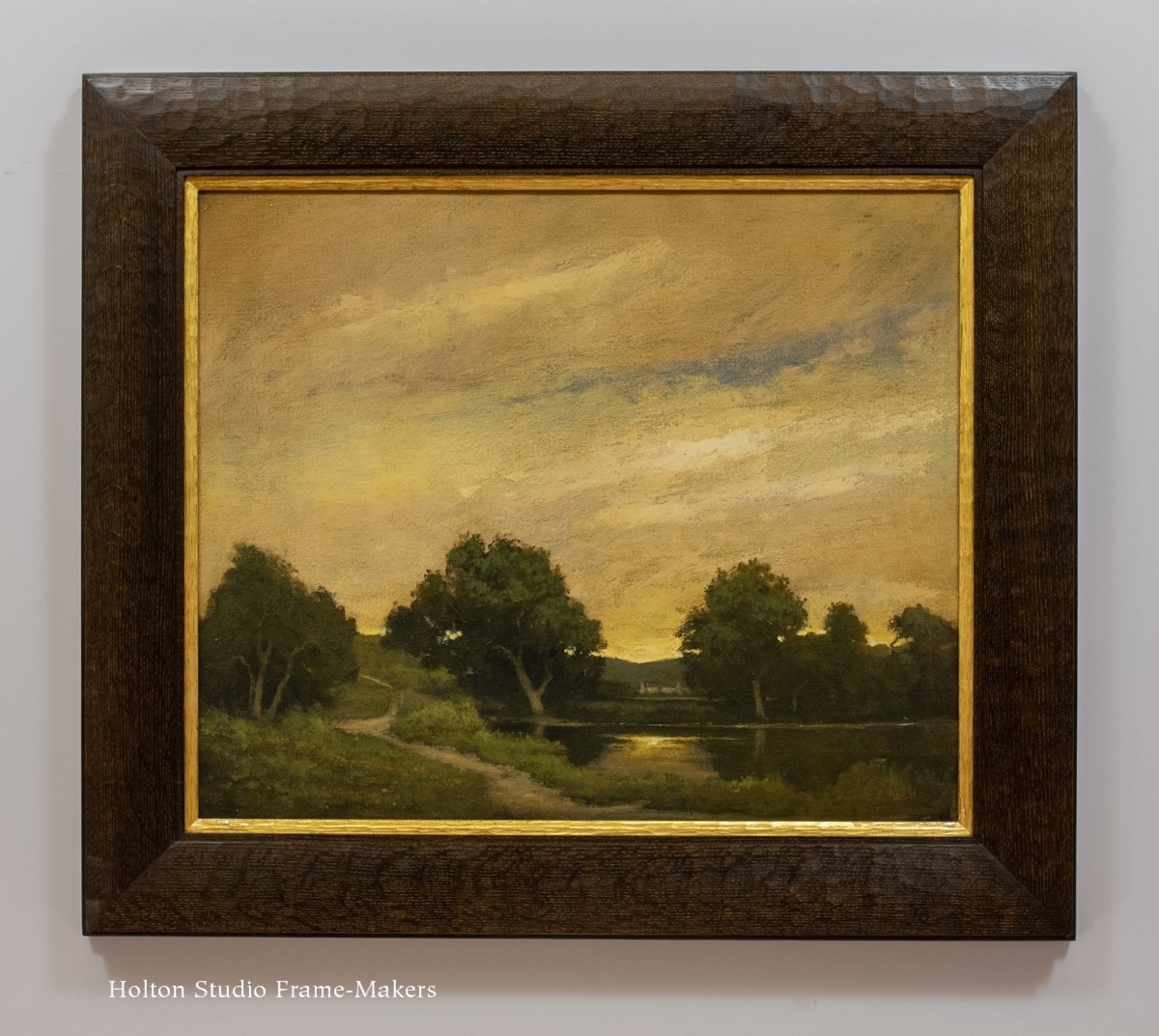
Paul Roehl, “Overcast,” 2017. Oil on board, 20″ x 24″.

Framing Toshi Yoshida and the Wings of Love
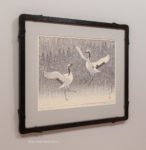
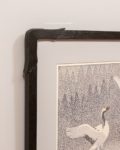
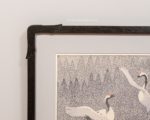
This rare large (13″ x 17-1/2″) woodblock print made by Toshi Yoshida in 1994, “Dance of Eternal Love,” is an extraordinary and inspired image which my customer and I saw fit to play up in the framing by adapting the form of the expressively spread wings to adorn the corners. Those shaped corners of the 7/8″ wide black-stained walnut frame, which is about 21″ x 25″ overall, also have proud splines. Like several frames posted lately, this one has a painted slip, in this case in a grey lilac keyed to the print, and the slip is shaped to follow the lines of the frame. 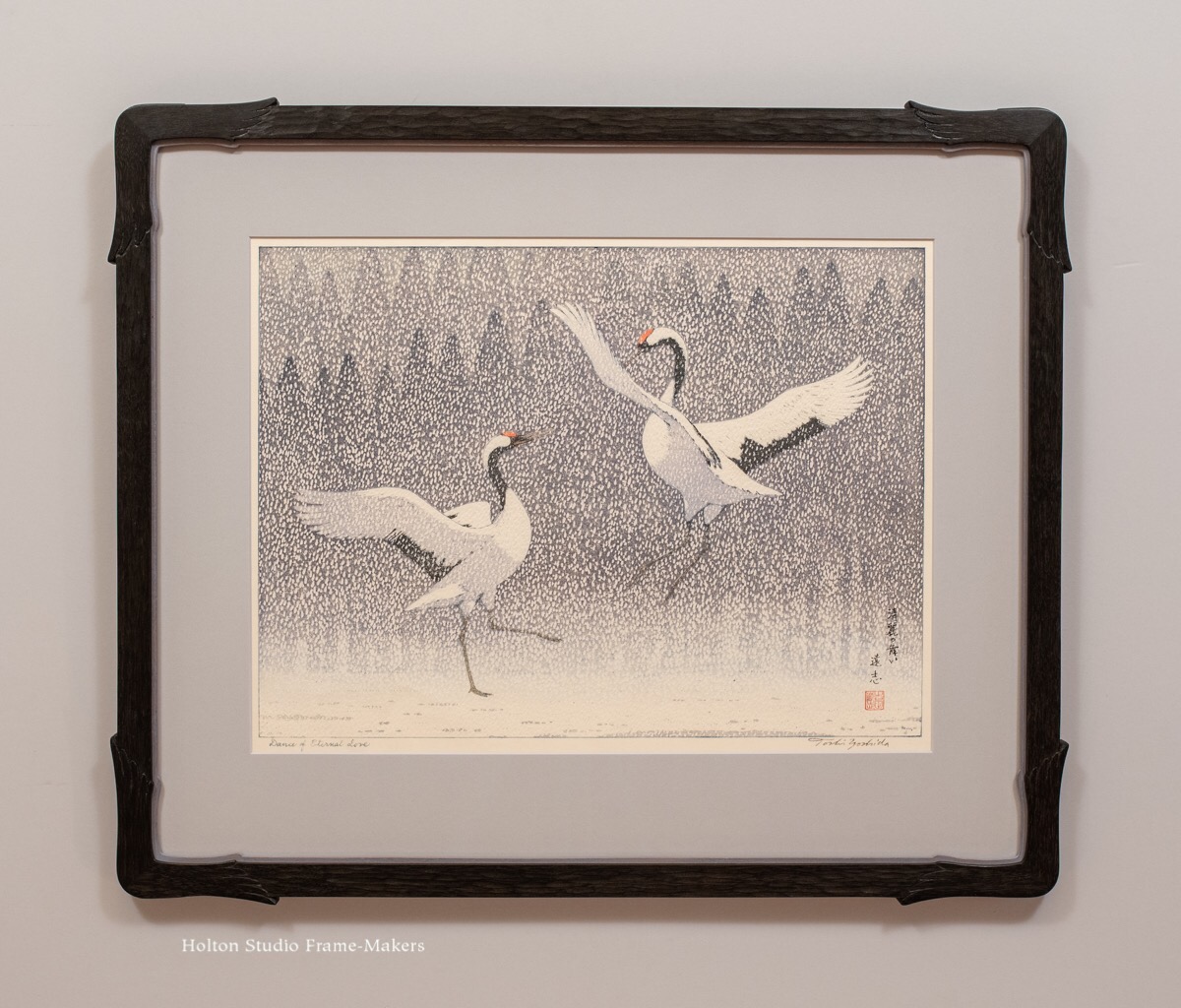 We frame pictures we love, and framing them right means framing them lovingly. Picture and frame, like two people—or two cranes—in love, complement each other in a kind of amorous duet.