On the Corner: Carved Flute Samples

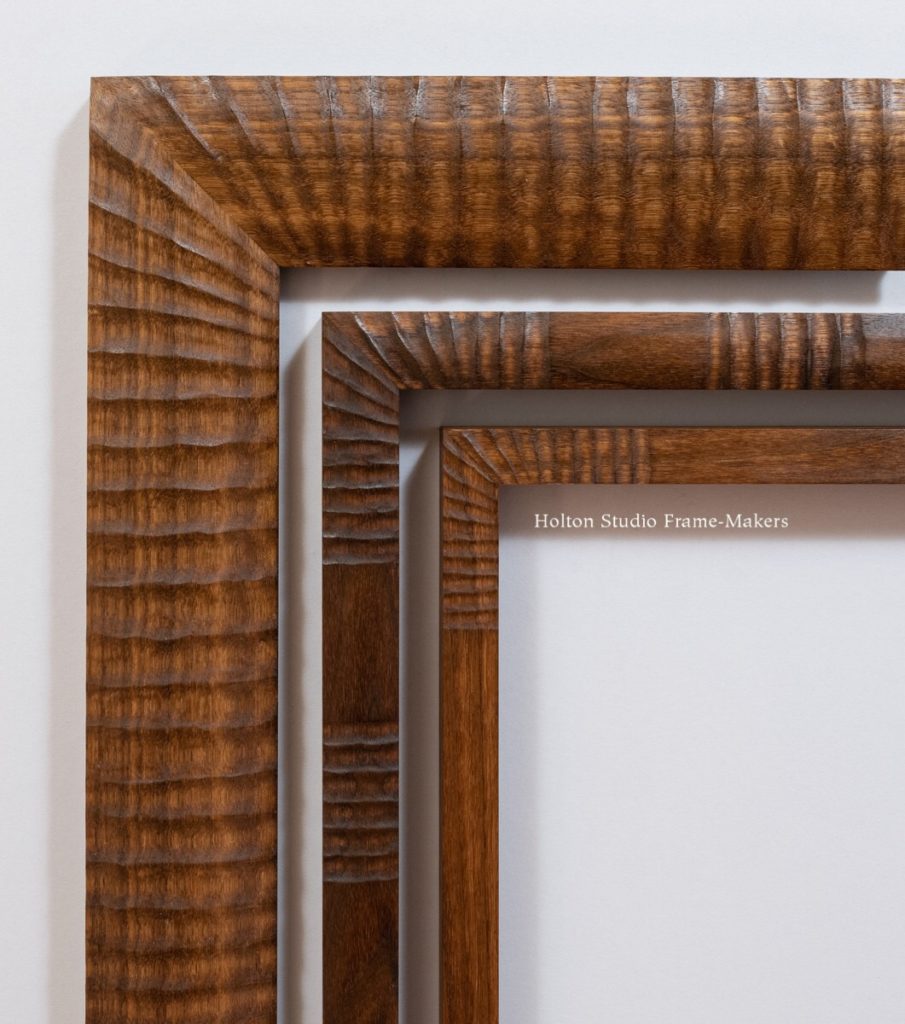
My last post showed how we framed a Robert Daughters paintingRobert Daughters painting in a frame design with carved flutes cut across the grain. Here are three corner samples I made a month or so ago, with that same idea. And on all of these the flutes round the corner, which I like.

The outer one, which is 2-1/2″ wide, is simply a wider version of the cap molding on the Daughters. The middle one is an inch wide and is also a cushion form. The inner one is a 3/4″ wide flat. All are walnut finished with linseed oil (I recommend Ottosson’s purified boiled linseed oil) and wax. The oil penetrates deeply (so requires a few coats before the surface builds up enough to stop looking dry in a day or two), not only enriching the color but also darkening the wood—especially, of course, the end grain. That includes the ridges. The result is that the oil accents the carved pattern. These patterns take time (not just carving but sharpening!) and are a little tedious, but can be very effective on a picture.Carved walnut picture frame corner samples

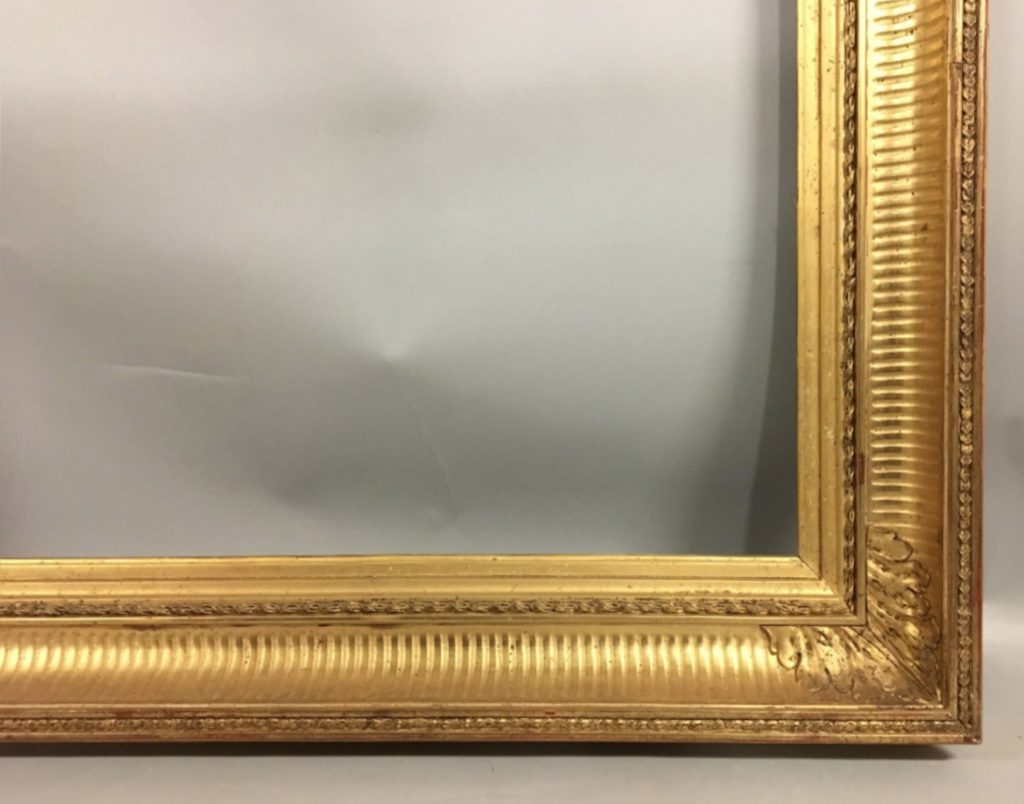
French fluted frameFlutes cut across the molding profile are a common convention. At right is a 19th century French example. This pattern’s popularity surely has to do with its effectiveness in directing the eye into the picture, as well as emanating the picture and its subject out into the surrounding world—twin effects instrumental to the essential function of the picture frame.


Carved walnut picture frame corner samples

Framing Robert Daughters

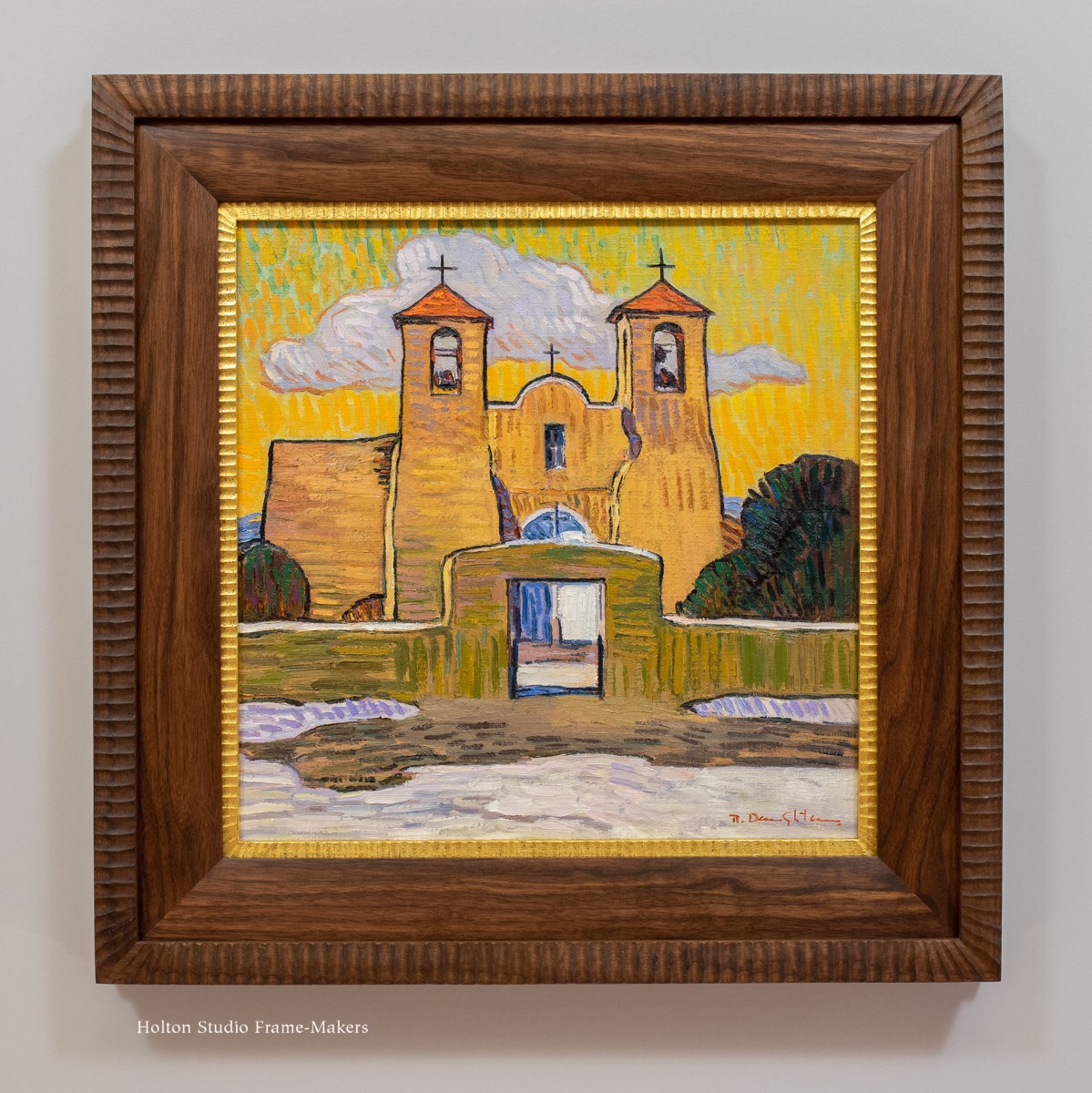
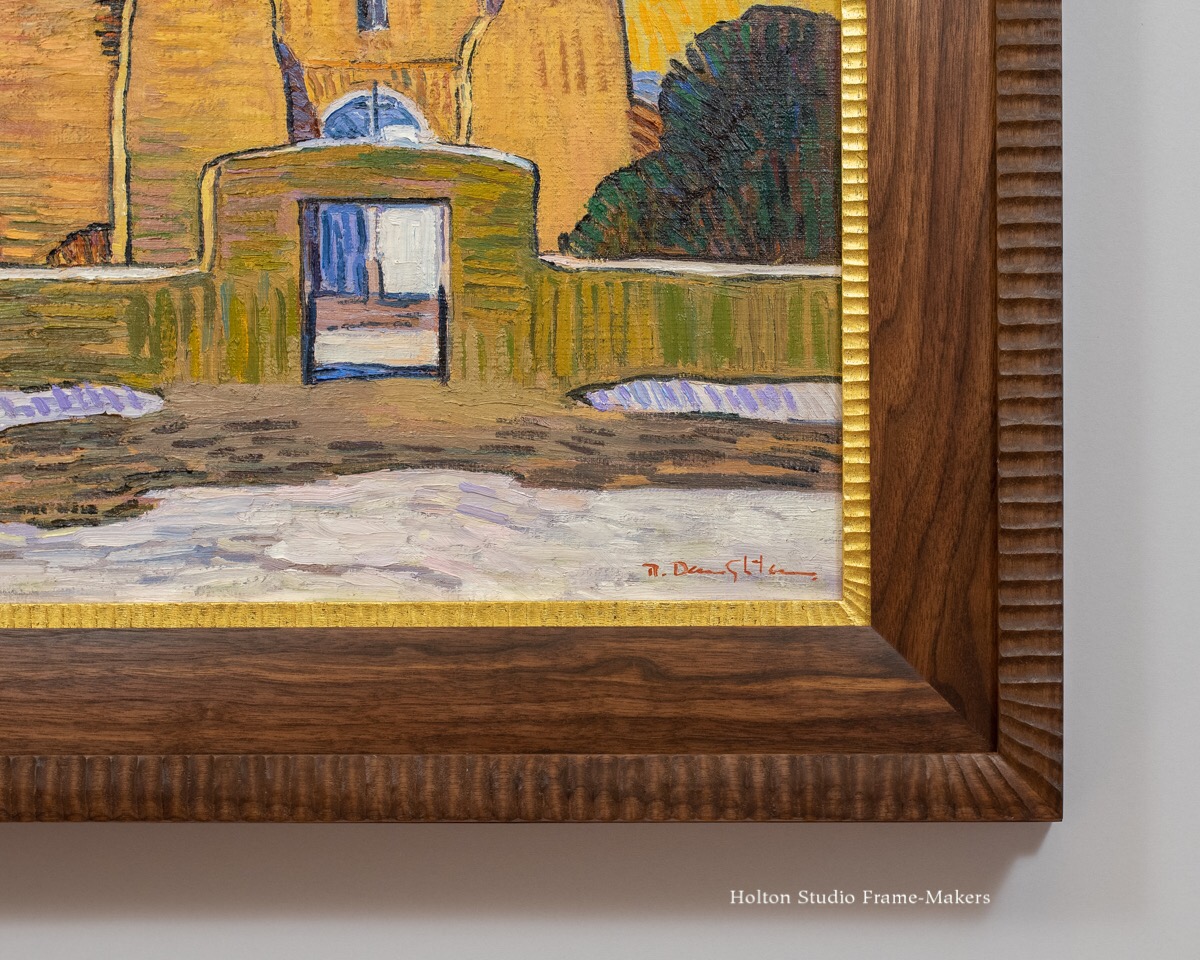
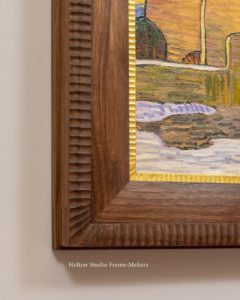
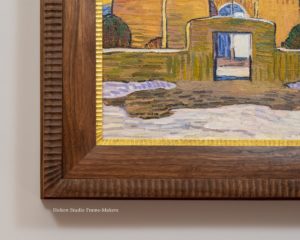
We just framed this painting of San Francisco de Asis Mission Church in Taos, New Mexico by Robert Daughters (1929-2013). We set the 15″ x 15″ “Taos Church” (n.d.) in a 3″ compound mitered frame with carved flutes cut across the grain on the cushion-shaped cap molding and the gilded liner. The 2″ intermediate molding is an (uncarved) low cushion. Sam finished the walnut frame with linseed oil and wax.

The idea was, in part, for the flutes to echo the brush strokes. (One online bio of Daughters cites, not surprisingly, Van Gogh as an influence.) But the way Trevor Davis expertly carved the flutes to turn the corners of the moldings also gives it a pleasing radiating effect suggestive of the Southwest’s desert sun.

The frame seems to me especially successful, too, because of the symmetry of the composition and the way it’s ordered around a definite, if subtle, center point. Speaking about his work, Robert Daughters painting, frame detailDaughters once said, “The composition always comes first. I like to have an important visual point; sometimes it’s a structure, and sometimes it might be a color.” In “Taos Church,” that visual point is, appropriately enough, a cross. A lesser artist would have been tempted to overplay the focal point. But in Daughters’s hands, the blue cross almost disappears into its blue background, while the artist lets the painting’s composition do the work of focusing our eyes on that point. Such complementarity and interdependence of the parts and the whole reflects a masterful understanding of composition. I’m pleased with how the frame serves this strategy.

For more frame designs with cross-grain flutes, see next post…

Robert Daughters painting

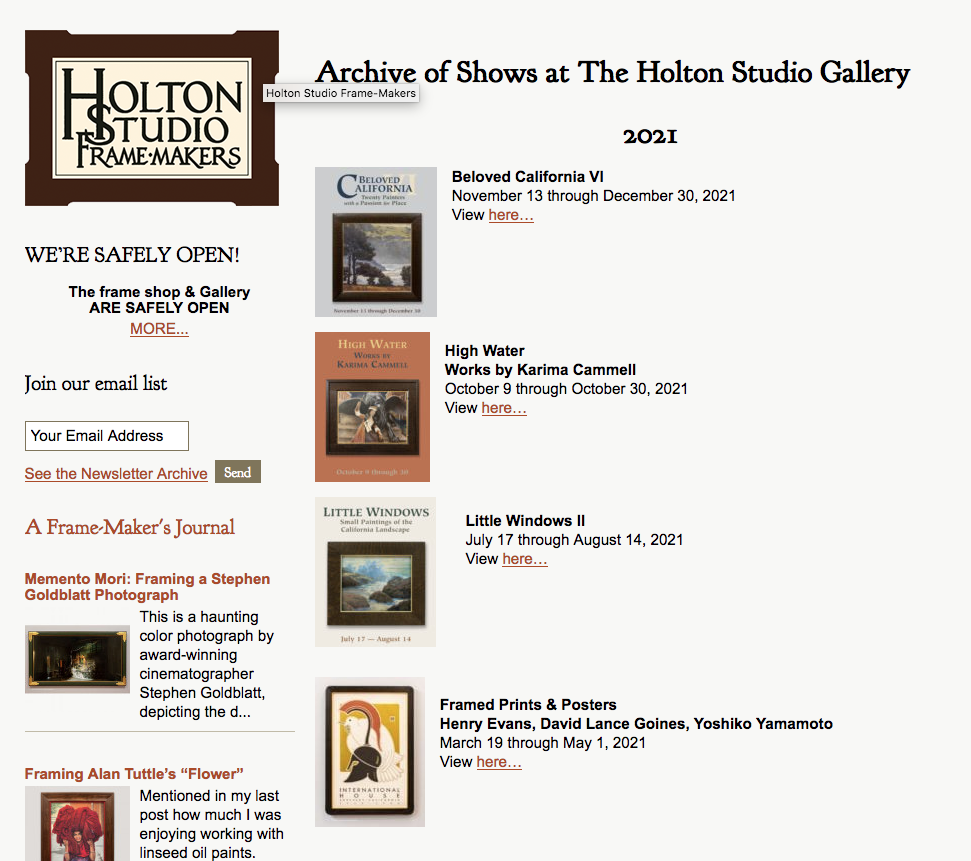
Archive of Past Shows Posted

Remember our first “Beloved California” show? (We’re coming up on “Beloved California VII”!) How about that terrific “Outside Hours: Landscape Paintings by Four Northern California Animation Artists” way back in 2010? Now you can go back and reminisce—or if you’re just learning about us, see what we’ve been up to these past many years. Jessie has just put together an archive page of past shows at The Holton Studio Gallery, including every “Beloved California.” Most shows have their own pages.

Check out the new gallery archive page here…

screenshot of gallery show archive page

Memento Mori: Framing a Stephen Goldblatt Photograph

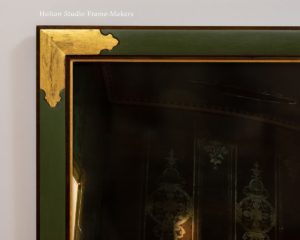
This is a haunting color photograph by award-winning cinematographer Stephen Goldblatt, depicting the decayed interior of a once-lavish aristocratic home in Mexico. It seemed to want a very different framing approach than most photographs. Stephen Goldblatt photoThe thing to aim for in framing, Walter Crane wrote, is “mural feeling.” Frames, he argued, should help restore pictures to their original and natural architectural place and role as murals. In the case of easel paintings, which are direct descendants of murals, that seems like a reasonable goal. It’s much harder, though, with photography, the genesis of which has nothing to do with architecture.
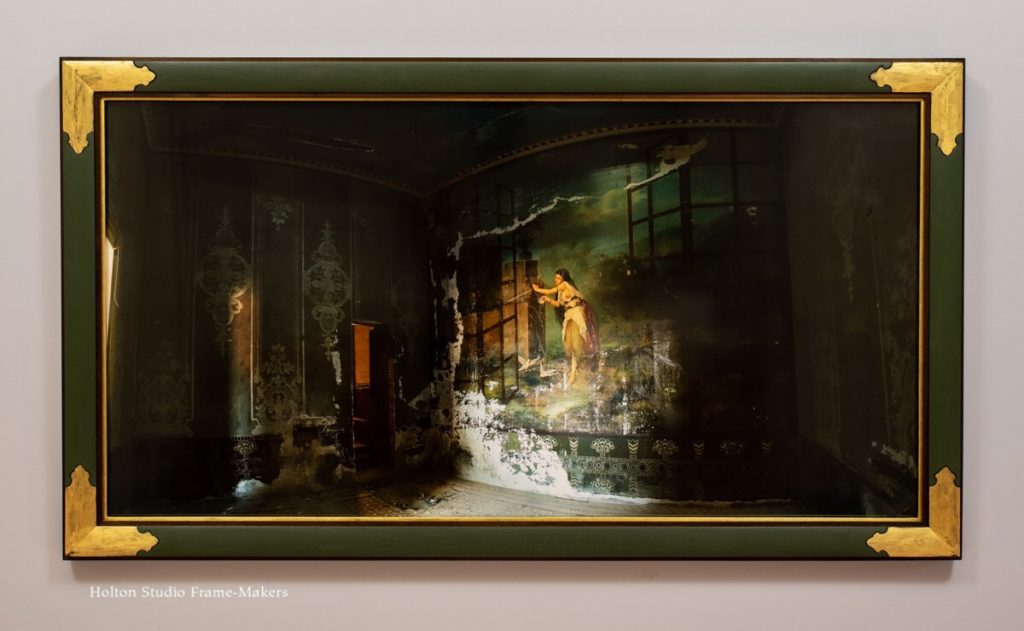
But what if a photo depicts a mural? This was a rare case when Crane’s guidance actually serves photography.
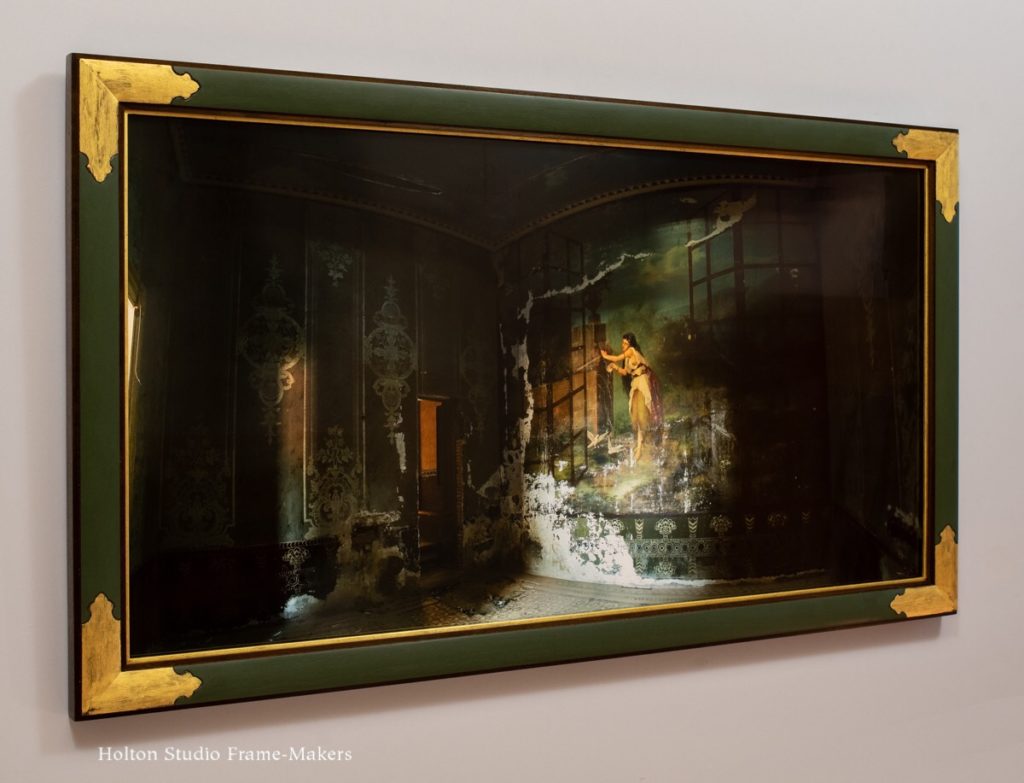
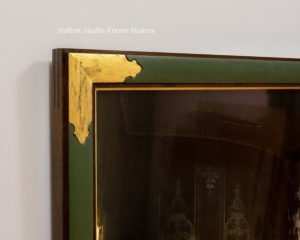
Stephen Goldblatt photoWe set the large 21″ x 41″ photo in a 2″ wide walnut frame. The fish-eye lens distortion of the room’s straight lines and flat walls suggested the primary form of the frame, which is a convex, or cushion, shape canted in toward the picture and bounded inside and out by a narrow step, or fillet. The face of the cushion is painted (with those lovely solvent-free Swedish linseed oil paints again) in the same green that dominates the walls. After studying the extensive and elaborate decorative details in the picture, I devised a simple carve pattern for the corners and Sam gilded them, suitably rubbing down the gold a bit. There’s also a gilt slip which helps give emphasis and definition to the dark picture.
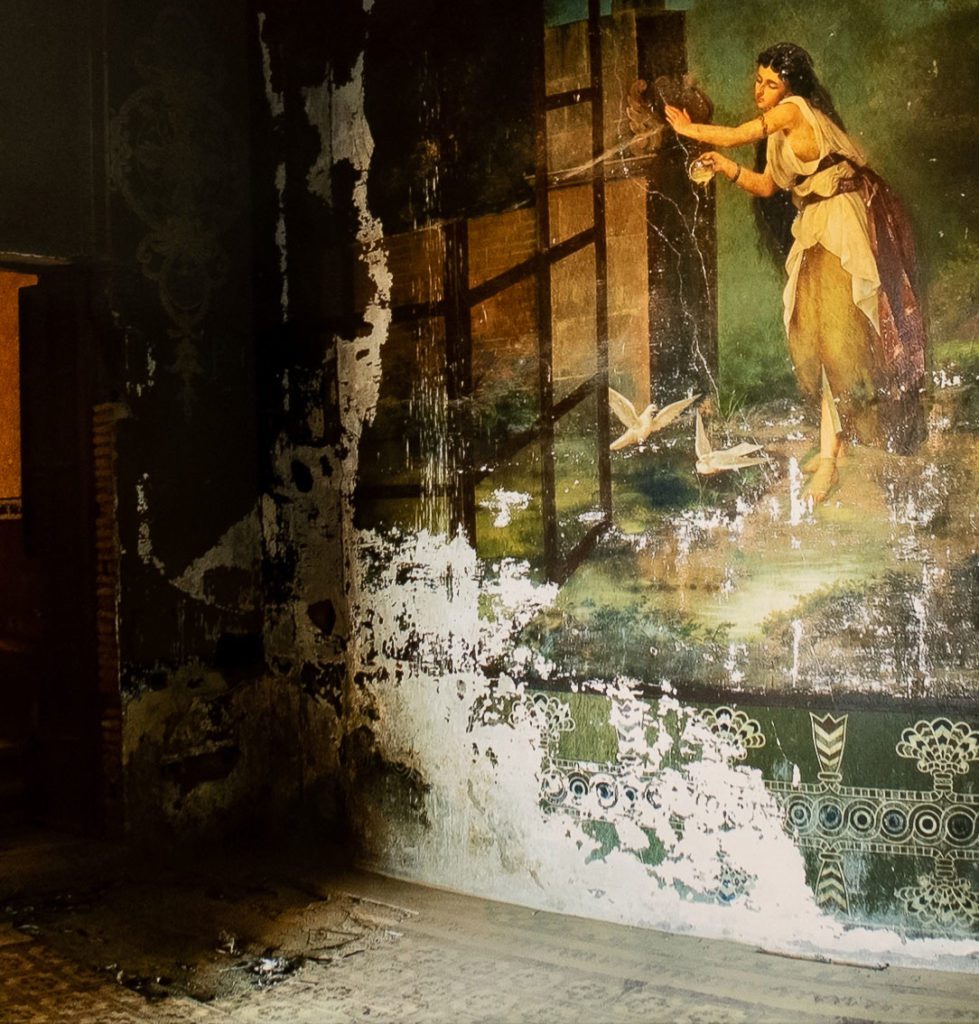
Detail, Stephen Goldblatt photoLife and Death—and Life Again

The mural depicts a great window opening up to a garden and a maiden at a fountain providing life-giving water to a pair of doves. The image’s theme of vitality sets it up perfectly for a role in a narrative about the cycle of life and decay. On the floor directly before the mural are several pigeon carcasses.

But a picture, and especially a framed picture, by re-presenting something, making it present again, makes it alive again, a participant in the world now. A scene of decay is transformed into a reminder of the fleeting nature of life—a memento mori. Though works of art inspired by that theme represent death, their point is to have us attend to the value of life. Thus they, themselves are not in decay, but are conscious works of art, made with care and in the full grasp of the vital, life-affirming truth they depict. For its part, the frame made in a manner sensitive to and alive to the picture in turn re-presents the picture. As an architectural element, it brings the photographer’s fixed, visual depiction into the tangible realm and architectural space our bodies occupy and move about in. There, it merges the relatively disembodied sense of vision (fixed on something distant and remote) with our other senses—our full, present, vital being.

The Still Photography of Stephen Goldblatt

Stephen Goldblatt may be best known as a director of photography on films like The Cotton Club, Julie and Julia, Lethal Weapon, The HelpThe list goes on. But since we’re dealing with one of his still photographs, it must be pointed out that before he got into film Goldblatt had a career as a still photographer. His chief claim to fame was taking part, in 1968, in the legendary (to Beatles fans) “mad day out.”

A wonderful interview with Goldblatt on photographing the Beatles, and his photography generally, may be found here.

Picture Framing Magazine featured this piece as its Design of the Month in December 2023. More…
Framing Alan Tuttle’s “Flower”

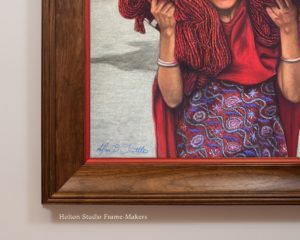
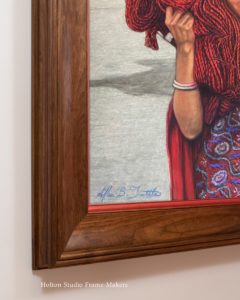
Mentioned in my last post how much I was enjoying working with linseed oil paints. Delaware artist Alan Tuttle gave me a good excuse to use them with this painting of his “red-headed friend,” the subject of “Flower.” The compound mitered frame Eric Johnson made is 3-5/8″ wide, in walnut finished with linseed oil and wax. Double reeds on the cap molding and at the sight edge echo the lines and forms of the bundled yarn. The 1/2″ wide ovolo liner, which also has a bead at the sight edge, is where I got to use my linseed oil paint.Alan Tuttle pastel, "Flower"

Alan Tuttle pastel, "Flower"Alan’s backstory for this 30″ x 23″ pastel: “I met flower in Varanasi, India. She was a laborer but I saw her as a runway model. She only briefly made eye contact from a distance accompanied by a pleasant smile and then she was gone.”

I still love the waterfall painting we framed for Alan several years ago, and which I posted about here.


Flowers for the Queen: Framing Louis Turpin

This is a 22″ x 20″ oil painting, “Reds and Yellows,” by contemporary British artist Louis Turpin. The painter’s website says he’s exhibited at The Royal Academy, The National Portrait Gallery and The Royal Society of Portrait Painters. So in this week that Britons are laying flowers at the gates of Buckingham Palace in tribute to the late Queen Elizabeth II, known for her love of gardens, this seems an appropriate painting to present on the blog.Louis Turpin painting

Framed Louis Turpin paintingIn the system of the world, and certainly in every satisfying composition, all things have their complements. Bright colors, like reds and yellows, are completed by dull colors, like greys and browns. In Turpin’s painting bright colors dominate, with dull tones used as a subordinate foil. The idea here is that the frame, in its complementary, subordinate and enhancing role, reverses that: a brown walnut surface dominates, while a yellow liner and muted green and blue painted lesser elements repeat the colorful palette. The shape of the 3-1/4″ wide frame suggests the leaf and petal forms. The carving echoes the loose brush markings.

The painting feels completed; the frame has done its work.


Trevor built the frame and I finished it with linseed oil and solvent-free linseed oil paint, which I’ve recently begun working with and am really enjoying.

Framed Louis Turpin painting, corner

Framed Louis Turpin painting, corner

A Frame Is a Kind of Torii Gate: Framing Another Shin Hanga Nocturne

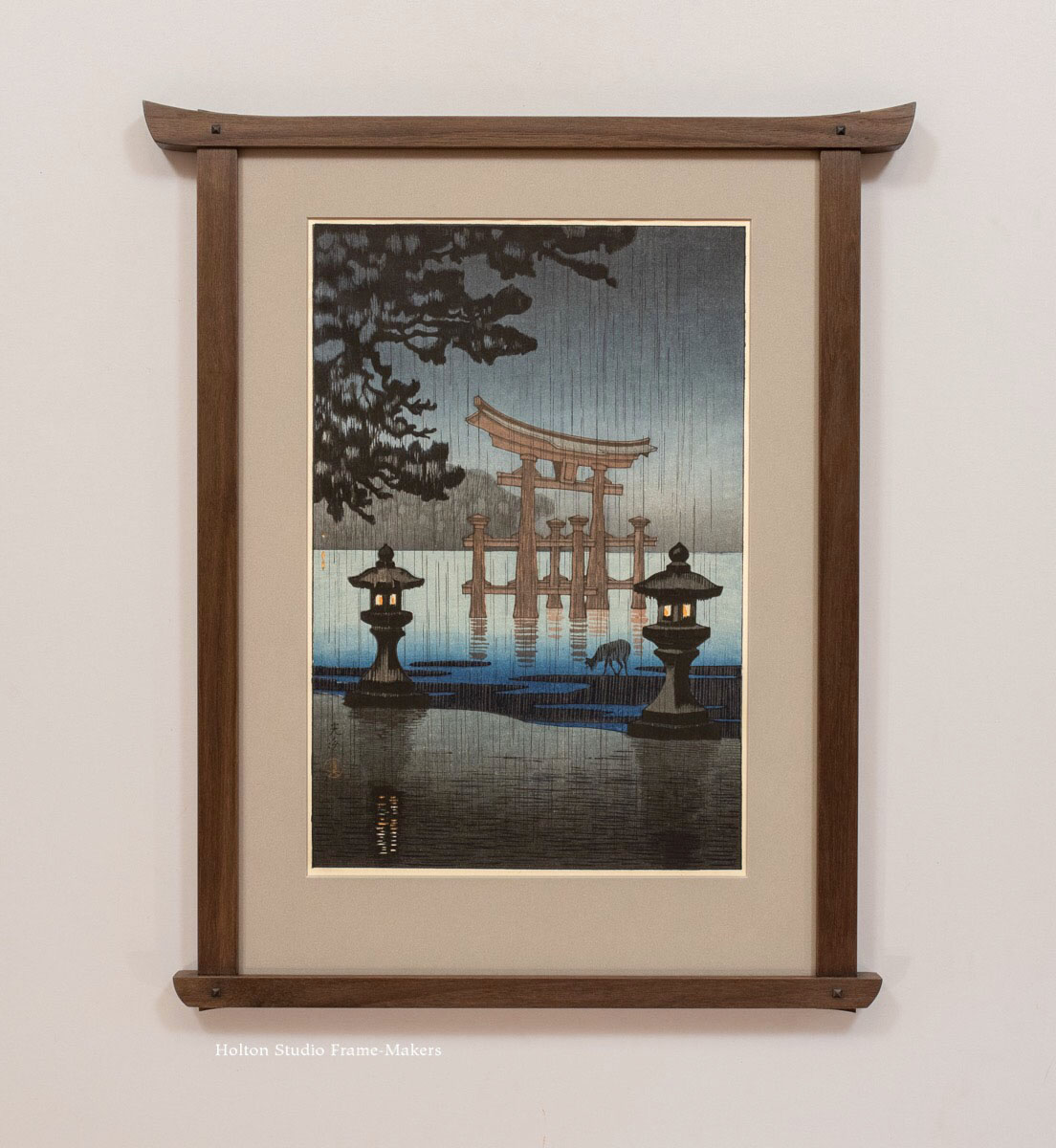
Like the Kawase Hasui print in my last post, this is beautiful nocturne out of the shin hanga tradition. “Rainy Miyajima” (1941, 15-3/8″ x 10″), is a woodblock by shin hanga master Tsuchiya Koitsu (1870 – 1949) depicting the torii gate at Itsukushima Shrine, a UNESCO World Heritage Site, on Itsukushima Island (popularly known as Miyajima).

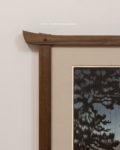
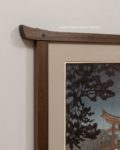
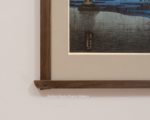
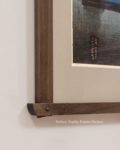
Because a frame is a bit of architecture, pictures of architecture generally suggest to the frame maker forms straightforwardly adaptable for his designs. This mortise and tenon frame that Trevor Davis built is a good example. Made in walnut, it has 1″ wide sides, while the top and bottom are just 3/4″ wide. But, as you can see, the top flares wider than that as it lifts and extends in imitation of the top of the gate. The top and bottom rails are slightly thicker than the sides, creating 1/16″ architectural reveals on the face of the frame at the joints. There is a 3/16″ pillow-shaped square plug at each joint. We finished the walnut with a black wash harmonizing it with the muted tones of the print.

Framed Koitsu print

Framed Koitsu printThe resemblance between a torii gate and a picture frame goes beyond the fact that they’re both works of architecture. Many architectural features and elements are liminal: they mark and facilitate transitions between different spaces and realms. Commoners at Miyajima would be required to approach the shrine by boat, passing through the shrine, and in so doing would understand they were passing from the mundane to the sacred realm—a liminal function of torii gates generally. Similarly, a picture frame marks off the picture’s realm—a realm that, if not necessarily considered sacred, represents things we deem most admirable and praiseworthy—from its everyday surroundings.


Learn more about Tsuchiya Koitsu at Koitsu.com.

Enjoy browsing a massive database of Japanese prints at ukiyo-e.org

The Sheltering Sky of Kawase Hasui

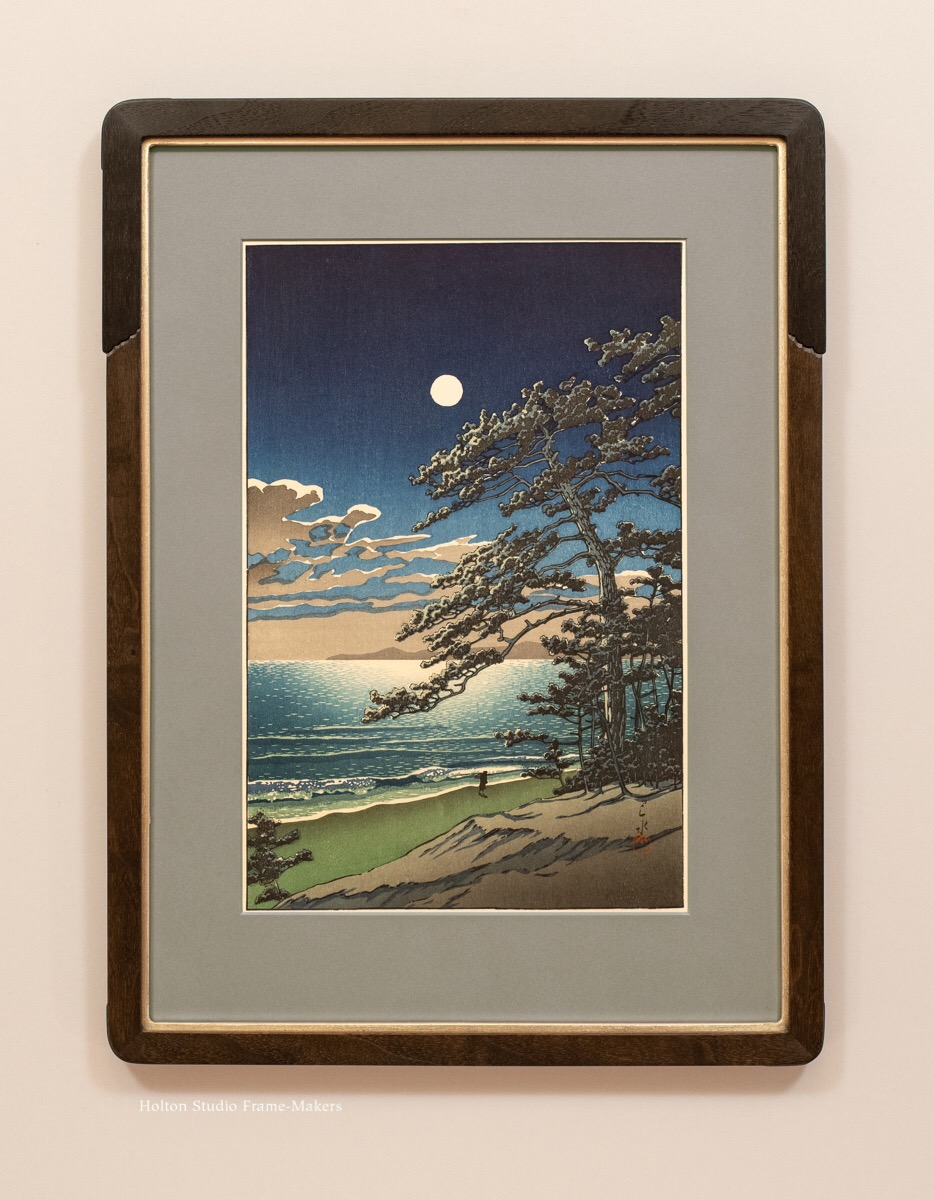
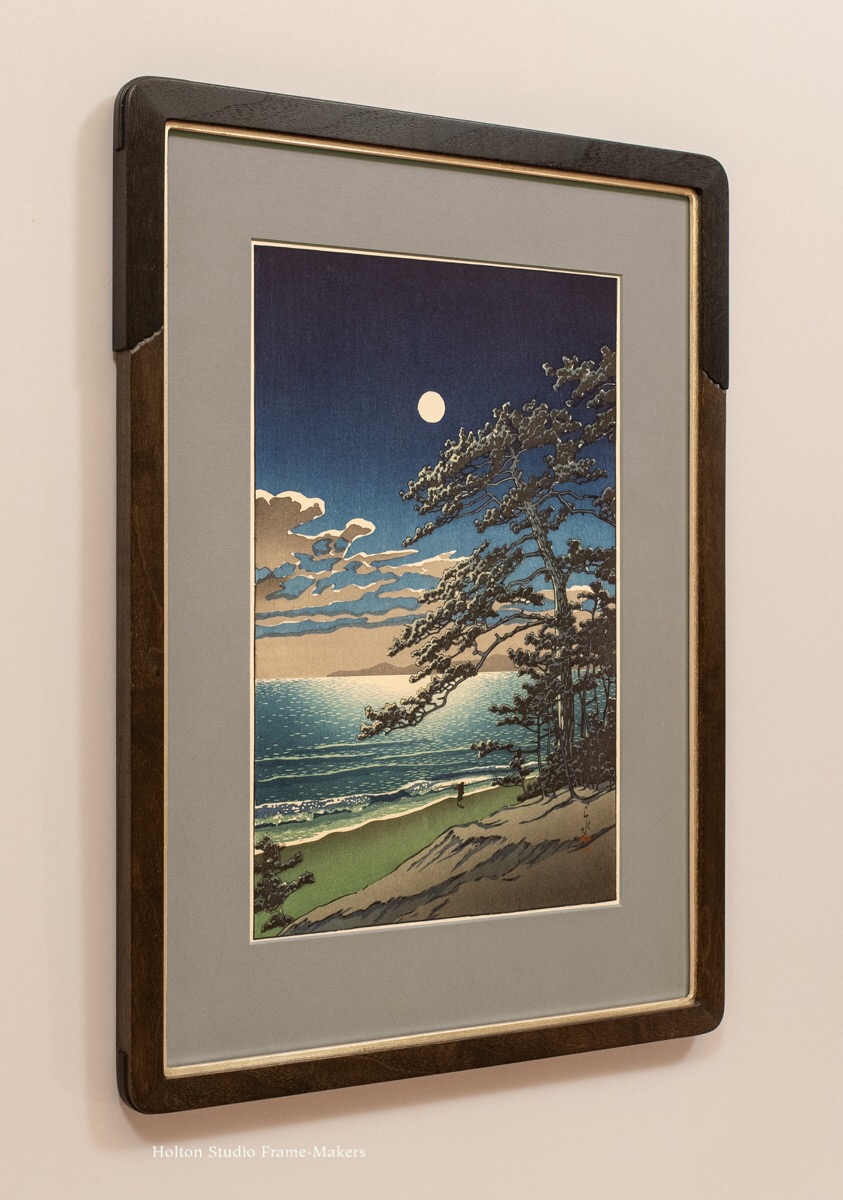
The still beauty of a scene like “Spring Moon at Ninomiya Beach” by the great Shin Hanga printmaker, Kawase Hasui (1883-1957) warrants few words. I’ll only say something about the frame—another example of a sheltering design, an approach I’ve featured in my last few posts (for a William Rice print, a set of tiles, and a Harrison Clarke etching). Hasui’s 1932 woodblock print is oban size (15-3/8 x 10-5/16″). The top portion of the walnut frame is 1″ wide and steps in 1/8″ part way down the sides. That heavier “sheltering” upper portion is stained black in contrast to the lower portion which has only a light black wash. The sheltering top ends with carved scalloped patterns that echo the tree sheltering the beach. The frame’s corners are rounded on both the inside and out and have proud splines. A white gold slip follows the rounded frame corners.

On nights like these, the still clear sky is all the shelter we need.Kawase Hasui print, framed

Kawase Hasui print, frame detail

Kawase Hasui print, framed

Another Sheltering Design: Framing a Harrison Clarke Etching

This is a 9″ x 6″ etching by Harrison Clarke titled “Garden Gate, Spain,” n.d. (1930’s). Most of the frame is 3/4″ wide, but it bumps out 1/8″ at the top portion, and that wider portion is also 1/16″ thicker than the lower part of the frame. The wood is walnut with a black wash. A 1/8″ wide walnut slip, stained black, adds definition and emphasis.

Framed Harrison Clarke etchingClarke worked for Willis Polk and other architects, and made architecture his main subject matter. (See his biographical information below.) The architectural subject of this print suggested the architecture of the frame. This is another example of the framing design approach I’m calling sheltering, in which the top portion of the frame is heavier, often emphasizing its architectural role as something like a roof, awning or lintel. (My last two posts, here and here, show other examples.) In addition to joining in Clarke’s tribute to the art of architecture, the frame pays tribute to Clarke’s art of etching with a bit of cross-hatched shading similar to that in the print, and giving subtle emphasis to the distinctive form of the frame.

Framed Harrison Clarke etching, corner detailAccording to the authoritative Edan Hughes‘s “Artists in California, 1786-1940”,

Harrison Clarke was born in Spokane, WA in 1890. Clarke studied architecture in the office of Willis Polk in San Francisco before serving in the Army during WWI. After his discharge in France, he studied at Ecole des Beaux Arts in Toulouse and made a sketching tour across Europe. Returning to the U.S., he devoted his attention to architectural renderings for Myron Hunt and other well-known architects. By the late 1920s he had settled in Los Angeles and was active there into the 1930s. His etchings are mostly architectural subjects.


Framed Harrison Clarke etching