Painted Slips and Liners

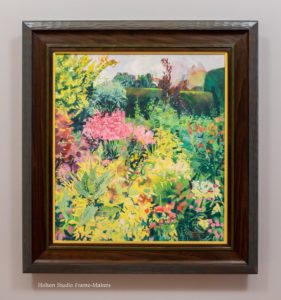
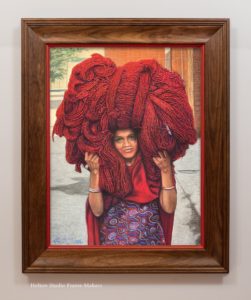
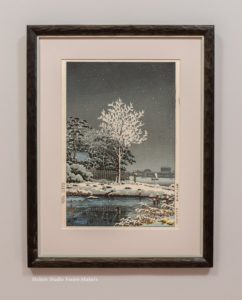
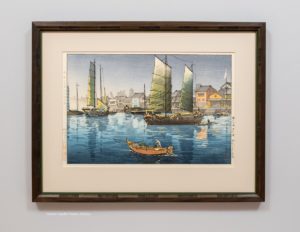
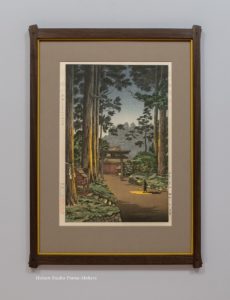
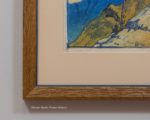
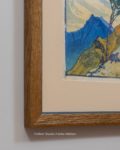
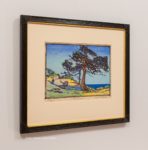
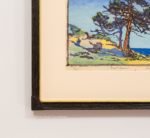
Many recent posts show frames that include a painted slip (a narrow flat or fillet) or liner (a narrow inner frame). While we’ve been using gilt and sometimes black slips for a long time, I’d come to realize that many pictures coming in really wanted a line of color instead. One early example is this oil painting, “Pancho,” by Eugenia Frances Baker McComas (1886-1982). A gilt liner would have been alright, but yellow paint resonated much better with the pigment on the canvas.

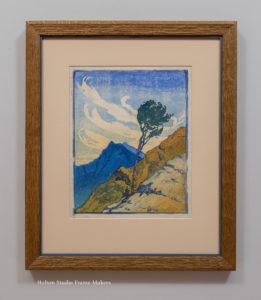
Right after we framed the McComas, this terrific little block print by Elizabeth Norton (1887-1985) walked in, and it too beckoned for a colored line, a slip, inside the frame. Eliz. Norton block print

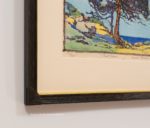
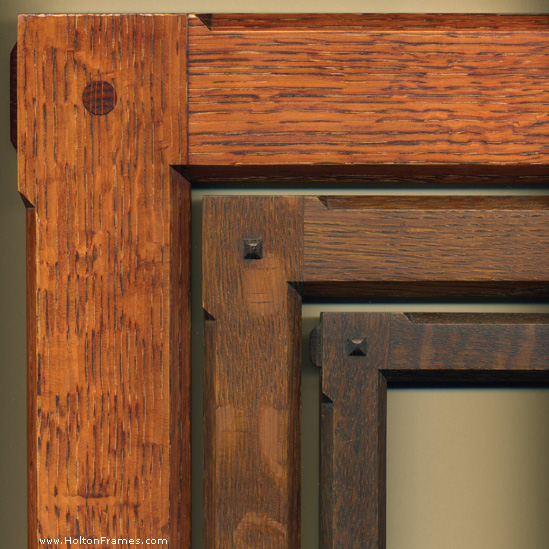
After that, I saw more and more opportunities for using colored liners and slips—especially for woodblock prints—and it became clear that I needed a set of samples to show customers. So here they are, at right.

I’ve been using milk paints (from Sinopia) and solvent-free linseed oil paints (from two Swedish companies, Ottossen and Allback). They’re a joy to use. Mostly we completely cover the wood (basswood works best). But the linseed oil paint in particular works beautifully in transparent coats, or tints. The three samples at the bottom of this picture are fumed quartersawn white oak with just a thin coat of paint allowing the wood grain to show through. Sometimes we use a coat of linseed oil wax on top.

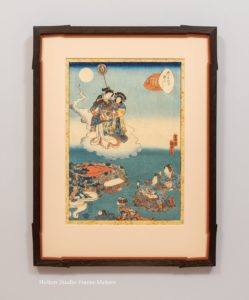
Below is a gallery of pictures framed with painted liners and slips. Most have already been seen on the blog, so links are provided to those posts, if you want to see more.

Save the Date: Beloved California VII Opens November 12

It’s been a joy these past several weeks seeing all the new work come in for Beloved California VII, our big annual all-gallery show of Northern California landscape paintings. And now on top of that joy we get the satisfaction of framing them! 

Carol Peek paintingWhen we received Carol Peek‘s vibrant “Sonoma Evening,” shown here, it seemed right away to stake its claim to the postcard and poster for the show. We gave the 8″ x 12″ oil painting a simple 2″ cushion with a repeat carved pattern on the outer bead, in stained quartersawn white oak.

After a fairly quiet past couple of years, we’re really looking forward to Beloved California VII, Twenty Painters with a Passion for Place. It opens on Saturday, November 12 with a reception for the artists from 1 to 4—save the date!—and will run through the end of the year. If you’re not on our snail mail list, let us know and we’ll mail you a postcard!

For more on Carol Peek, visit her page, here…

Framing Another Tsuchiya Koitsu Woodblock

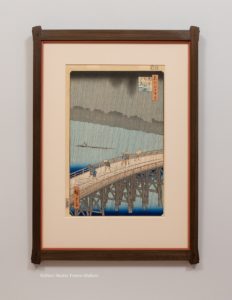
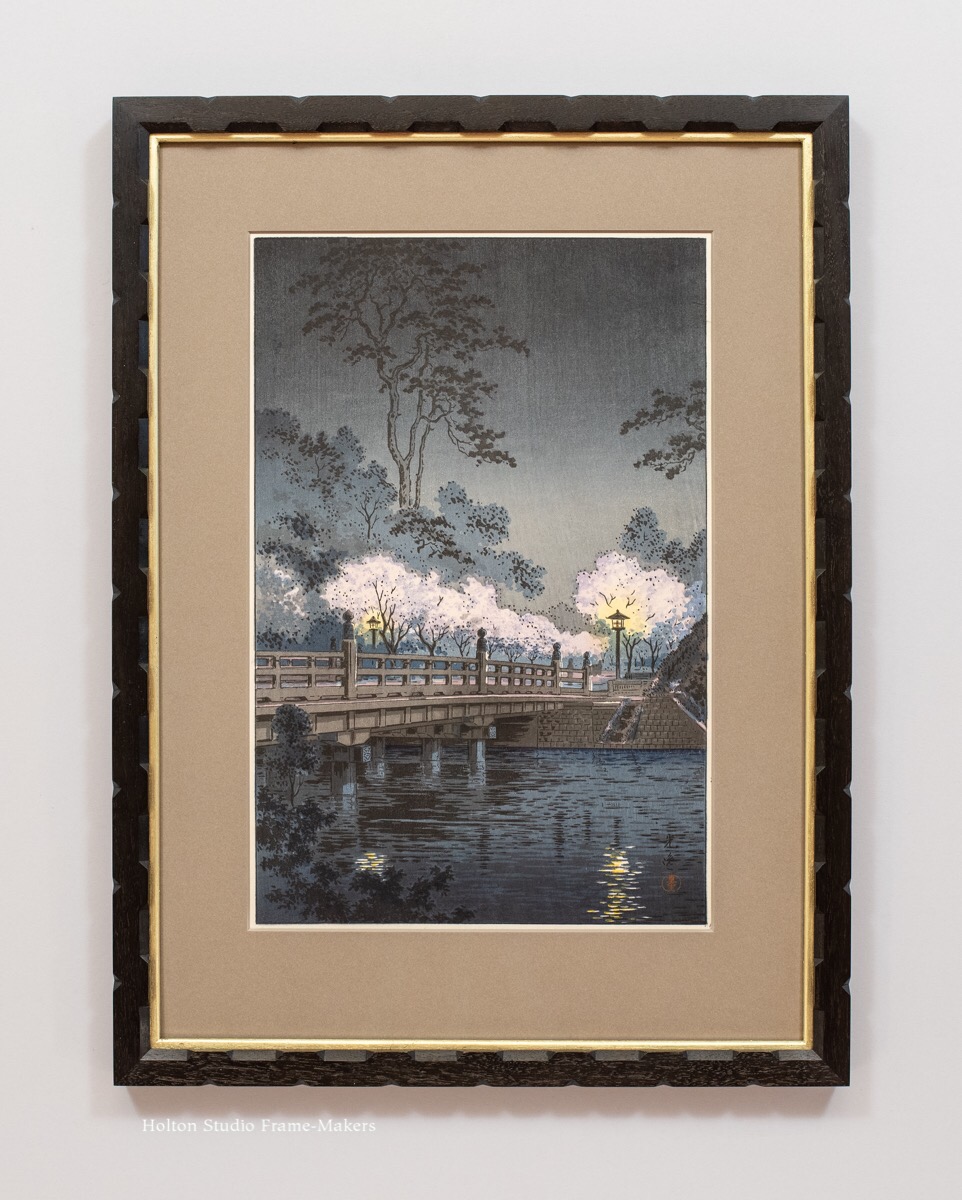
A recent post featured a framed print by the shin hanga master Tsuchiya Koitsu (1890-1949) depicting the 17th century torii gate at Miyajima. This print, by the same wonderful artist, is another structure over water—albeit a much more modern structure. As in the earlier example, the architecture depicted in the print has suggested the frame design, in this case its carved pattern. The 1933 image shows and is named for Benkei Bridge in Tokyo. It’s oban size, 14-1/4″ x 9-1/2″. The 3/4″ wide frame is walnut, stained black, with a 1/8″ pale gold slip.

Indulge yourself in Koitsu’s entire catalog raisonne online here… More than a dozen impressions of this particular print may be found on this page on the Ohmi Gallery website… Tsuchiya Koitsu printCorner detail, framed print by Koitsu

Remember the Trees: Framing Margaret Patterson

Often when explaining to customers my primary principles of framing, I say I rely first of all on the inherent character and beauty of the wood, because nothing we make is as beautiful as what nature makes. It’s become a bit of a stock line, leading me to my second principle… But one time the customer, a bright young woman, stopped me in my tracks and made the point far better than I had: “We have to remember the tree.”

Margaret Jordan Patterson, photo

Margaret Patterson painting trees

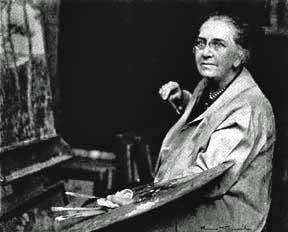
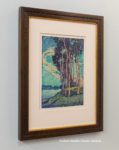
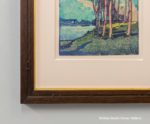
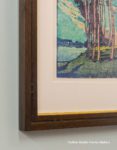
It’s a notion that by all evidence was close to the heart of the notable New England printmaker Margaret Jordan Patterson (1867-1950) who created the three woodblock prints of trees featured here. The first one, which we framed for California Historical Design (sorry, it sold) is titled “In the High Hills,” (ca. 1920, 11″ x 8-1/2″). We gave it a simple 1″ wide carved slope, No. 22 CV,  in quartersawn white oak. In addition to echoing with the carved bevel of the frame the texture of the rocky slope in the picture, I recognized the print’s ochre color as something we could match by fuming quartersawn white oak—that is, exposing it in a sealed box to strong ammonia fumes which react with the tannin in the oak, darkening the wood. So fumed it is, with just a clear finish. Then we repeated the ochre-blue complement of the print by painting the 1/8″ slip blue with linseed oil paint.Framed margaret Patterson print


Frame design sketchThe second print, “Coast Cedars,” (1920’s, 8″ x 10-1/2″) is in a 3/4″ wide carved walnut frame stained black, with a 23 kt gold leaf slip. The corners have carved patterns echoing the print’s jagged edges, with the pattern going into the inside corners as well (and followed by the gilt slip). Proud splines further articulate the corners. (Sketch made for the customer is shown at right.) Some insights about the artist and this print may be found online here.Framed margaret Patterson print

My third example of Patterson’s trees is a print we framed a few years ago, shown below. We set the print in a 1-1/8″ wide flat frame with a narrow carved panel with simple carved stops near the corners. The frame is stained mahogany, and has a gilt slip. Like the frame above (and those in numerous past posts, like this one), the frame here imitates the block used to make the print: in this case, the double bars repeat that detail in the depicted tree trunks. The entire margin was trimmed off at some point, so we floated the print in the window of an 8-ply mat.

Framed Margaret Patterson print

WWI photo destroyed forest, FlandersThe print above, “Tall Trees, Belgium” was created on one of Patterson’s many extended trips to Europe (she learned printmaking in Paris). If it seems like nothing more than a pretty picture, consider that she made it in 1914, just before all hell broke loose, with results like those at right.

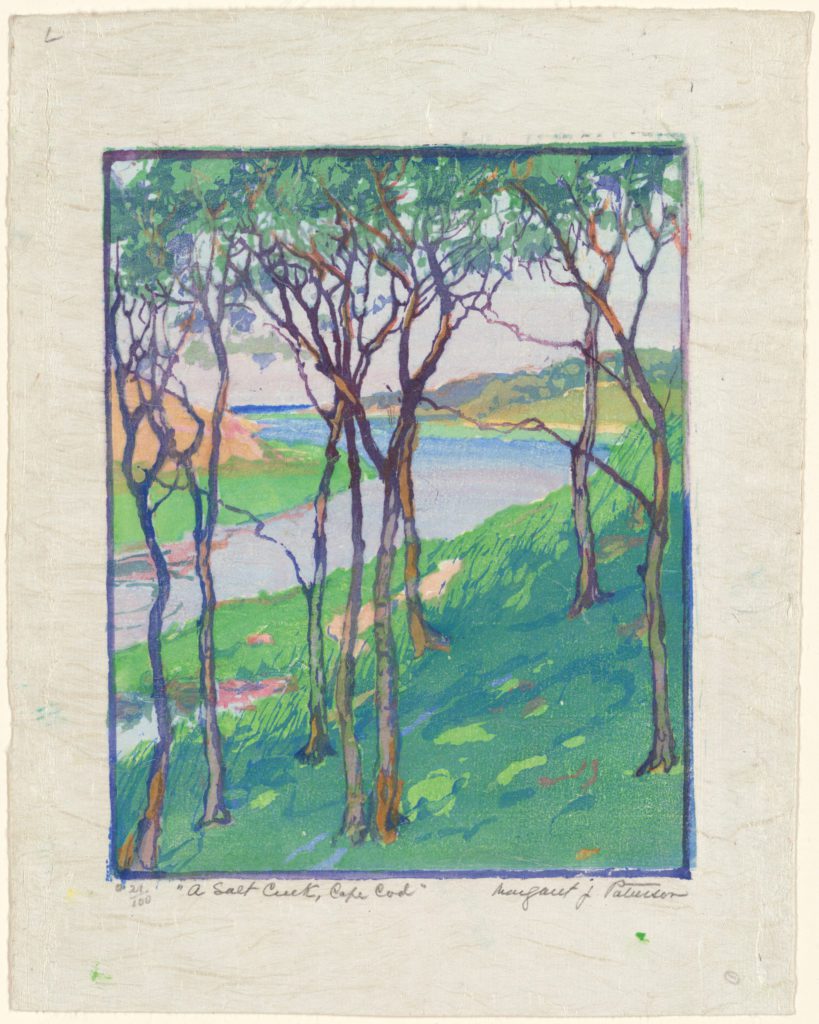
I notice on Margaret Patterson’s Wikipedia page there’s another very fine print of trees: “A Salt Creek, Cape Cod,” 1918 (New York Public Library Collection), below. Just needs a carefully made frame in wood, one showing that we too, like Margaret Patterson, remember the tree.


Framing a Sean Thackrey Photograph

This large 24″ x 38″ color photograph of a pear tree is the work of the late winemaker Sean Thackrey (1942-2022). We framed it close in stained walnut that complements the deep greens of the print. It’s a quiet, subtly shaped 3″ wide profile that curls up at the back edge and has a narrow cushion at the sight edge. Around that cushion is a slender ovolo carved to harmonize with the branches. An 1/8″ slip is finished with bronze powder to match the fruit. Eric Johnson’s excellent work.

Read about Sean Thackery’s extraordinary creative spirit in his New York Times obituary…Sean Thackrey photo, framed

Sean Thackrey photo, framed

Framed Prints Sale, through Oct. 8!

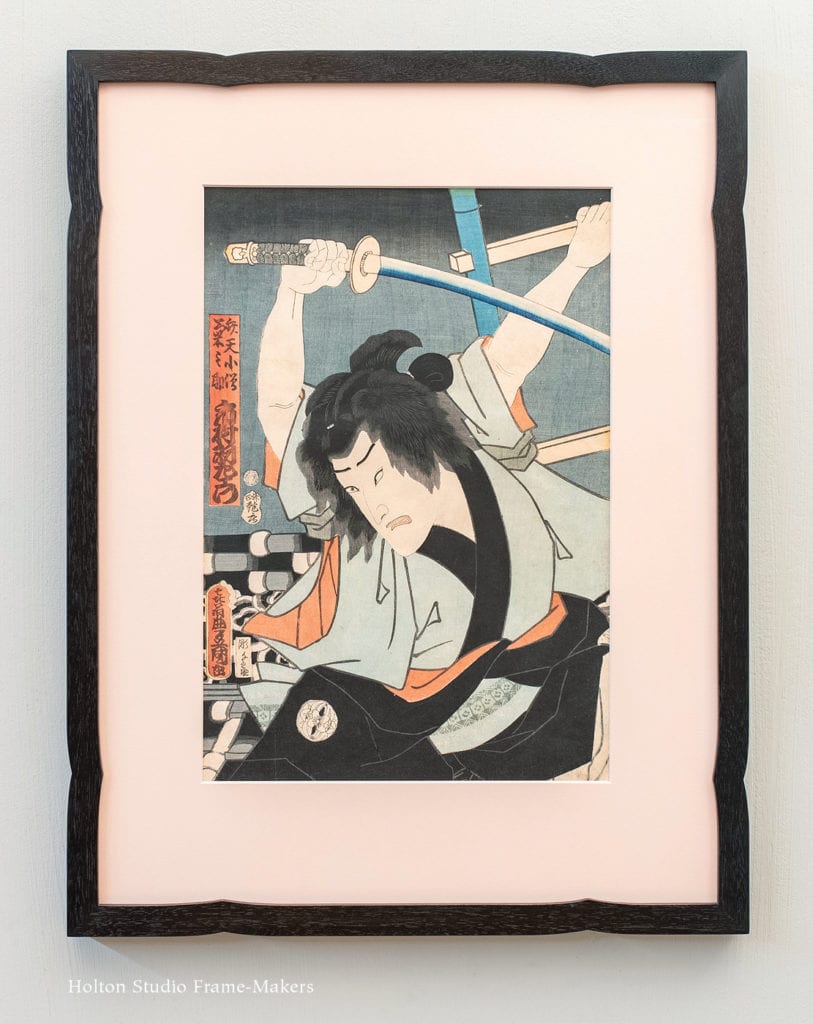
We’ve decided it’s time to move all of our framed prints. For just a week—today through Saturday, October 8—you can enjoy big price breaks on beautiful signed and editioned works by Yoshiko Yamamoto, Tom Killion, Henry Evans, and  David Lance Goines, as well as antique Japanese prints, like the Kunisada below (which, at just $650, is more than 30% off!). And all are beautifully (and archivally) framed, of course. Purchases may be made in person or online. View the sale page here…

Kunisada print

Utagawa Kunisada(1786-1865), “Ronin Wielding a Sword,” 1862. Was $950. Sale price: $650.
BUY

Framing Shiro Kasamatsu and the Landscapes of Japan

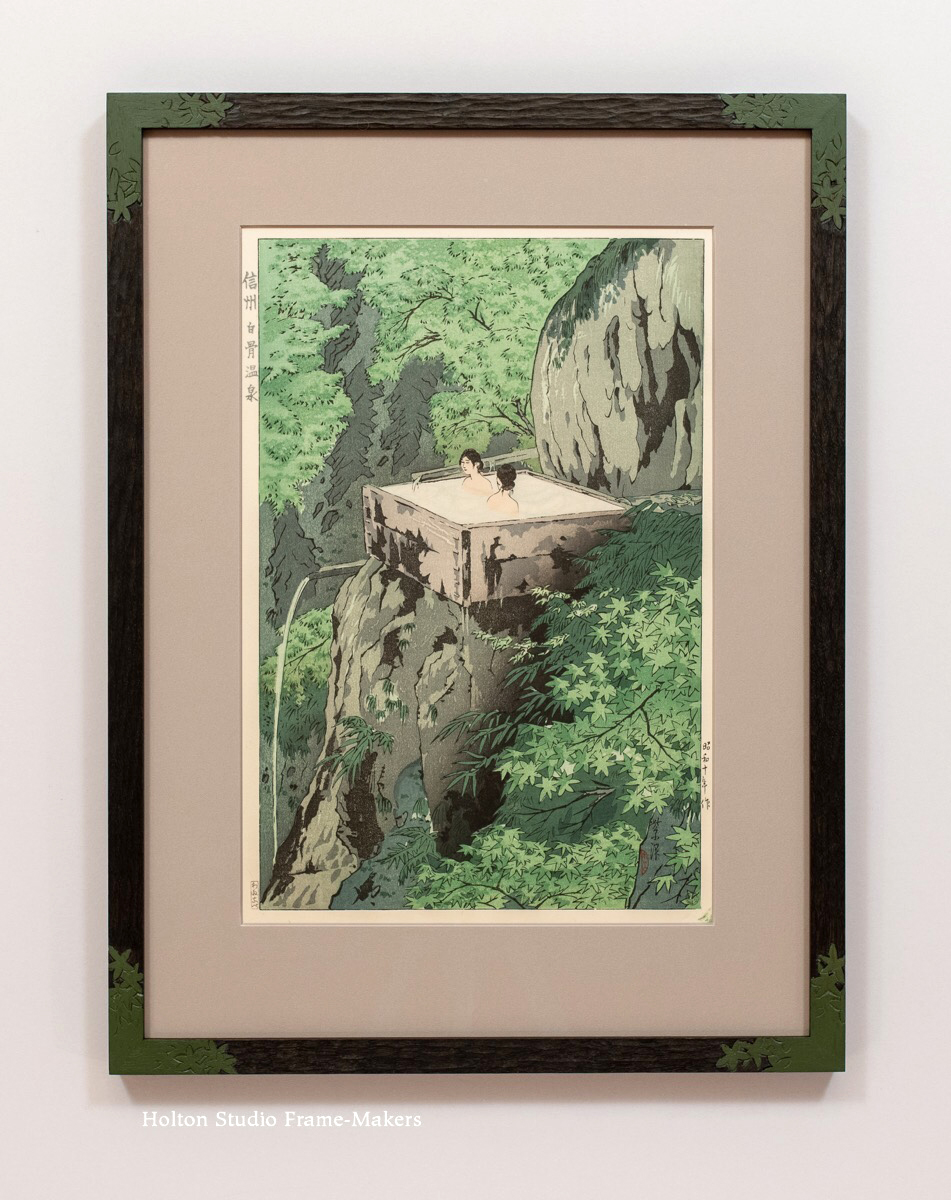
Here are three Japanese woodblock prints by shin hanga master Shiro Kasamatsu (1898-1991) demonstrating the artist’s fondness for Japan’s landscape and traditional Japanese life. All are oban size (about 15″ x 10″).

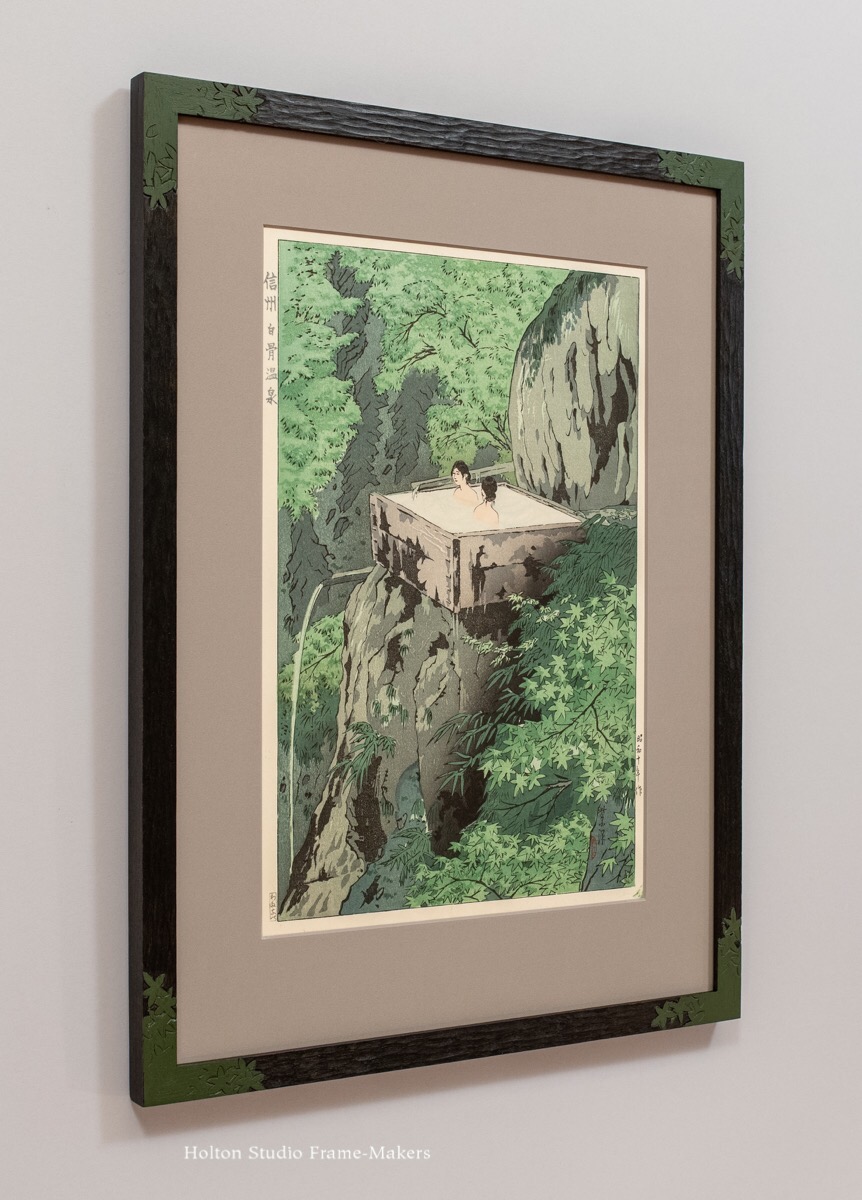
The lush green trees framing the subject of the first one, “Shirahone Hotspring, Shinshu,” 1935, presented an obvious cue for the frame design: a 3/4″ wide carved walnut setting with a black wash and carved and painted green leaves accenting the corners.

Framed Shiro Kasamatsu print, corner detail

Framed Shiro Kasamatsu print

The second Shiro Kasamatsu print we recently framed, “Snow at Matsushima,” 1954, shows the beautiful seventeenth century Godaido Temple in winter. Because of the architectural subject, the customer and I chose a 1″ wide through mortise and tenon frame, No. 4001, in walnut with black wash. The edges of the frame are softened and carved a little to harmonize with the texture of the snow-covered trees.

Lastly, “Inubozaki Cape, Inubo Point,” 1956, also oban size, is in a 1″ wide No. 320 CV in quartersawn white oak stained black. We felt that the carved cove molding suited the rugged shape and texture of the rocks.

See more work by Shiro Kasamatsu here…

Framing a 1912 Hammered Copper Plaque

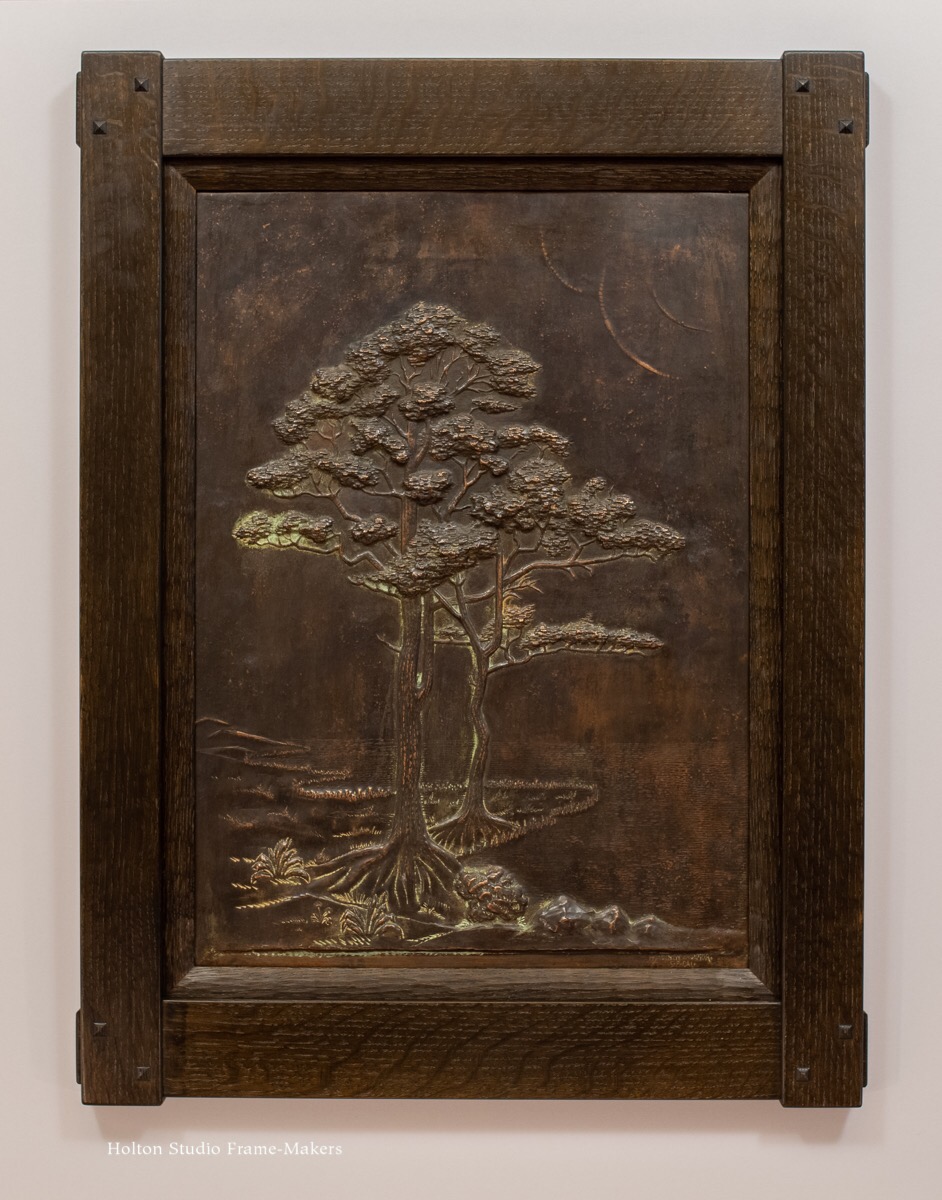
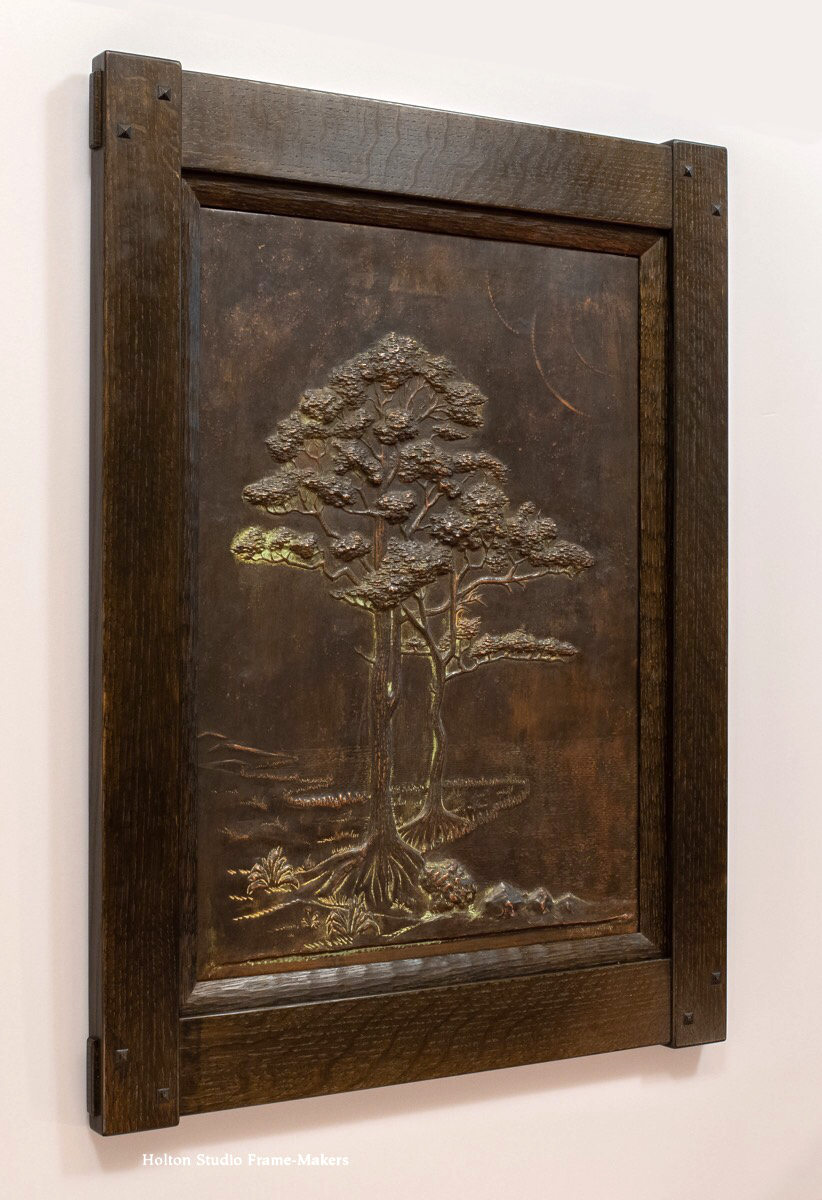
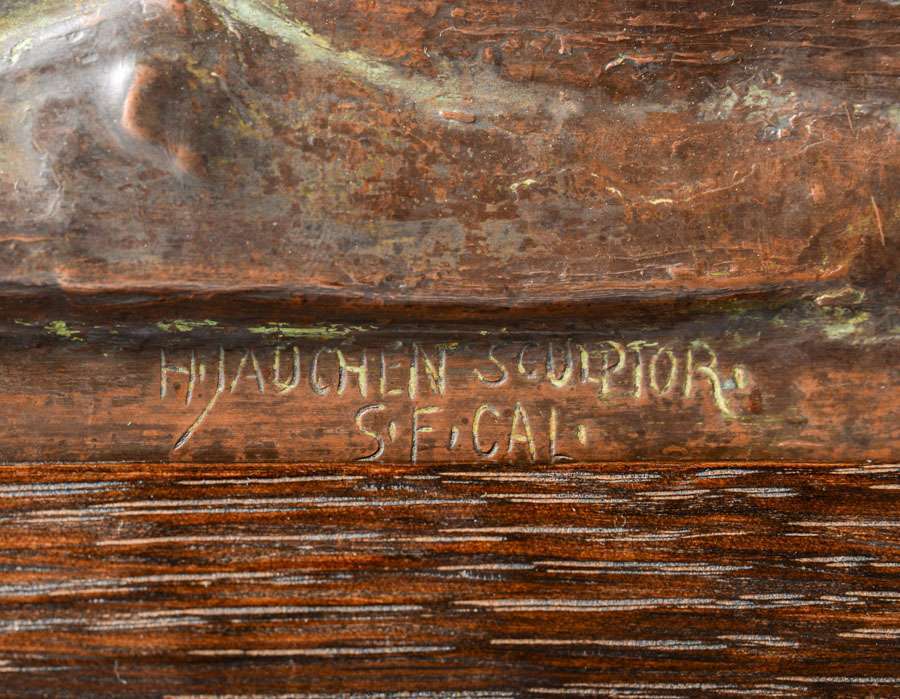
Like the subject of my last post, William S. Rice, Hans Jauchen (1883-1970) was an important craftsman and educator in the Bay Area during the Arts and Crafts Movement. Born and raised in Germany, he came to San Francisco in 1910 where he founded the Olde Copper Shop on Sutter Street. He also taught metal working at UC Berkeley and Stanford University. This 24″ x 17-1/4″ repousse plaque, framed for California Historical Design, is dated 1912. Representing Monterey Cypress trees, it’s a superb example of Jauchen’s work and the Arts and Crafts era in Northern California. The frame, made by Trevor Davis, is a through mortise and tenon design, our No. 4001, with 2-1/2″ wide sides and 3″ top and bottom and inlaid square plugs over the dowels that pin the joints. We added to the frame a carved cushion inner molding to mimic the form and texture of the trees. The frame and liner are quartersawn white oak with dark Weathered Oak stain.

Available from California Historical Design.

Hans Jauchen hammered copper plaque

Hans Jauchen hammered copper plaque

Hans Jauchen signature

Framing “Old Edinburgh,” a William Seltzer Rice Woodblock

This woodblock print by William Seltzer Rice (1873 – 1963), “Old Edinburgh,” (ca. 1916) is about 9″ x 7″. We put a 2-1/4″ wide solid core rag mat around it (3″ on the bottom) and set it in a 1″ wide stained quartersawn white oak through mortise and tenon frame, No. 1201, we call the “Kelmscott.” An inlaid raised square plug articulates each corner.Wm Rice print, framed

Wm S Rice photo, 1906

William Seltzer Rice, 1906

William Rice’s first artistic interest was in painting. In early years he set up a studio in a corner of his grandfather’s carriage painting shop in Lancaster County, Pennsylvania. He would later study with Howard Pyle, before moving to Northern California in 1900 to begin what would become a notable teaching career. Rice spent the summer of 1913 in Europe, where it seems likely he sketched this scene. The print, though, is believed to date from about 1916, a year after the Panama-Pacific Exposition in San Francisco, where the woodblocks displayed at the the Japanese pavilion inspired Rice to resolve to focus on that art form. In 1918, he was given his first major exhibition at The California Palace of the Legion of Honor. In addition to pictorial arts, Rice worked in ceramics, hammered copper, leather, and wood.

We’ve framed numerous Rice prints and paintings. Another recent example is here…

Wm Rice print, framed