Framing Lucia Mathews and the 1915 World’s Fair

We just framed this wonderful and historic little gouache by Lucia Kleinhans Mathews which depicts Bernard Maybeck’s Palace of Fine Arts in San Francisco. This year is the centennial of San Francisco’s Panama-Pacific Exposition—the World’s Fair announcing The City’s comeback from the Great Earthquake and Fire of 1906. The Palace of Fine Arts, which hosted the fine art galleries for the Fair, is the one of very few buildings that remain from the event—although the original plaster building disintegrated so badly in the decades after it was constructed that it had to be rebuilt in more permanent material to satisfy San Franciscans’ love for the place and desire to have it endure. Painting the Palace at night, with lights dancing around the building and off the lovely lagoon, trees and landscape which are so much a part of it, Mathews captures the spellbinding effect of a place that citizens and tourists alike still find magical. Mathews and Maybeck embodied the great hope that given The City’s special setting and location, San Francisco would become a place where the arts would thrive, not just for the this event but for generations. This tiny gem contains great dreams.

LKMathews-in-408-5098-web

No. 408—1″ on Lucia Kleinhans Mathews, untitled (the Palace of Fine Arts), 1915. Gouache, 3-1/2″ x 5-1/2″. Frame in cherry (Deep Red-Brown stain).

The frame is a No. 408—1″ in cherry with a deep red-brown stain. The mat has a gold ink line for definition and emphasis.

This piece is on view at the California Historical Society’s exhibit, “City Rising: San Francisco and the 1915 World’s Fair.”

More work by Lucia and her husband Arthur Mathews may be seen at the Oakland Museum (see collections online here).

A beautiful letter press printed biography of Lucia Mathews by my wife, Stephanie McCoy, is available from the printer and publisher, The Arts and Crafts Press, here.


Mr Turner and Martin Luther King: Framing Visions of Social Justice

This year marks the fiftieth anniversary of one of the key moments of Dr Martin Luther King, Jr.’s civil rights leadership—an event that’s the subject of the film “Selma”, which is up for an Academy Award next weekend. Hardly anyone will note the connection between King and the subject of another biographical picture among the nominees, “Mr Turner.” But it’s a fascinating link which reveals a sadly obscured, yet most important, influence on King’s quest for social justice. It also reminds us of the powerful historical influence of pictures—and not just the moving kind but paintings.

Slave-ship

JMW Turner, “The Slave Ship,” 1840. Oil on canvas, 36″ x 48″. (Originally entitled “Slavers Throwing overboard the Dead and Dying—Typhon coming on”.) Click image to view large.

The civil rights movement in America, which had no greater leader than King, is rooted in the undying spirit of African American slaves who endured and struggled to overcome slavery’s unfathomable inhumanity. It’s also rooted in the work of abolitionists moved by the cruelty of that institution. In 1840, JMW Turner painted “The Slave Ship” in support of the abolitionists’ campaign against the international slave trade. The painting’s based on a real incident involving ship owners throwing slaves overboard in a storm in order to make an insurance claim for the loss. Turner’s last words were, “The sun is God,” and at the center of this painting, the sun is casting its judgement on the great injustice of the slave trade.

It’s an image that particularly captivated a young John Ruskin (whose father bought the painting for him) and, according to Ruskin scholar Clive Wilmer*, was a key early inspiration leading the art critic to later become one of the greatest modern social reformers. Ruskin soon began to think about art as labor, and the fine arts as fundamentally akin to, not separate from, all human labor. As he saw it, the demise of art was simply part of the degradation and denigration of manual work in the modern, especially the industrial, era. With “The Nature of Gothic” of 1853 and especially with his publication, in 1860, of Unto This Last, Ruskin’s scathing protest against the injustices of industrial labor conditions and laissez-faire economics caught the attention of the industrialized world. Ruskin considered the book his most important, and its apparent failure to bring about immediate social change was a large factor in its author’s growing sense in his later years that his life’s work had been futile.

Despite his enormous fame in his day, Ruskin’s true character and contribution has, indeed, been to a large extent unfairly buried by history. His depiction in the film “Mr Turner” reflects this sad fate, being pretty insulting to Ruskin, as the New York Times and The Guardian rightly pointed out.

But the memory and influence of true prophets endures. And one person whom Ruskin deeply affected was a young Indian lawyer living in South Africa. In a chapter in his autobiography called “The Magic Spell of a Book,” Mahatma Gandhi described how a friend seeing him off at a train station handed him a copy of Unto This Last. “The book was impossible to lay aside, once I had begun it,” he wrote. “It gripped me… I could not get any sleep that night. I determined to change my life in accordance with the ideals of the book.” Of the books he’d read in his life, he went on, it was this “one that brought about an instantaneous and practical transformation in my life... I translated it later into Gujarati, entitling it Sarvodaya (the welfare of all). I believe that I discovered some of my deepest convictions reflected in this great book of Ruskin, and that is why it so captured me and made me transform my life.”

Gandhi found three key teachings in Ruskin, which were, as he described them:

1. That the good of the individual is contained in the good of all.
2. That a lawyer’s work has the same value as the barber’s inasmuch as all have the same right of earning their livehood from their work.
3. That a life of labour, i.e., the life of the tiller of the soil and the handicraftsman, is the life worth living.
The first of these I knew. The second I had dimly realized. The third had never occured to me. Unto This Last made it as clear as daylight for me that the second and the third were contained in the first. I arose with the dawn, ready to reduce these principles to practice.

As many people know, Martin Luther King was deeply influenced by Gandhi, calling him “one of the half-dozen greatest men in world history.” “If humanity is to progress,” he wrote, “Gandhi is inescapable. He lived, thought, and acted, inspired by the vision of humanity evolving toward a world of peace and harmony.” In an article for Ebony Magazine in 1959, he wrote, “While the Montgomery boycott was going on, India’s Gandhi was the guiding light of our technique of non-violent social change. We spoke of him often.” And when the boycott was over, King went to “the land of Gandhi” and reported that “The trip had a great impact upon me personally.”

What’s widely understood is that King took from Gandhi his teachings on non-violence and civil disobedience (traced in turn to Hinduism, but indirectly so, curiously, through Henry David Thoreau). But these were strategies in the struggle, not the goal and aim of the struggle, which was social justice. And for this larger vision as well, no less than tactics of non-violence, King found in Gandhi powerful inspiration and wisdom. (In terms of how Ruskin’s thinking helped shape King’s, as much might be said for Walter Rauschenbusch. King biographer Stephen B. Oates emphasizes how King, as a seminary student, discovered Rauschenbusch’s writing and picked up from him late nineteenth century Social Gospel teaching. Ruskin, and especially Unto This Last, according to Donovan Smucker’s Origins of Walter Rauschenbusch’s Social Ethics, was a primary influence on Rauschenbusch.) King read Gandhi’s translation—translated back again into English—of Unto This Last, the  title of which refers to Jesus’s parable of the vineyard-keeper paying all his workers what we’d call a living wage; and we hear King invoking, in his stirring speech in Memphis during the sanitation workers’ strike of 1968, the same Biblical principles of economic justice toward all workers:

[W]henever you are engaged in work that serves humanity and is for the building of humanity, it has dignity, and it has worth. One day our society must come to see this. One day our society will come to respect the sanitation worker if it is to survive, for the person who picks up our garbage, in the final analysis, is as significant as the physician, for if he doesn’t do his job, diseases are rampant. All labor has dignity.

Not enough people appreciate the emphasis King came to place on economic justice as well as racial justice. “[I]t is a crime,” he declared, “for people to live in this rich nation and receive starvation wages.” King identified the basis for the degradation of blacks in their degradation as laborers, but even more fundamentally, in the degradation of manual labor itself. The theme, in King’s message, of the dignity and nobility of manual work is frequently overlooked. But it’s extremely important and underpins his teachings. It’s also directly attributable to King’s reading of Gandhi (and Rauschenbusch), and in turn to Gandhi’s reading of Ruskin. Even before Unto This Last, in his introduction to The Seven Lamps of Architecture, Ruskin was finding the basis of true art in its expressive possibilities, rooted in the inherent nobility of all work. “However mean or inconsiderable the act, there is something in the well doing of it, which has fellowship with the noblest forms of manly virtue,” he wrote. “There is no action so slight, nor so mean, but it may be done to a great purpose, and ennobled therefore…that chief of all purposes, the pleasing of God.” Similarly, King preached that “All labor that uplifts humanity has dignity and importance and should be undertaken with painstaking excellence.” A poem (by George Herbert) quoted by Ruskin would be echoed by King more than a century later in a Baptist Church in Montgomery, Alabama.

A servant with this clause
Makes drudgery divine;
Who sweeps a room as for thy laws,
Makes that and the action fine.

In his sermon, King said that

If a man is called to be a street sweeper, he should sweep streets even as Michelangelo painted, or Beethoven composed music, or Shakespeare wrote poetry. He should sweep streets so well that all the hosts of heaven and earth will pause to say, here lived a great street sweeper who did his job well.

He told of “a fellow…that used to shine my shoes, and it was just an experience to witness this fellow shining my shoes. He would get that rag, you know, and he could bring music out of it. And I said to myself, “This fellow has a Ph.D. in shoe shining.”

Even larger themes in King’s message appear reminiscent of Ruskin. In “Stride Toward Freedom,” King echoed Ruskin’s repudiation, in Unto This Last, of “the utilitarianism of Bentham and Mill”. He wrote,

Gandhi was probably the first person in history to lift the love ethic of Jesus above mere interaction between individuals to a powerful and effective social force on a large scale. Love for Gandhi was a potent instrument for social and collective transformation. It was in this Gandhian emphasis on love and nonviolence that I discovered the method for social reform that I had been seeking…

But Gandhi’s idea “to lift the love ethic…to a powerful and effective social force” might be traced to the very first sentence of Unto This Last:

Among the delusions which at different periods have possessed themselves of the minds of large masses of the human race, perhaps the most curious—certainly the least creditable—is the modern soi-disant [so-called] science of political economy, based on the idea that an advantageous code of social action may be determined irrespectively of the influence of social affection.

At the heart of Ruskin’s critique of classical economics was his denouncement of its proposition that narrow economic self-interest could ever serve as a governing principle of human societies instead of the eternal moral principle of charity. Living in a racially homogenous society, Ruskin naturally had little to say about race. He did, however, have a great deal to say about the terrible abuses occurring between groups living in the same society but harshly separated and exploited—in his case, the rigidly defined social classes of Victorian England—and strived as few of his contemporaries did to mend the social fabric and gain justice for Britain’s working class. If British workers were not slaves as blacks in America were, they were nonetheless treated as commodities. Ruskin identified “things which are not, and which it is criminal to consider as, personal or exchangeable property. Bodies of men, land, water, and air, are the principal of these things.” Late in his life he founded the Guild of St George, devoted to slaying the dragon he identified as “the Lord of Decomposition”—the destroyer of the bonds of social affection and the rule of cooperation and charity. The Guild was a utopian dream, but one shaped by an admirable faith and reading of the Gospel that rejected heaven as a matter of afterlife and insisted on the promise of a just and happy society and life here on earth. In the final chapter of his five volume Modern Painters, which he’d undertaken as a defense of Turner against an art establishment that had spurned the painter, Ruskin wrote that in the Lord’s Prayer, “there is not anything about going to another world; only something of another government coming into this; or rather, not another, but the only government,—that government which will constitute it a world indeed.” “[T]he Kingdom of God means,” Ruskin wrote in the preface to a late edition of Sesame and Lilies,

not meat and drink, but justice, peace, and joy in the Holy Ghost… [S]uch joy is not by any means, necessarily, in going to church, or in singing hymns; but may be joy in a dance, or joy in a jest, or joy in anything you have deserved to possess, or that you are willing to give; but joy in nothing that separates you, as by any strange favour, from your fellow-creatures, that exalts you through their degradation—exempts you from their toil—or indulges you in time of their distress.

This warning, which pervades Ruskin’s thought, against social insularity and separation is the same ethical understanding that objected to segregation in the American South. It’s the same stirring vision punctuating and climaxing one of the very greatest speeches in American history—King’s “I Have a Dream” speech—calling on the world to

speed up that day when all of God’s children, black men and white men, Jews and Gentiles, Protestants and Catholics, will be able to join hands and sing in the words of the old Negro spiritual: Free at last! Free at last! Thank God Almighty, we are free at last!

But more, it’s the same embrace of a just and charitable society not in the ever-after but the here and now that led King to refuse to be patient for the fulfilling of his dream. And if Turner had offered an image of profound despair and injustice, then the end of the slave trade, the emancipation of the enslaved, and the achievements of the civil rights movement had elevated King to heights impossible for Turner to imagine—heights from which a vision of profound hope and justice obtainable in this world and in the not-too-distant future, could, even now, be seen. In the famous “Mountaintop” speech he gave the night before his assassination, God has, he said, “allowed me to go up to the mountain. And I’ve looked over. I’ve seen the Promised Land. I may not get there with you. But I want you to know tonight, that we, as a people, will get to the Promised Land.”

King would not be the King we know but for Gandhi, and Gandhi would not be the Gandhi we know but for Ruskin. For both Gandhi and Martin Luther King, Jr., John Ruskin was a singular teacher, upholding for the world the ideal of love as a guiding principle and light, the lamp of social justice they would follow. It’s a light lit in no small part by Mr Turner’s witness against the slave trade—the sun burning down in fierce judgment upon the masters of “The Slave Ship.”

*Introduction to Clive Wilmer, John Ruskin: Unto This Last and Other Writings (Penguin Classics, 1985)

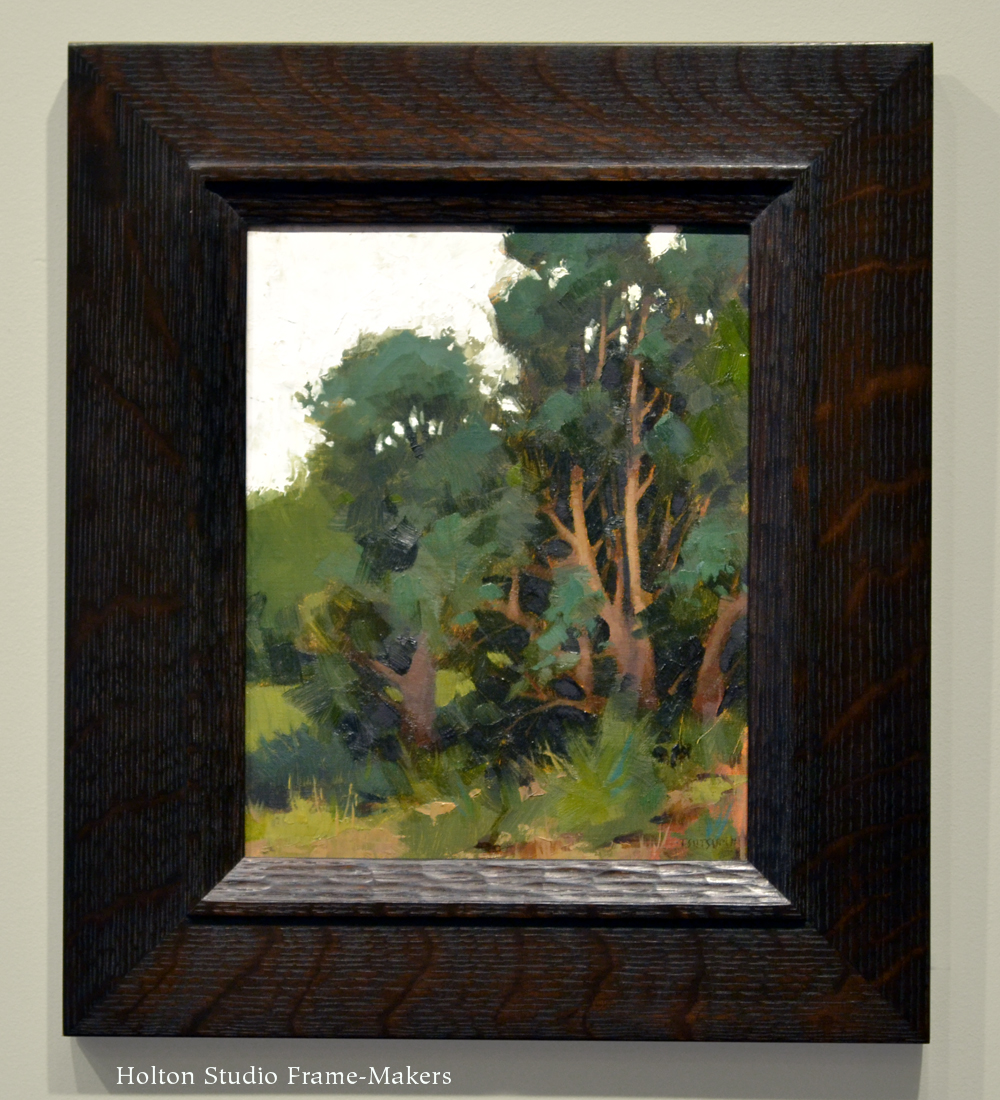
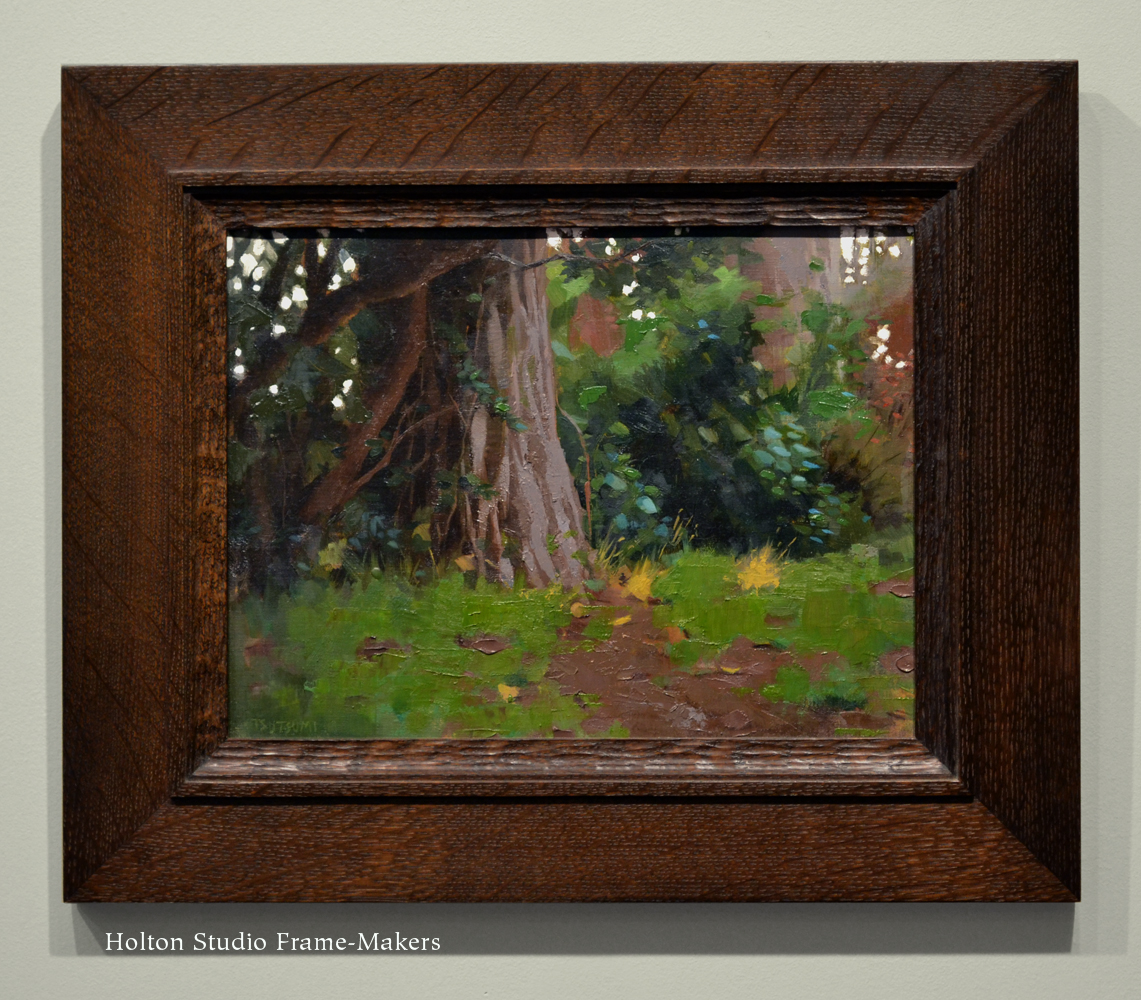
Congratulations to Oscar Nominee Dice Tsutsumi!

Daisuke “Dice” Tsutsumi, one of our artists who works at Pixar, has been nominated for an Academy Award! His movie, “The Dam Keeper,” which Dice made with Robert Kondo, is among the five selections in the Animated Short Film category. Of the five paintings we’ve had, we still have two, shown below and on Dice’s page. See the other three on his archive page, here.

Proud of you, Dice! Congratulations!

Check out the trailer…

Check out Dice’s blog…

Remove featured image

Robert Flanary—Paul Roehl Show Opens Tonight

Tonight’s opening of “A Continuous Harmony: New Tonalist Paintings by Robert Flanary and Paul Roehl” will be extra-special as it will also be the debut of the make-over of Holton Studio Gallery. Come join us from 5 to 7 and celebrate these two greatly talented and wise landscape painters. Here’s a before and after shot. As you can see, the corner sample display has largely been turned over to the presentation of paintings.

Shrm-Gal-b4-aft-web

The Show—

Below are pictures I took this morning showing the display—but you really have to see these wonderful and subtle works in person. See the show page here…


A Continuous Harmony

We are in the final stages of framing and preparing the gallery (a minor remodel is underway!) for next Saturday’s opening of our show, “A Continuous Harmony: New Tonalist Paintings by Robert Flanary and Paul Roehl.” The reception for these wonderful artists will be from 5 to 7 in the evening. I do hope you can join us. A full preview of the show is here.

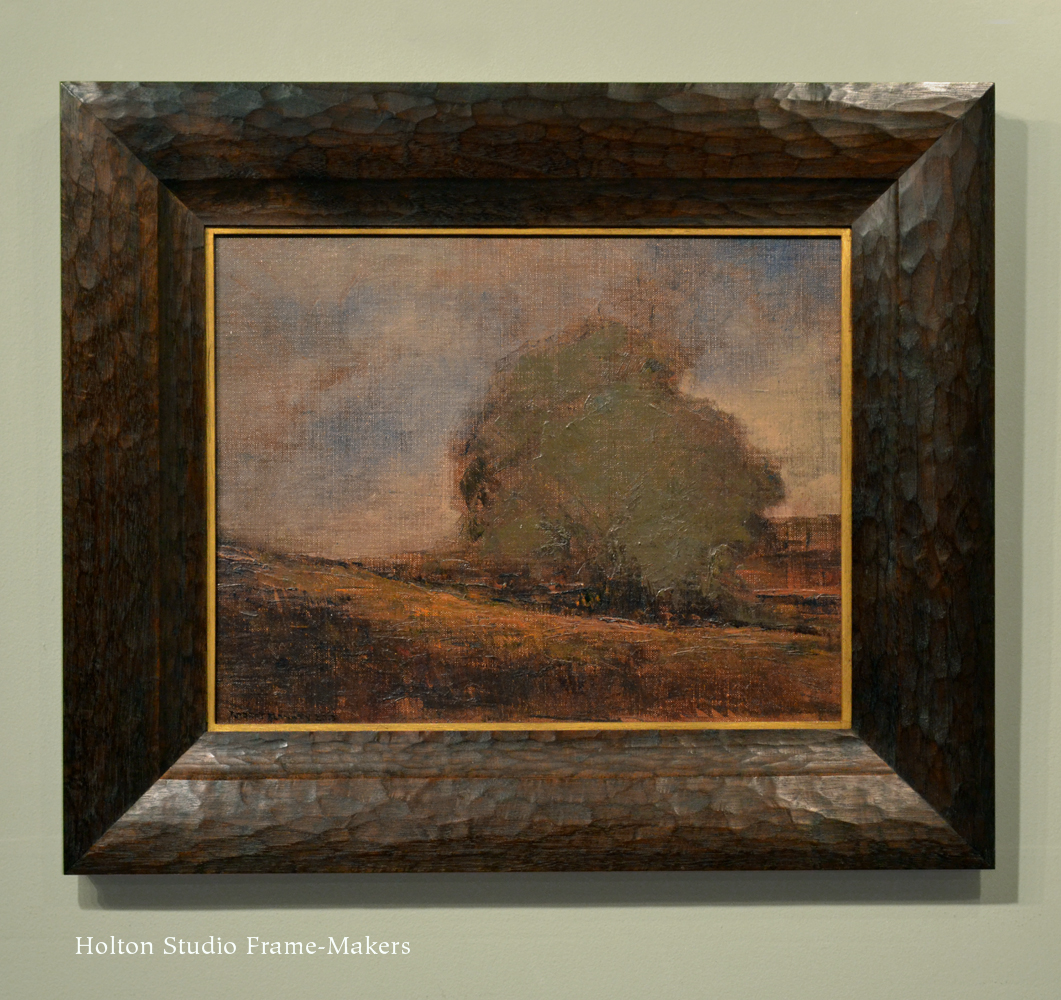
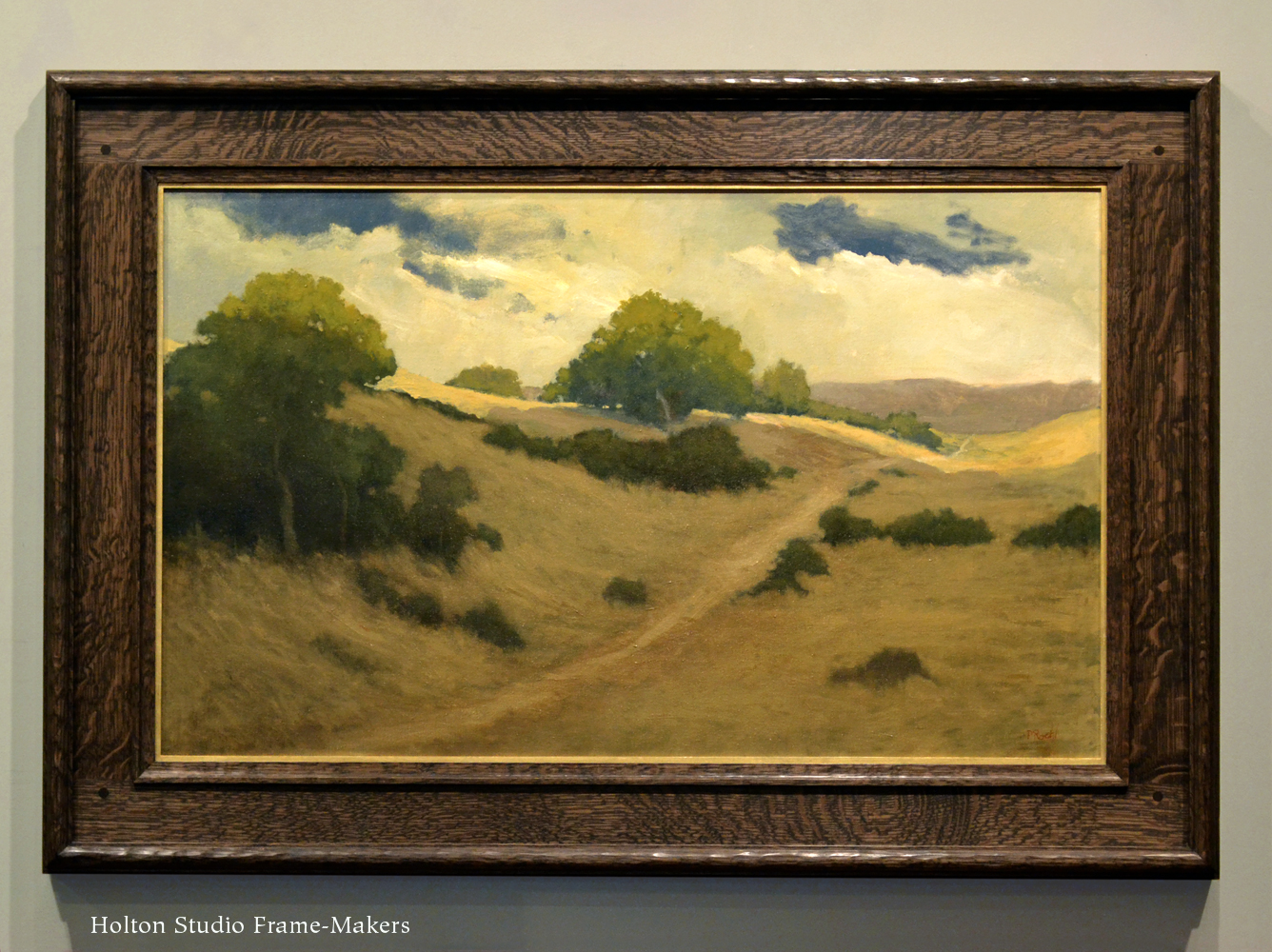
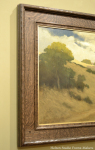
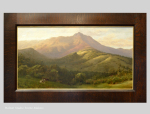
Here are two paintings to be featured: “Grove on a Hillside, Blue, Grey Sky”, by Robert Flanary; and “Sierra Foothills” by Paul Roehl. In addition to building picture frames, I’ve been framing, in words, the animating spirit, the artistic inspiration behind the show. A blog post featuring a couple of prime examples of the paintings in the show seems a good place to also include some curatorial thoughts on the show.

First things first:

Robert Flanary painting

Robert Flanary, “Grove on a Hillside, Blue, Grey Sky”, 11″ x 14″. Frame in carved walnut with gilt liner. View large…

Paul Roehl painting

Paul Roehl, “Sierra Foothills”, 22″ x 36″. Carved cassetta frame in stained quartersawn white oak, with gilt liner. View large…

Framing Tonalism

If you’re a fan, as I am, of the writer Wendell Berry you may recognize the title of the show from the name of a collection of his essays (thank you to Sara Atwood for recommending them to me!). Yes, I stole the name, but Mr. Berry himself stole it: in the epigraph of the book he quotes the mountaineer Thomas Hornbein. Reflecting on his encounter with the Himalayan people and how they live in relation to the landscape, Hornbein wrote that

[T]here was no impression of nature tamed. It seemed to me that here man lived in continuous harmony with the land, as much and as briefly a part of it as all its other occupants. He used the earth with gratitude, knowing that care was required for continued sustenance…In this peaceful co-existence, man was the invited guest.

“Continuous harmony with the land” is a notion most of  the modern world seems to have lost. And there’s no more plain evidence of that than the established so-called Art World’s abandonment of landscape painting and disdain for harmony. Yet we only need to go back a hundred years to find a vital instinct for finding and honoring the primal harmony and unity between the human race and the natural world that did, after all, give birth to us; and that artists and those concerned with art revered such things. For example, in 1913, Stanford University professor Edward Howard Griggs wrote in his book The Philosophy of Art: The Meaning and Relations of Sculpture, Painting, Poetry and Music that

“All art…draws its forms ultimately from nature. Thus the final principle of all appreciation of beauty lies in the relation we sustain to the nature world.” (My italics.)

Such views were commonplace, and I choose this one primarily for its local origin. The Bay Area and northern California naturally bred such views. My last post showed a couple of paintings by one of our greatest local painters, William Keith, one including his good friend John Muir. The two men shared a passion for sustaining that relation to nature which Griggs addressed. Keith, along with Arthur Mathews, played a significant role here in the Bay Area in the widespread tendency of the day—not properly a movement—often identified as tonalism. (Keith and Mathews were each students of leading tonalists George Inness and James McNeil Whistler, respectively.) Again, Professor Griggs wrote eloquently of its spirit:

“[T]he beauty of the landscape is not in the lake, river, forest, hills or sky; but in all these fused together in a harmonious whole. Similarly, the beauty of a Corot painting is not in the misty group of trees, the dancing figures, the mellow dawn light or the subtle atmosphere, but in the composition of these into a harmony.”

Such concerns strike many as not only outdated, but a betrayal of the iconoclastic mission they suppose has been eternally assigned to artists to subvert all that’s come before, transgress, and—for it’s a radically evolutionary mission—never repeat or produce even a semblance of what’s been done before. And yet, as Arthur Mathews wrote, “[W]oe to him who believes that he may cut loose from all precedent.” Evolution may have other directions in mind for us—such as cultivating the earth and the arts of living on it.

At least one artist, having thoroughly explored the modern art scene, has ideas of where to go from here. Paul Roehl writes,

My interest in a tonal approach to painting is predicated on a continuing interest in nature as something mysterious and beautiful and finally compelling, as well as a way out of what seems to me a kind of hopelessly fractured dead end in the world of contemporary art… I looked to the past as a way forward and I found the Barbizon painters, their legacy and influence in American and California painting, a resulting tonalism and ultimately an approach to art that seemed to defy temporary fashion and offer continued possibilities.

Continued possibilities are, after all, what we seek, aren’t they? Instead of the fractured world we’ve created, we need to restore harmony—from the Greek, harmos: “joining”. If landscapes “have been done” that hardly seems like a reason to ignore the landscape and “the relation we sustain to the nature world”—to stop seeing it, to stop seeking harmony in it. We cannot be done with nature as long as nature is not done with us.

A final note: The gallery improvements are pretty simple but will mean a dramatic enhancement to and expansion of the display of paintings. We’re very excited about this change and think you’ll enjoy it. (And come check out our ingenious solution to where to put all the displaced corner samples!)

Hope to see you next Saturday!

Again, you can preview the show here…

Frame details—

Great Re-framings: William Keith, John Muir and the Wilderness

We’re finishing 2014 with a flourish, having just re-framed two paintings by one of California’s greatest landscape painters, William Keith (1838-1911). The first is dated 1872, the year his fellow Scot John Muir introduced Keith to Yosemite, and so has great significance not only in the story of the painter’s life, but for the history of California and the United States—especially with respect to the conservation movement. The figure at the left, wearing white shirt and black trousers, is John Muir. Coincidentally, Muir died exactly 100 years ago (actually on Christmas Eve).

Keith-Sentinel-5049-web1200

William Keith, “Sentinel Rock,” 1872. Oil on canvas, 18-1/4″ x 14-1/4″.

Keith-SentRock-b4-web

William Keith, “Sentinel Rock,” before re-framing

The following excerpt from Alfred Harrison’s excellent essay, “The Art of William Keith”* provides the historical background—and illuminates how both the painter and the great conservationist re-framed how we view the wilderness.

During their winter in Boston, [William’s wife] Lizzie Keith arranged for [the couple] to visit with her illustrious cousin, Ralph Waldo Emerson. Emerson had recently returned from a trip to California that included a visit to Yosemite. While there, he told the Keiths that he had made the acquaintance of a remarkable, young, Scottish-born lover of the mountains named John Muir. Back in California, Keith heard Muir’s name again from his friends Ezra and Jeanne Carr… Jeanne Carr gave Keith a letter of introduction as Keith set out to visit Yosemite in the autumn of 1872. The same age, and from the same background, Keith and Muir immediately became friends…

In 1872, Muir was just beginning to be recognized as a significant interpreter of mountain environments and an advocate for preserving the wilderness. He had come to California in 1868, venturing on foot to Yosemite, where he was inspired by the grand scenery. Unlike eighteenth-century aesthetes who saw nature as a fallen world where the devil and God’s surrogates did battle, Muir considered the wilderness as God’s perfect handiwork, a morally-healthy cathedral that contained implicit sermons. Only where the clumsiness of man had interfered with creation—especially in what Muir referred to as the “choke-damp” of cities—did values deteriorate and life become a sordid struggle for survival.

The implication of such an outlook for the landscape painter was clear—paint the beauty of real nature. This view dovetailed neatly with Ruskin’s admonitions and the increasing influence of science that Muir himself was advancing. Despite his awareness that mountain grandeur was fading as a fashionable subject for landscapes, Keith himself was swept up in the enthusiasm for the newly-discovered Sierra Nevada and its awesome scenery.

Of course, one of the great transformations pointed to by this picture is that of the lives of Yosemite’s last Indians, seen here camped by the Merced River, as Europeans approach them and their lives undergo catastrophic alterations.

Among “Ruskin’s admonitions” with which both men were likely familiar, this one comes to mind: “Whenever people don’t look at Nature, they always think they can improve her.”** As I’ve argued, the main problem with gold frames is that they interfere with our ability to see the painting, and so to “look at nature.”

Wm Keith, “Mt Hood,” before re-framing

The second Keith painting, “Mt Hood,” is significant because it was a gift from the painter to the Governor of California, George Perkins. Interestingly, the Perkins family maintained that the painting depicted Mt Shasta, which is, unlike Mt Hood, located in the governor’s state. Did Keith give the governor a painting that happened to be looking for a home and render it a more suitable gift by simply telling the governor that the picture was of Mt Shasta? In any case, Keith clearly shared the sentiments expressed by Muir when he wrote, “The mountains are calling and I must go.”

William Keith, "Mount Hood," n.d. Oil on canvas, 16-1/2" x 31-1/2".

William Keith, “Mount Hood,” n.d. Oil on canvas, 16-1/2″ x 31-1/2″.

While Keith himself is known to have favored humbler settings than the gilt exhibition frames these came to us in, he had little or no control over how clients and dealers framed his work. Keith did achieve financial success, but nonetheless complained that his fortune never felt secure. As it did for most artists, living in constant fear of poverty had a lot to do with accepting the flattering packaging offered by the gilt frame convention.

The two frames are similar in profile—they’re basically our No. 348.108.1—but the one on “Sentinel Rock” is adapted to that painting’s more dramatic perspective and the walls of the Valley by sloping into the picture at a steeper angle. Both frames are quartersawn white oak, “Mt Hood”‘s stained Medieval Oak stain and “Sentinel Rock”‘s in Dark Medieval Oak.

Both examples have been added to the page, “Fixing a ‘Very Prevalent Error'”, where you can see the before and after shots side-by-side.

 More on William Keith…

Other Keiths we’ve frame are here, here and here.

*In The Comprehensive Keith: The Hundred Year History of the Saint Mary’s College Collection of Works by William Keith, ed. Carrie Brewster. Hearst Art Gallery, 2011. More on St Mary’s College’s William Keith collection…

**from “The Two Paths.”

Framing a Hudson River School Painting

Feeling very privileged indeed to have had the chance to frame this classic view of the Hudson River by a Hudson River School painter, Charles Wilson Knapp (1823-1900). Just completed this week, the frame is a 4″ wide Compound Mitered frame, in a slope form with a cove at the outside and a peaked cap molding. The forms are pretty direct and straightforward readings of the essential forms and perspective of the painting.

More on Charles Wilson Knapp…

Knapp-web1200

Charles Wilson Knapp (1823-1900), undated, untitled view of Hudson River. Oil on canvas, 23″ x 41″.

Knapp-cbr-web1000

Corner detail. (Click image to view large.)

Framing the Simple Home (One by Raymond Dabb Yelland)

There’s something about a cabin in the wilderness, a simple home completely at home in the natural landscape, making us part of the landscape ourselves—placing us in our true element, placing us in the great frame of creation.

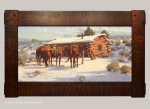
Jim C. Norton (b. 1953), untitled (horses and log cabin), n.d. Oil on canvas, 15 x 30.

Jim C. Norton (b. 1953), untitled (horses and log cabin), n.d. Oil on canvas, 15 x 30.

One of the images in my last post (included again here, at right) is such a cabin, itself a frame of walls well-joined (the joints fully articulated). And so in the same spirit we framed it, and gave the simple, well-made home it’s own simple, well-made home.

That one’s contemporary (by Jim C. Hall). Two others we’ve framed recently are older pieces. The first anonymous—which strikes me as suitable, given the vernacular subject matter (unknown architect; unknown painter). It’s in a simple carved slope, our No. 2 CV. The wood is quartersawn white oak in Saturated Medieval Oak stain, and the profile is 2-1/2″ wide. I like the way the carving echoes the dappled light and leaves—and paint—of the picture. The second is by a very notable California painter, Raymond Dabb Yelland (1848-1900). The stained quartersawn oak cassetta frame is 4″ wide.


WoodCabin-in-2CV-4956-web1200

Anonymous, untitled (cabin in the woods), no date. Oil on board, 11″ x 18″.

Yelland-5052-web-1200

Raymond Dabb Yelland (1848-1900), “Charcoal Burner’s Cabin,” Cascades, OR, 1881. Oil on canvas, 16″ x 24″.

Yelland-5052-dtl-web1200

Detail of cassetta frame in carved quartersawn white oak.

Good Citizen’s Picture Frames

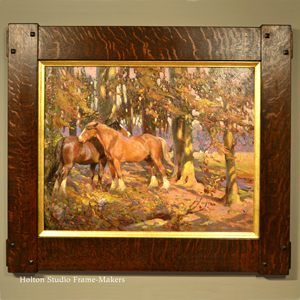
We’ve recently framed some pretty great pieces in the fairly plain and simple, but hefty mortise-and-tenon frames that have been a specialty of ours from day one (twenty-one years ago!). You can scroll down to see notable examples. I like to borrow a phrase from William Morris to describe them: “good citizen’s frames.” View our Mortise-and-Tenon frames in the catalog…  See more examples of pictures in Mortise-and-Tenon frames in the Portfolio…

Hall-Companions-in-35-40B-4998-webpostIn his 1882 lecture, “The Lesser Arts of Life,” William Morris had some important advice on furniture and furnishings—advice applicable to frames. The distinction between simple and “makeshift” bears emphasis; all should be well-made. In your “work-a-day furniture,” use stout, solid wood, and don’t neglect your joinery, he says. And don’t be shy to have more decorative work, if you can and wish. Only do it with integrity. The passage doesn’t address frames directly, but the admonition to “think first of the walls” certainly speaks to our particular art form. (Of course, Morris was a maker of wallpaper, so he wasn’t thinking exclusively of pictures.) The especially memorable lines are in bold.

Simplicity is the one thing needful in furnishing, of that I am certain; I mean first as to quantity, and secondly as to kind and manner of design. The arrangement of our houses ought surely to express the kind of life we lead, or desire to lead; …[our] houses…should look like part of the life of decent citizens prepared to give good commonplace reasons for what they do. For us to set to work to imitate the minor vices of the Borgias, or the degraded and nightmare whims of the blasé and bankrupt French aristocracy of Louis the Fifteenth’s time, seems to me merely ridiculous. So I say our furniture should be good citizen’s furniture, solid and well made in workmanship, and in design should have nothing about it that is not easily defensible, no monstrosities or extravagances, not even of beauty, lest we weary of it. As to matters of construction, it should not have to depend on the special skill of a very picked workman, or the super-excellence of his glue, but be made on the proper principles of the art of joinery: also I think that, except for very moveable things like chairs, it should not be so very light as to be nearly imponderable; it should be made of timber rather than walking-sticks. Moreover, I must needs think of furniture as of two kinds: one part of it being chairs, dining and working tables, and the like, the necessary work-a-day furniture in short, which should be of course both well made and well proportioned, but simple to the last degree; nay, if it were rough I should like it the better, not the worse; with work-a-day furniture like this we should among other blessings avoid the terror which now too often goes with the tolerably regularly recurring accidents of the week.

But besides this kind of furniture, there is the other kind of what I should call state-furniture, which I think is proper even for a citizen; I mean sideboards, cabinets, and the like, which we have quite as much for beauty’s sake as for use; we need not spare ornament on these, but may make them as elegant and elaborate as we can with carving, inlaying, or painting; these are the blossoms of the art of furniture, as picture tapestry is of the art of weaving: but these also should not be scattered about the house at haphazard [intervals], but should be used architecturally to dignify important chambers and important places in them. And once more, whatever you have in your rooms think first of the walls, for they are that which makes your house and home; and if you don’t make some sacrifice in their favour, you will find your chambers have a kind of makeshift, lodging-house look about them, however rich and handsome your movables may be.

Examples—

View our Mortise-and-Tenon frames in the catalog…

See more examples of pictures in Mortise-and-Tenon frames in the Portfolio…