“With Four Sticks of Wood”: A Simple Home for Bernard Maybeck

A couple of months ago, we were asked to frame a portrait of the architect Bernard Maybeck (1862-1957) to hang in the larger frame of Maybeck’s 1902 Faculty Club at UC Berkeley.

No portrait cries out for the architecture of a frame like a portrait of an architect. You might say that frames are architecture at its most refined. So making a frame for a portrait of an architect to hang in one of his buildings* is especially gratifying to a frame-maker. Frames, no less so than the portraits they complete, are inherently honorific. To be asked to frame this portrait, though, was not only gratifying but also a special honor for Holton Studio.

First, though, the painting.

Framed Bernard Maybeck paintingThe noted portraitist Winifred Rieber (1872-1963) painted this likeness of Maybeck in the 1920’s after the architect had gained fame for his Palace of Fine Arts, the most beloved building of the 1915 Panama Pacific Exposition in San Francisco. (In 1951, he would be awarded the Gold Medal by the American Institute of Architects.) Such portraits frequently become treasured heirlooms, as the original of this one is for the Maybeck family. (This copy we framed to hang in the Faculty Club is a print on canvas.)

Framed Bernard Maybeck paintingWe gave the 30″ x 25″ canvas a 4″ wide mitered frame. It is for the most part a plain flat, which allows the frame to rely above all on the inherent beauty of the wood. (That is to say, the quarter sawn white oak serves the frame the same way Maybeck’s raw redwood walls serve the architecture of the Faculty Club). We beveled the inside and outside edges of the flat face. The inside bevel leads the eye in to the picture, and also, along with the outside bevel, repeats the angularity of the rendering, especially the lines of the subject’s architectural setting. (Note how the sill of the window in the painting meets the miter of the frame.) Those bevels are carved. The tooled texture complements the smooth face of the frame and also echoes the loose, impasto brush work.

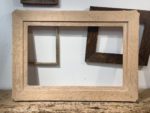
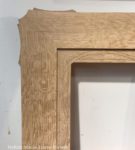
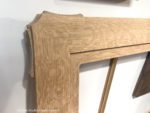
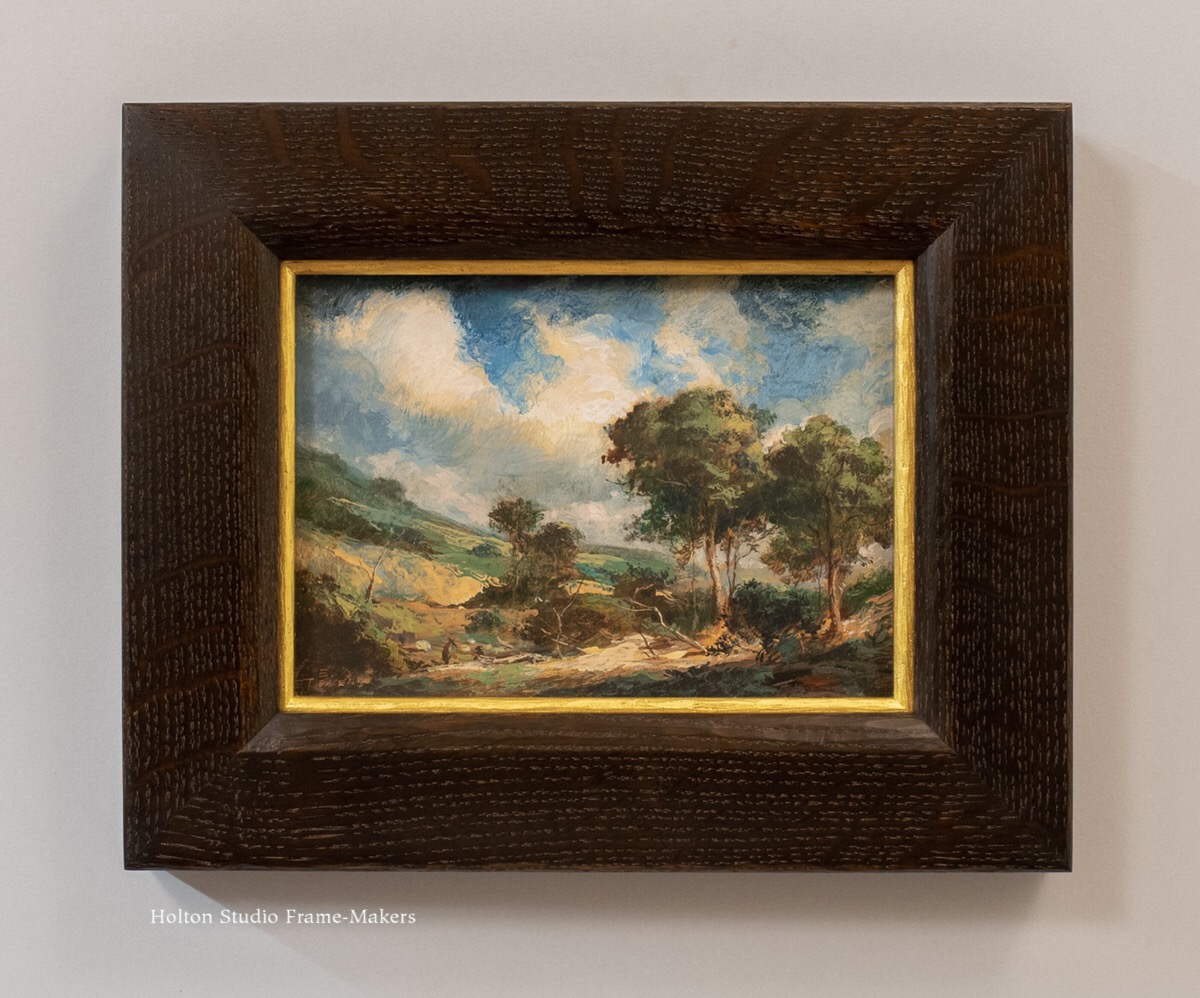
The outer bevel also serves the outset corners of the frame, which protrude slightly but have their radiating effect enhanced and accented by the outer carved bevel which stops where the corners step out. (Similar treatment can be seen on this frame, and this one. This Thomas Hill painting was the first piece we made this frame design for.)

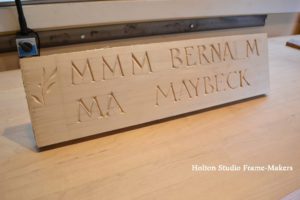
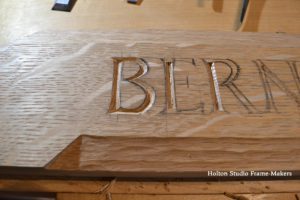
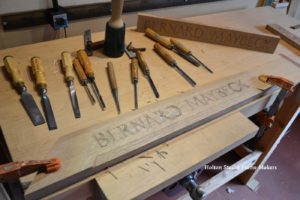
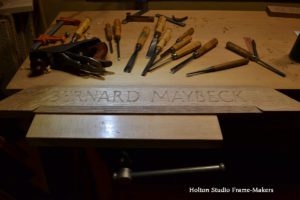
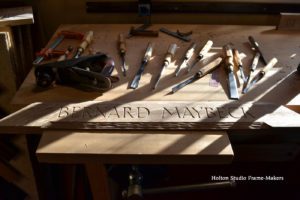
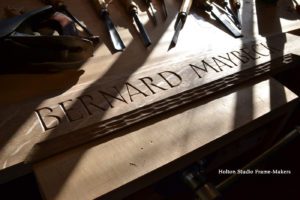
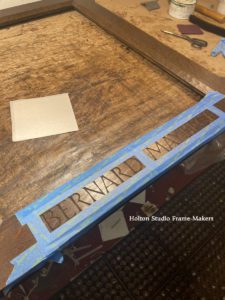
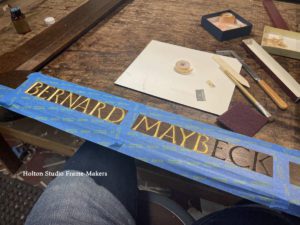
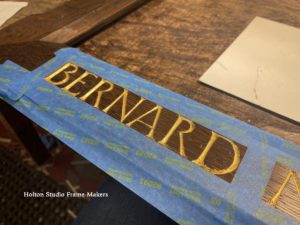
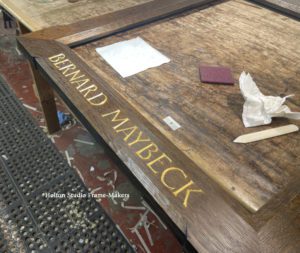
Detail of frame for portrait of Bernard MaybeckTrevor Davis and I built the frame, and I carved the architect’s name across the bottom. The lettering is a simple Roman, but “waisted,” meaning the stems are all pinched a bit in the middle. Sam gilded the letters.

When the Maybeck Foundation asked me to help them honor my city’s great architect by framing a portrait of him to hang in one of the architect’s exemplary public buildings, and requested that I carve Maybeck’s name across the bottom, I don’t think they had any idea what the task would mean to me. For natives like me, the city is impossible to imagine without Maybeck’s architectural legacy.** And personally, it was a chance to express my admiration and appreciation for a great advocate of craftsmanship in architecture, and thus one of my heroes.

Frame detail

It’s not at all an elaborate frame. But that was part of the beauty of this opportunity—to provide a simple home to honor the master of Berkeley’s simple home ideal. Framed portraits are reciprocating: they not only represent a figure (that is, literally re-present the deceased, making the departed present again), thus honoring him or her; they also represent (and re-present and express) the admiration of the painter and the framer who are honoring the figure, and more broadly, the community that person has touched.

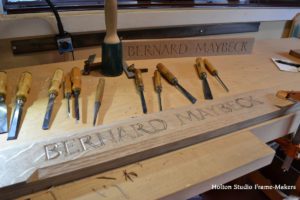
Lettering being carved—Bernard Maybeck

In any case, frames, as I said, are inherently honorific, and so is carving a person’s name in oak and gilding it—especially when the honoree is himself a carver (although in Maybeck’s case too self-effacing for us to ever know which carved details to attribute to him). The very act of carving is devotional. It’s not only the pinnacle of the art of frame making but the epitome of the ideal of work as “love made visible,” in the words of Kahlil Gibran.

Even apart from the carved lettering, though, the simple architecture, the simple home that the frame provides his portrait, offered the opportunity to honor Maybeck. “With four sticks of wood,” he once said, “you can express any human emotion.” Such wisdom, especially helpful to a frame-maker, is only a glimpse of the many elemental lessons Maybeck taught me in the art and architecture of the frame.

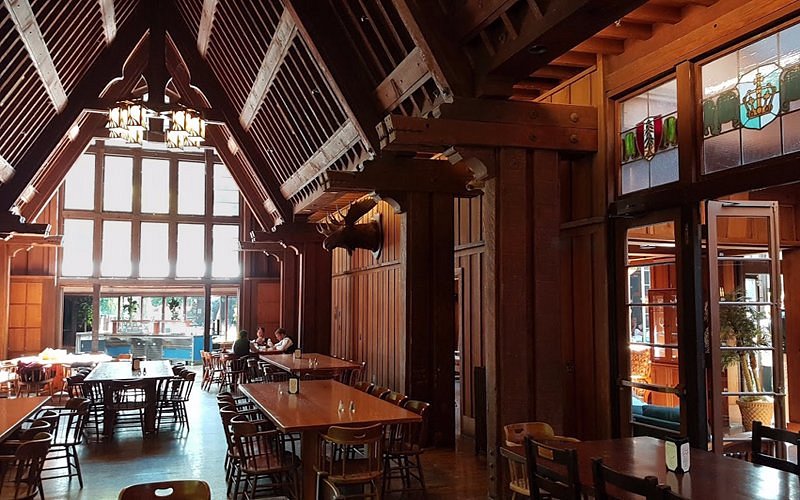
Faculty Club

Speaking of the devotional nature of carving, in the Great Hall of the Faculty Club (right), carved into the supporting beams along the sides of the room, dragon heads keep watch over the proceedings. Maybeck said that carved dragon heads, a recurrent detail in his buildings, were his tribute to his father’s trade—and, we can surmise, the craftsman ethos that his father’s work impressed upon him. It’s hard to imagine Maybeck didn’t have a hand in their making.
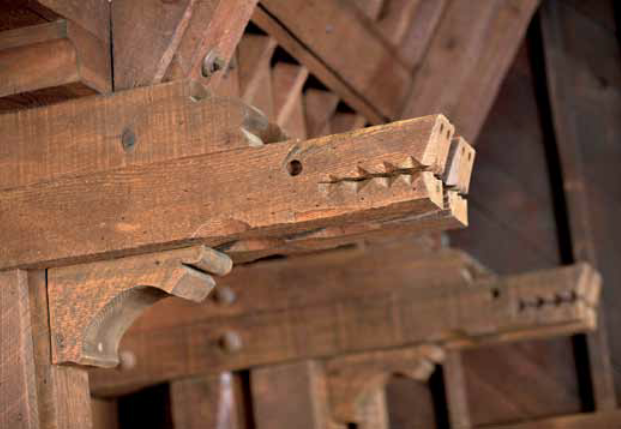
 

Carved dragon head, UC Berkeley Faculty ClubIn any case, as dragons go, these appear remarkably friendly. That is to say, they express Maybeck’s own affable spirit. When the university decided it needed a building that would be a place for the faculty to enjoy “mutual good fellowship” it couldn’t have chosen a more suitable architect than Maybeck.
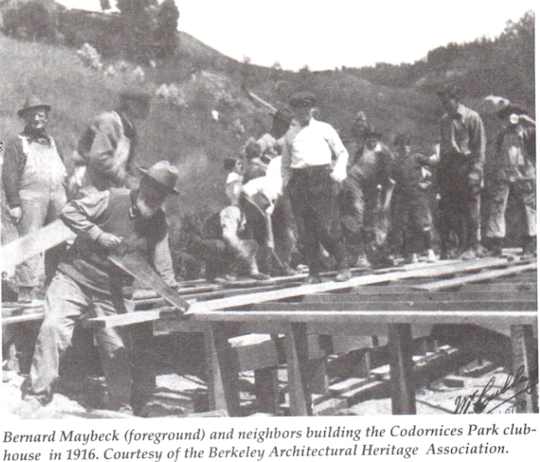


Bernard Maybeck on jobsiteMaybeck’s generous spirit and appreciation for craftsmanship in the art of architecture was once illustrated for me by Robin Pennell, whose father, Frank Pennell had been a contractor for Maybeck. Robin recalled his father’s story of meeting the architect on a job site to inspect the house’s just-completed framing. Maybeck was struck by the framers’ beautiful workmanship, admiring in particular the perfectly mitered and nailed stud braces. And he said to the contractor, “Forget about the paneling specified for the interior walls. I want to be able to see this workmanship. Just fill in between the studs with plaster and leave the framing exposed.”
Interior, Maybeck's First Church of Christ, Scientist, Berkeley

First Church of Christ, Scientist, Berkeley

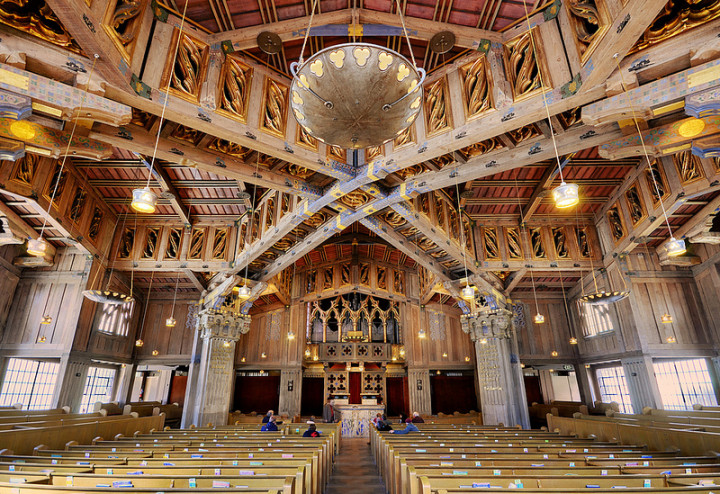
Pennell’s story tells us that for Maybeck, details like carved dragon heads are more than a quirky personal gesture.***  To walk through Maybeck’s masterpiece, The First Church of Christ, Scientist, Berkeley, is to witness not only the old understanding of architecture as the collaboration of trades, but also those trades practiced at their freest and most expressive. It is to experience the full meaning and truth of William Morris’s, “Art is the expression of man’s joy in his labor.” It is in the well crafted details, at the scale at which human hands are able to work at their most dexterous, expert and expressive, that the artisan feels his or her individual power and participation.

When we finished framing the painting, a friend picked it up from the shop and hung it at the Faculty Club. A few weeks later, the Maybeck Foundation hosted a small gathering to celebrate the portrait’s installation. In this building made for “mutual good fellowship,” I got to bask in fellowship with my hero—not only in the presence of his re-presentation that is the portrait, but also in his still-living architecture (that is a living reminder of the humane way of building that modern architecture might have been). Not least of all, I got to enjoy Maybeck’s presence in the friendly company of a number of his descendants. Tim Holton with framed painting of Bernard MaybeckA couple of family members, including Maybeck’s great-grandson, Scott Nittler, filled me in on what he regarded as the family’s main trait traceable to Bernard Maybeck: his optimism. And though Scott wouldn’t have pointed it out to me, I observed for myself that other oft-noted Maybeck trait: kindliness.

I love that the picture shows Maybeck in one of his simple wooden homes, one we could re-present and complete with the home that is a frame. And I love that the architect is seated at a window, a picture frame being a window as well, and windows being “the eyes of a house” and offering prospect—that necessary complement to protection and shelter, and of keen interest, therefore, to any architect, but especially to an optimistic one.

Maybeck looks a bit shy, and not too excited to be the focus of attention. There is no vanity in this portrait. The shadowy frame complements and enhances the sun shining through the window and falling significantly on the architect-artisan’s plain white shirt, and on this figure remembered for his sunny disposition. I was satisfied by how the slightly outset mitered corners of the frame suit Maybeck’s benevolent radiance, demonstrating for the master that I’d learned his lesson: “With four sticks of wood, you can express any human emotion.”


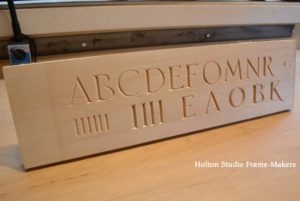
Process—the carved and gilded lettering

Notes

*The room where the portrait hangs was in fact designed by John Galen Howard, and was added on to Maybeck’s original building adjacent to the Great Hall. Maybeck’s first biographer, Kenneth Cardwell noted that “Nothing would have please Maybeck more that this organic growth of a building.” At least for me, then, the whole building is, if not Maybeck’s, supremely Maybeckian in its social and collaborative spirit.

** See Ursula Le Guin, “Living In a Work of Art,” in Words Are My Matter, 2016. As tributes to Maybeck go, this account, by one of Berkeley’s best writers, of growing up in a Maybeck house is a brilliantly observant and insightful. Le Guin digs deep into the influence and meaning of houses and architecture, and the especially beneficent effect of Maybeck’s architecture on her as a person and especially as an artist. I would add that, given the architect’s influence on the city (at least its hillside neighborhoods), the essence of Le Guin’s experience in the surroundings of a Maybeck house applies nearly as much to those of us who didn’t actually live in a Maybeck but nonetheless grew up surrounded by Maybeck’s buildings and the whole architectural tradition in which he was the primary force.

***In On the Edge of the World, architectural historian Richard Longstreth attributes much of Maybeck’s fundamental concern with craftsmanship to his reading, while a student in Paris, the work of Gottfried Semper (1803-1879) and Viollet Le Duc (1814-1879). “Semper emphasized crafts…because he believed they provided the key to the laws of architecture. His underlying thesis, that the laws governing crafts and architecture were the same, may well have had the greatest impact in shaping Maybeck’s views.” Similarly, “Viollet repeatedly emphasized the construction process as a craft and principal contributor to the building’s spirit. Viollet believed that in the past creativity and discipline in design came from the builder… His portrayal of the artist as a liberated craftsman probably inspired Maybeck, as it reinforced his own inclinations.”
“Humanization”: Framing Ukrainian artist Aleksei Bordusov

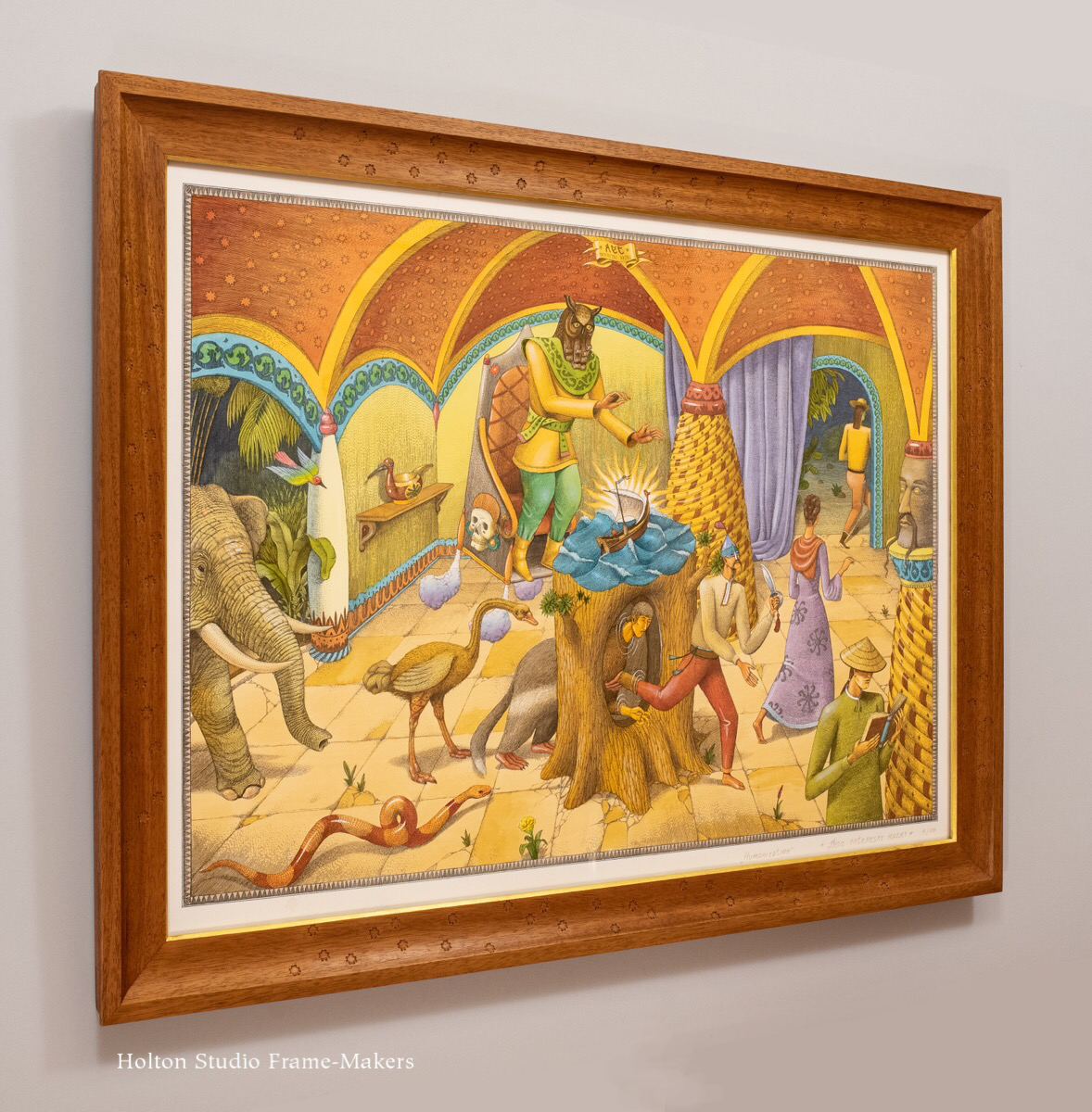
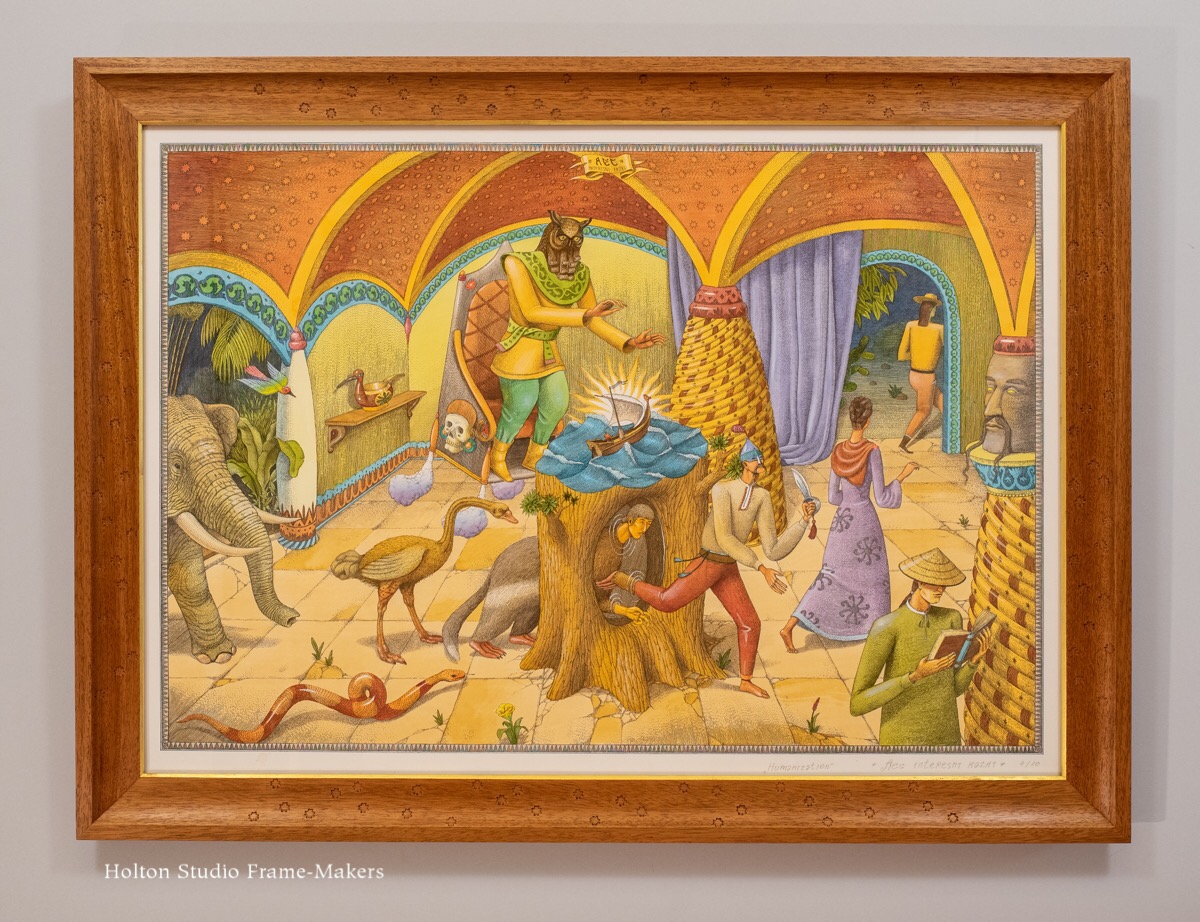
I’ve been wanting to post about this job we framed many months ago. Finally pulling it out of the archives I remembered the enigmatic image as well as its intriguing title: “Humanization.” But I’d forgotten who the artist was. Looking it up today, his identity gave this picture’s title a whole new meaning: “Humanization” stands in opposition to the dehumanization that is war—what the artist, Aleksei Bordusov (a.k.a. Aec Interesni Kaski) is presumably witnessing right now in his city of Kyev, Ukraine.

framed Aleksei Bordusov print

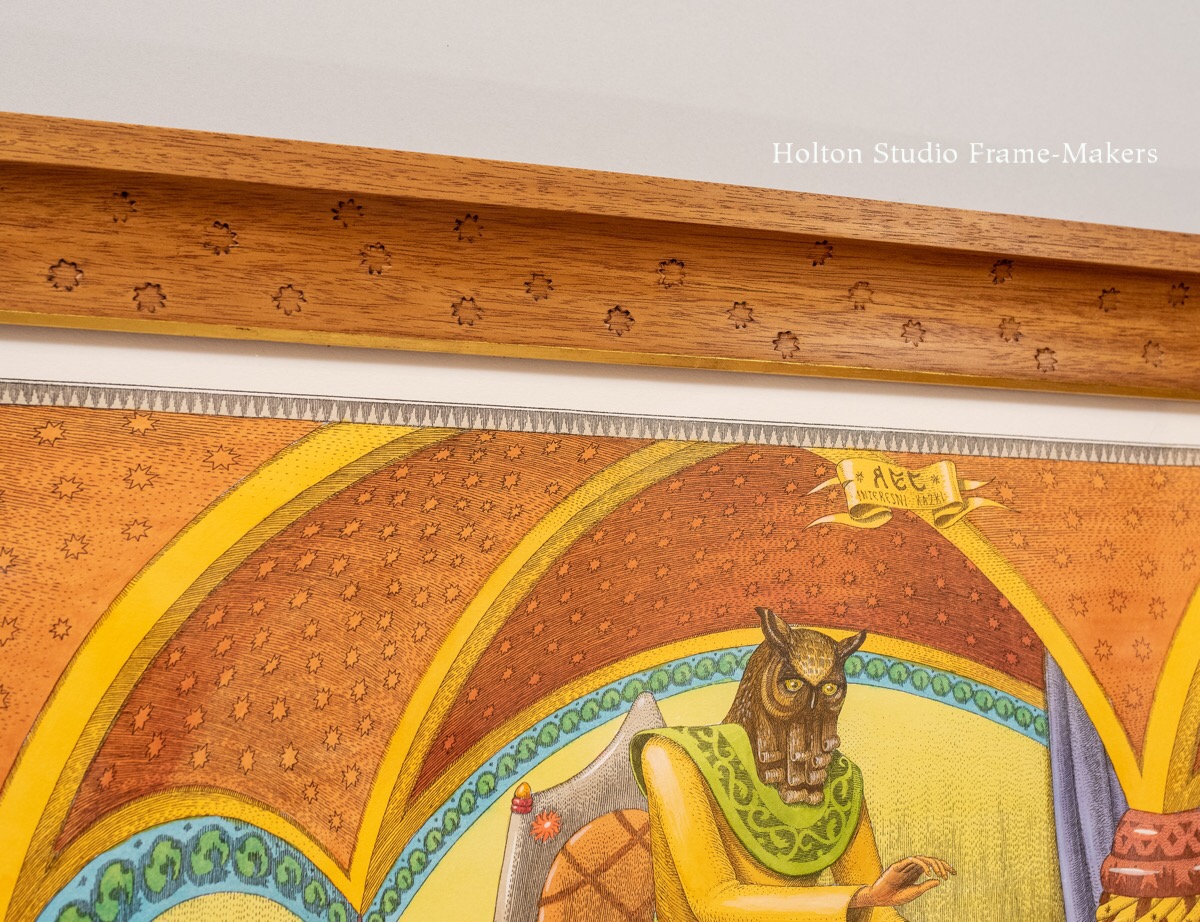
frame detailframe detailThe picture portrays humanization as not only evolutionary. For this muralist with a degree in architecture, humanization evidently has much to do with the art of building and the many arts it shelters. Such making, after all, makes us human—humanizes us. Conversely, acts of war and destruction are our unmaking, our dehumanization.

But the picture is nonetheless as enigmatic as a dream—and perhaps that’s the nature of our imperfect and elusive understanding of our own humanity.

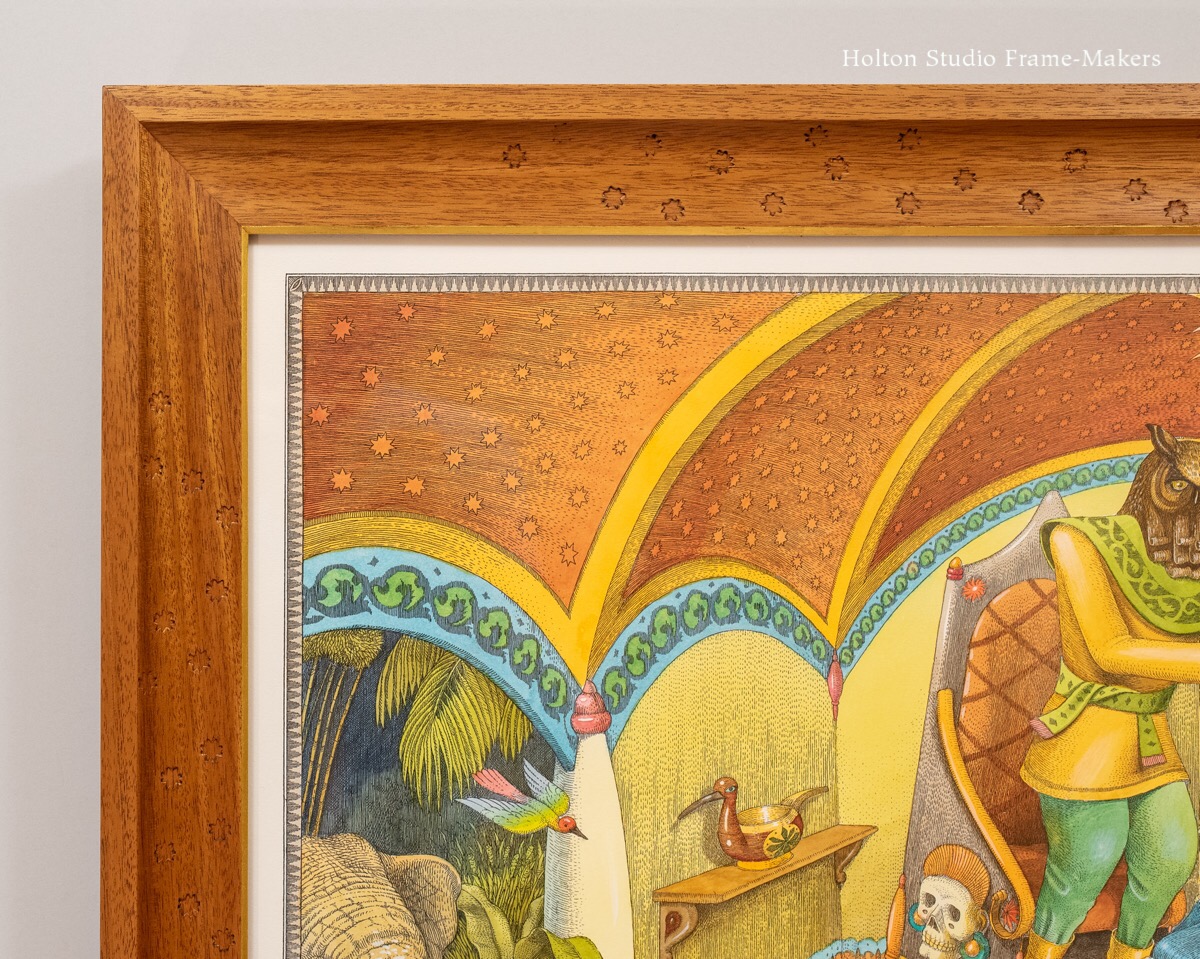
The architecture of the frame is drawn from the architecture depicted in the 26″ x 36″ print.  Playing off the vaulted ceiling that frames the fantastic scene, we created a 2″ wide Honduran mahogany cove frame with a chamfered and parcel gilt sight edge. I made a steel punch in the shape of the gilded stars on the ceiling and used it to decorate the mahogany. We finished the wood with clear oil followed by a dark wax to accentuate the punched stars.framed Aleksei Bordusov print

Aleksei Bordusov and St George

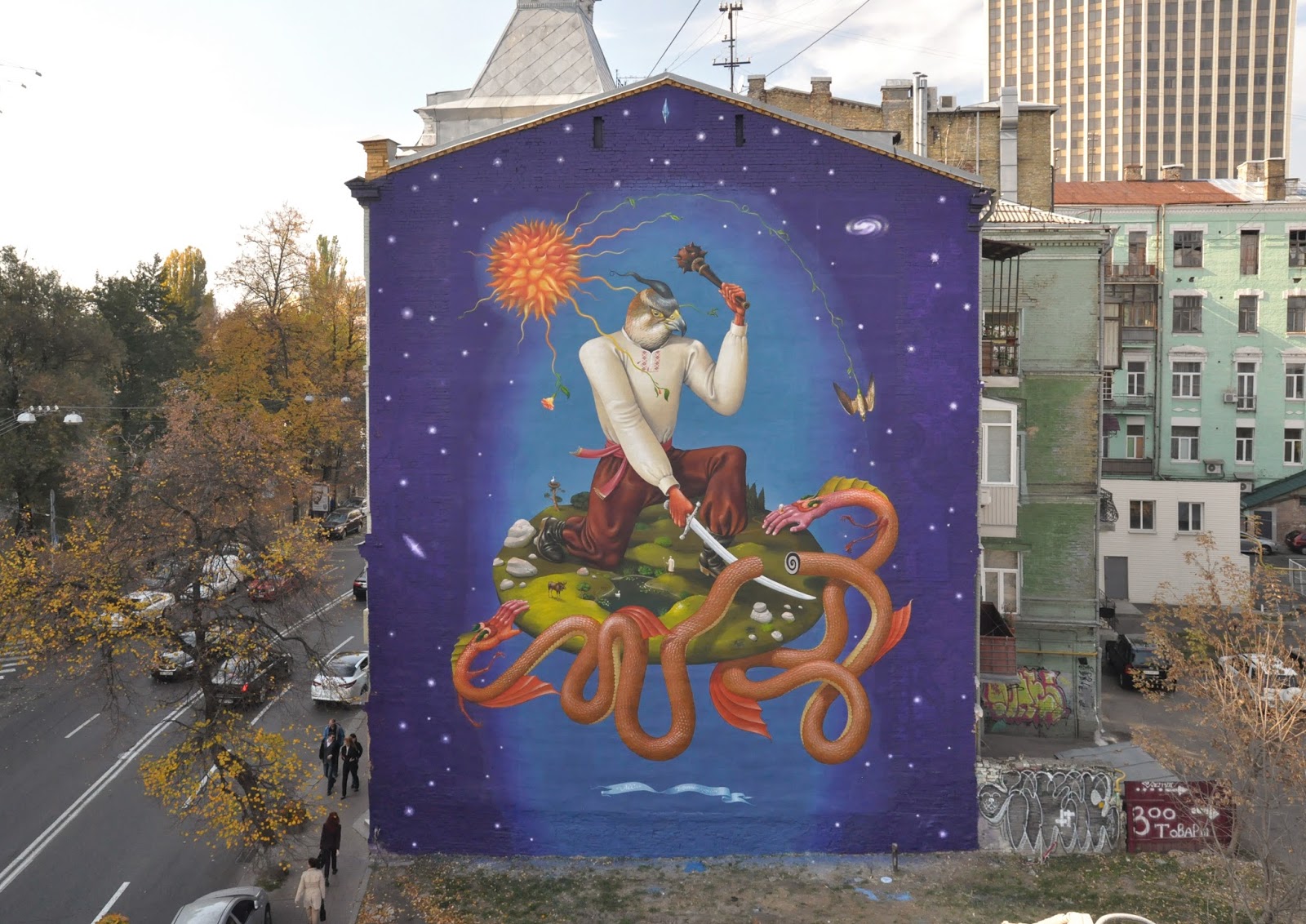
Mural by Alexei BordusovAfter earning a degree in architecture, Aleksei Bordusov’s artistic career began in earnest in the early ’90’s when, according to his website, “he started painting on the streets of Kyev as part of a graffiti crew.” He eventually became a muralist and now has murals all over the world (including several in the US).

At right is one in Kyev. It’s called “St George.” John Ruskin, in founding his utopian project, the Guild of St George, identified the dragon St George is traditionally shown slaying as “the Lord of Decomposition”—the antithesis of the human creative spirit that joins the world. Note that in Bordusov’s version of the story, the dragon is a pair of land-grabbing hands. A webpage by a Kyev tour guide surveying the city’s murals notes that the artist has explained that “the warrior symbolizes Ukrainian people, and the serpent—all the sorrows and obstacles which the country stands opposite.”

One wonders, what will be the fate of this mural? We may hope that, even if Putin’s forces destroy it, the massive, architectural place and presence it has enjoyed has earned the image a permanence in the minds of many Ukrainians—an image of the human spirit conquering the dehumanizing, destructive beast.

But it is the lives and well-being of Mr. Bordusov and the Ukrainian people that we are most concerned for. May the war be brief, few lives lost, and the elusive dream of humanization somehow triumph.

Framing Thomas Jefferson Kitts

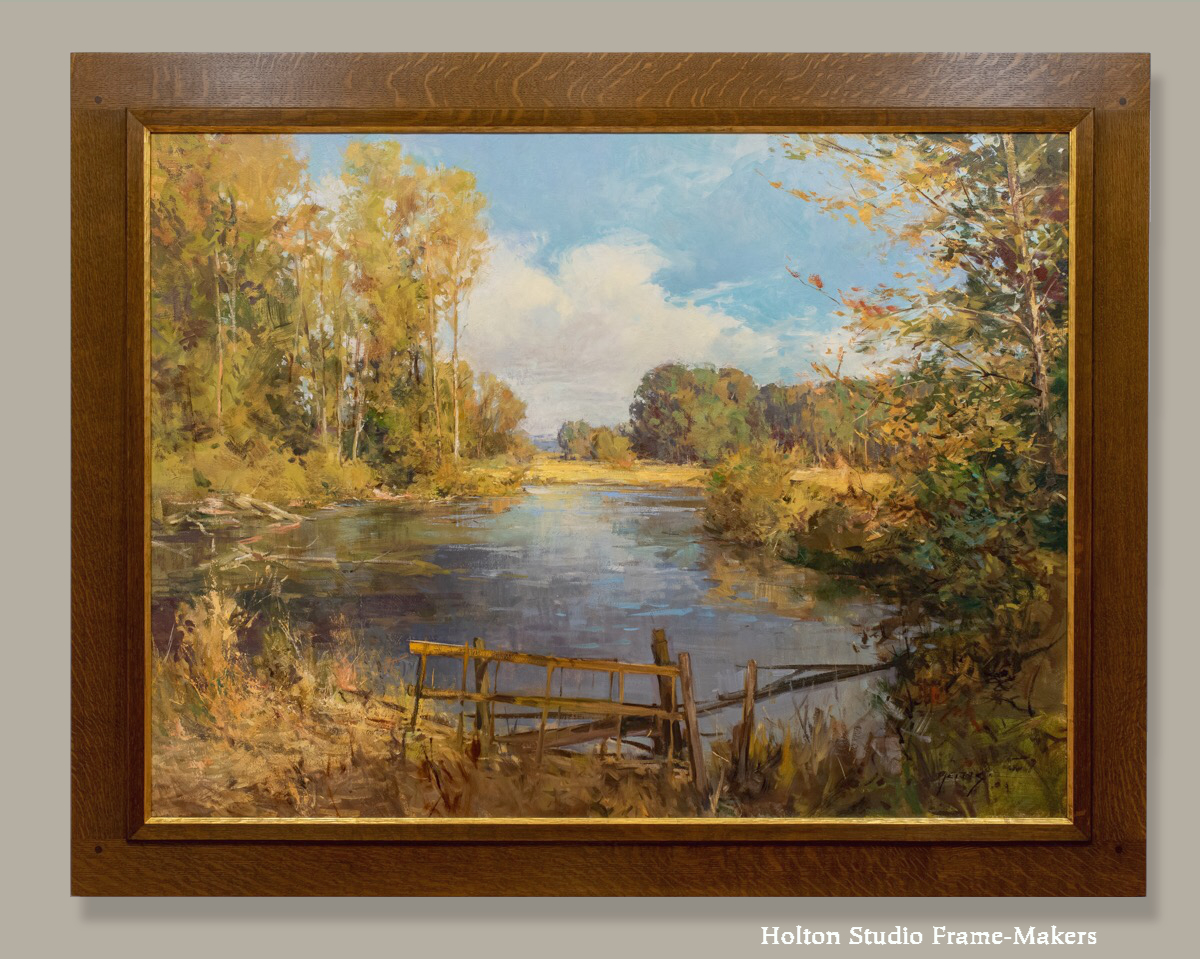
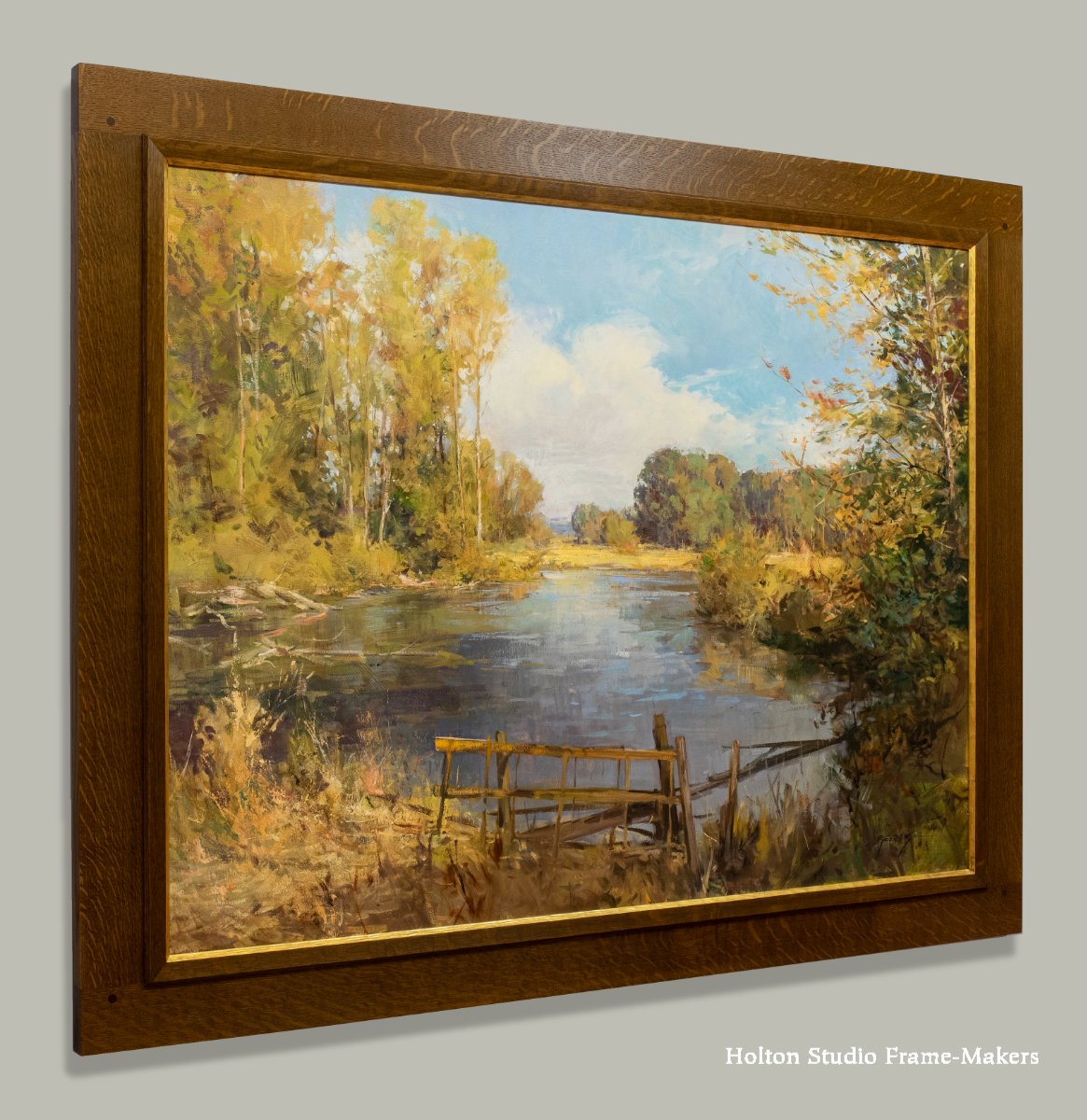
James Rieser at Rieser Fine Art in Carmel recently asked us to frame this beautiful landscape painting by contemporary Oregon artist Thomas Jefferson Kitts. “Tranquility” (2021, oil on canvas, 36″ x 48″) is available from Jim’s gallery. (View online, here.)

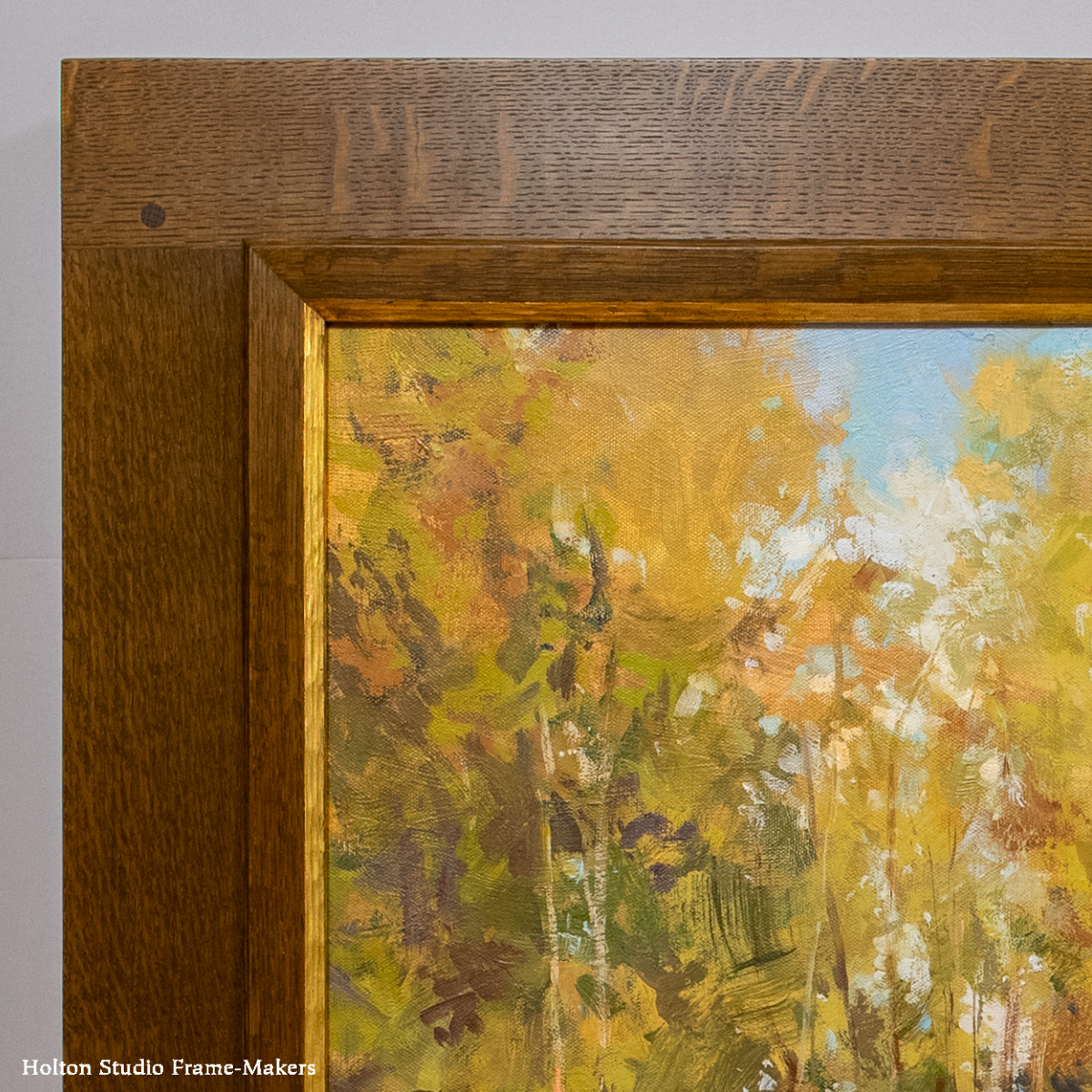
The old wooden structure (the remnant of a bridge?) in the picture’s foreground pushed us toward a plain mortise-and-tenon frame design: a 4″ wide compound Aurora in quartersawn white oak (Van Dyke stain) with a simple 1″ beveled sight mould with a carved and parcel gilt sight edge chamfer. The inner molding gives it emphasis, its bevel profile sustaining the wonderful perspective.

I especially love the light in this extraordinary painting by an extraordinary painter.

Thomas J. Kitts painting

frame corner

Thos Jefferson Kitts painting

A Second Carl Sammons Painting (for Twosday)

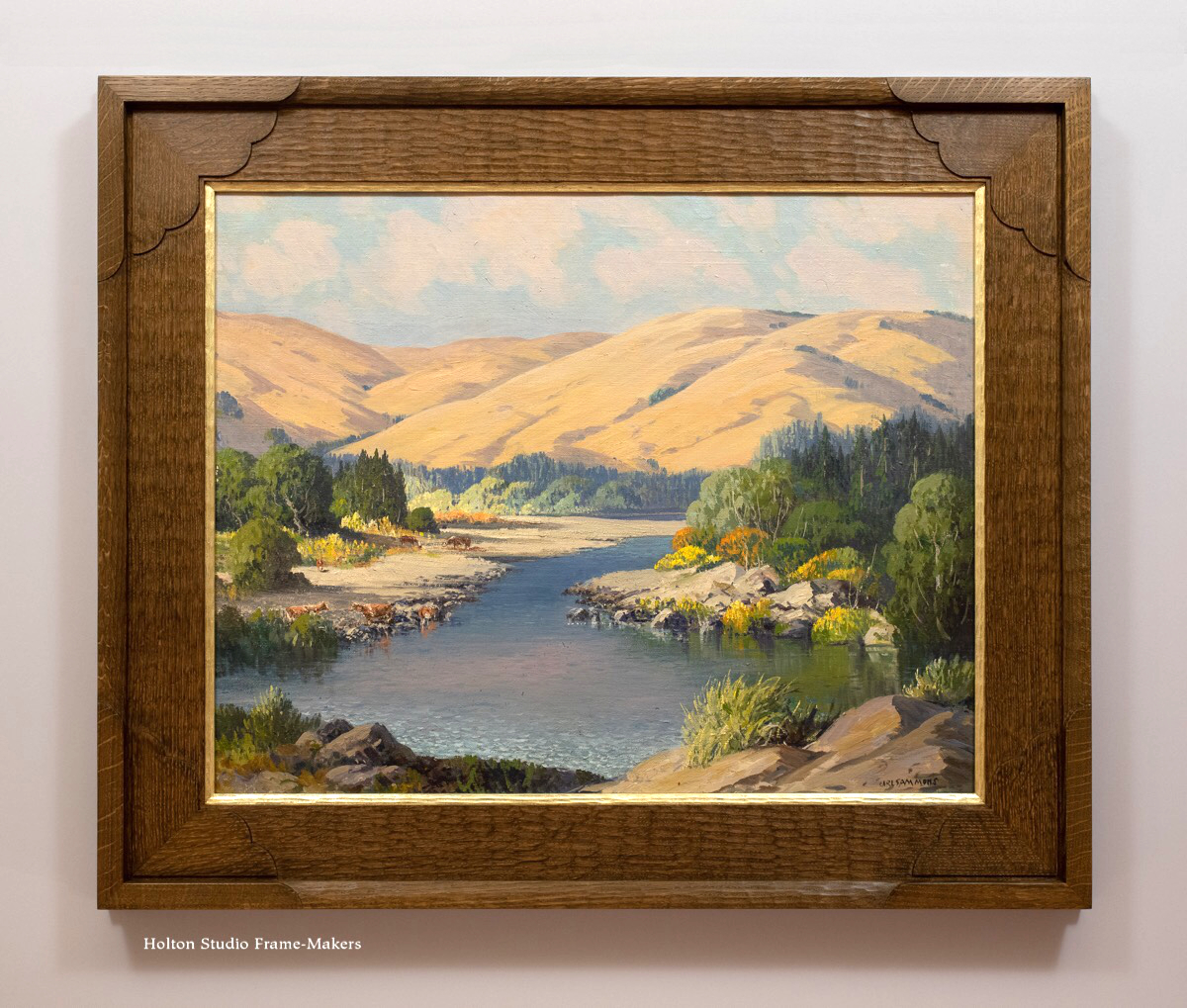
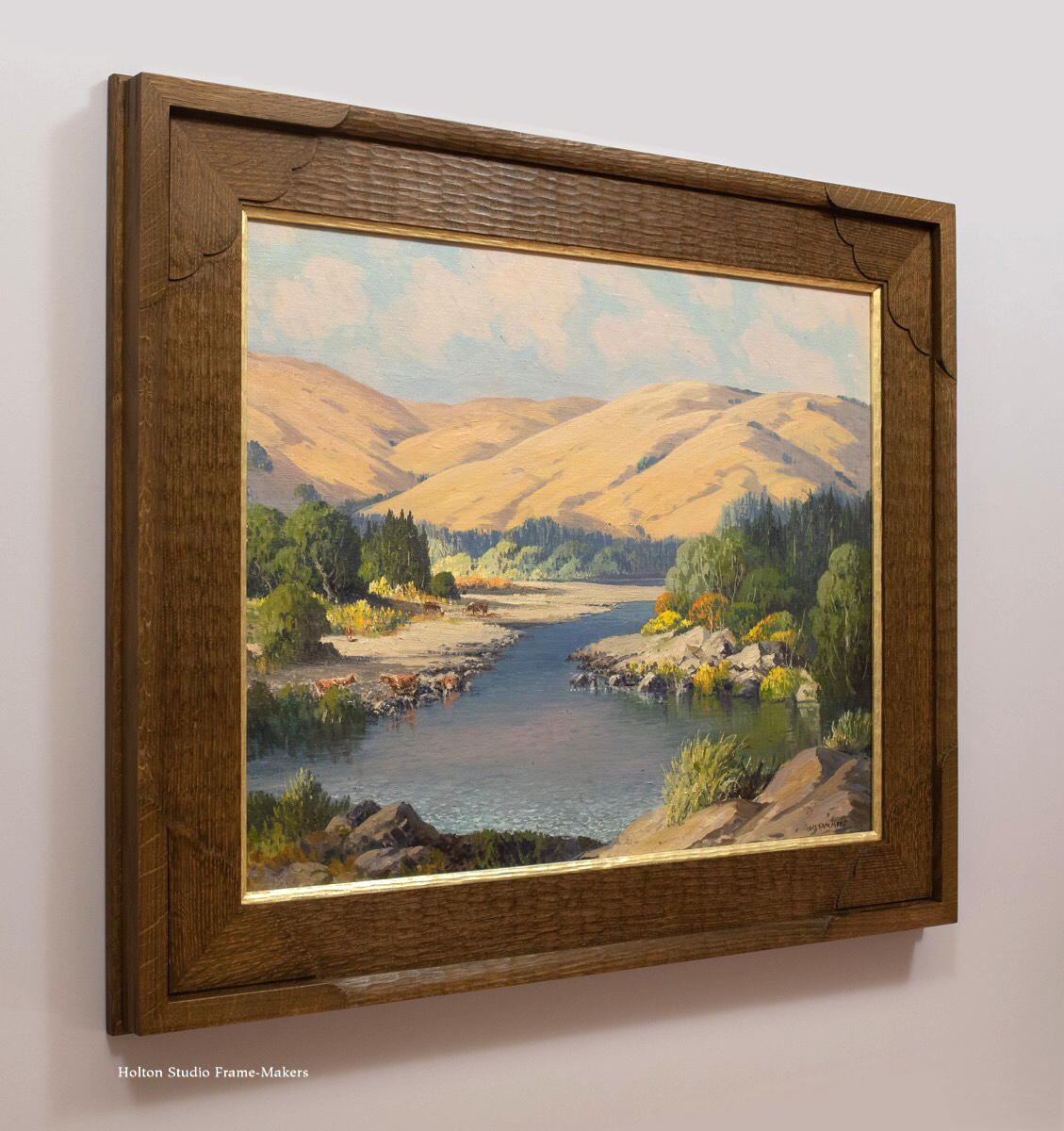
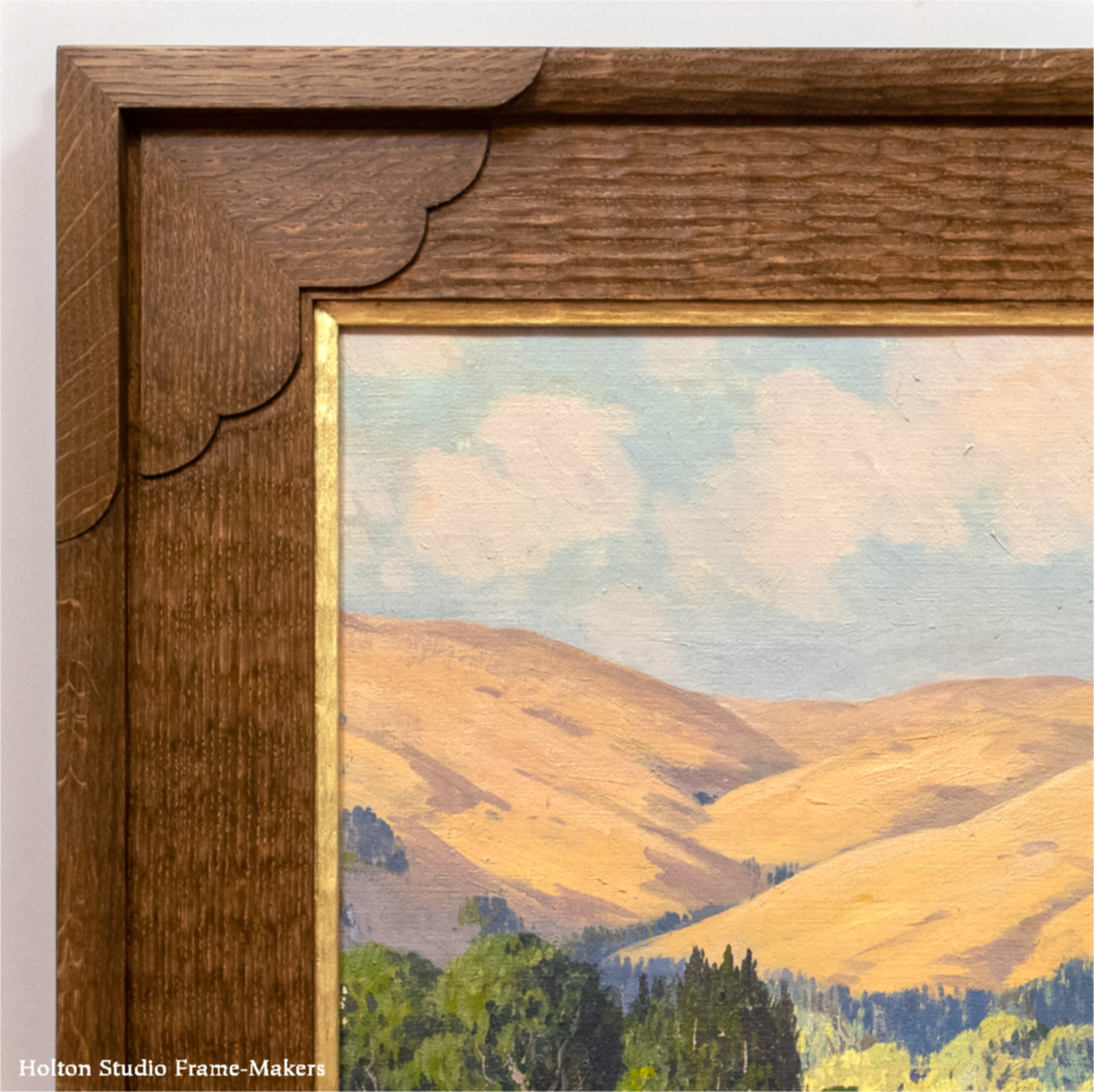
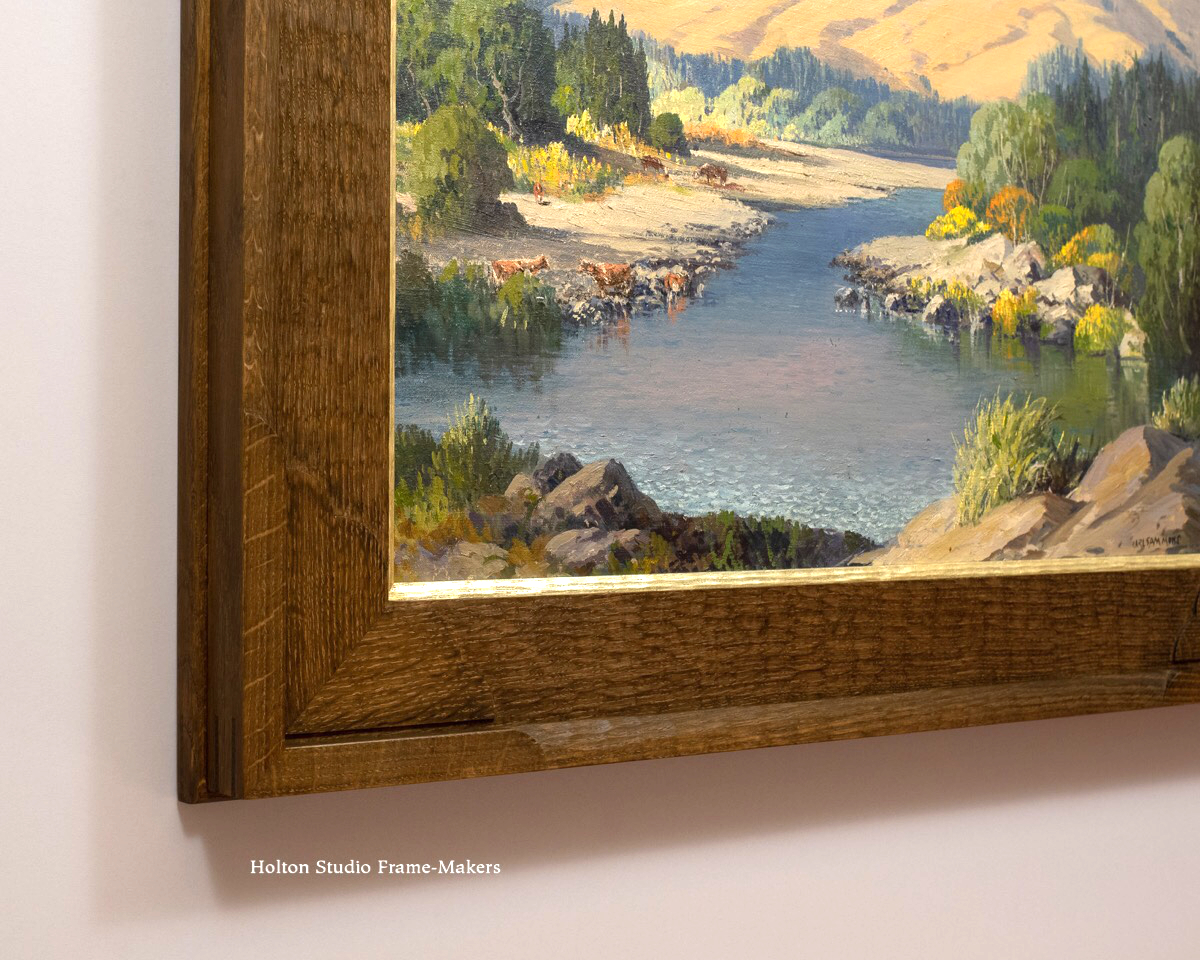
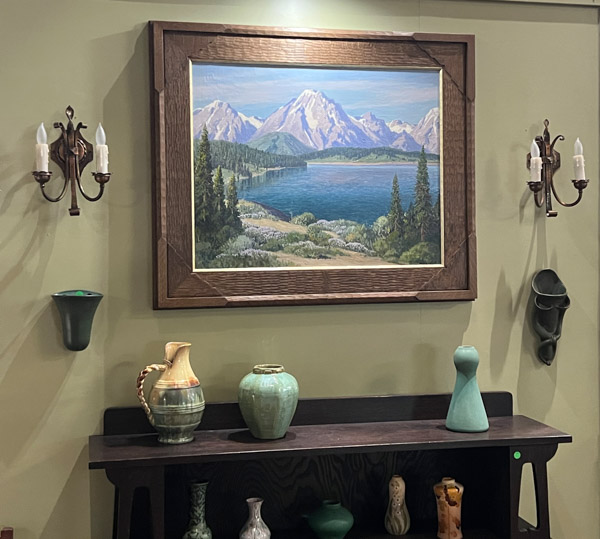
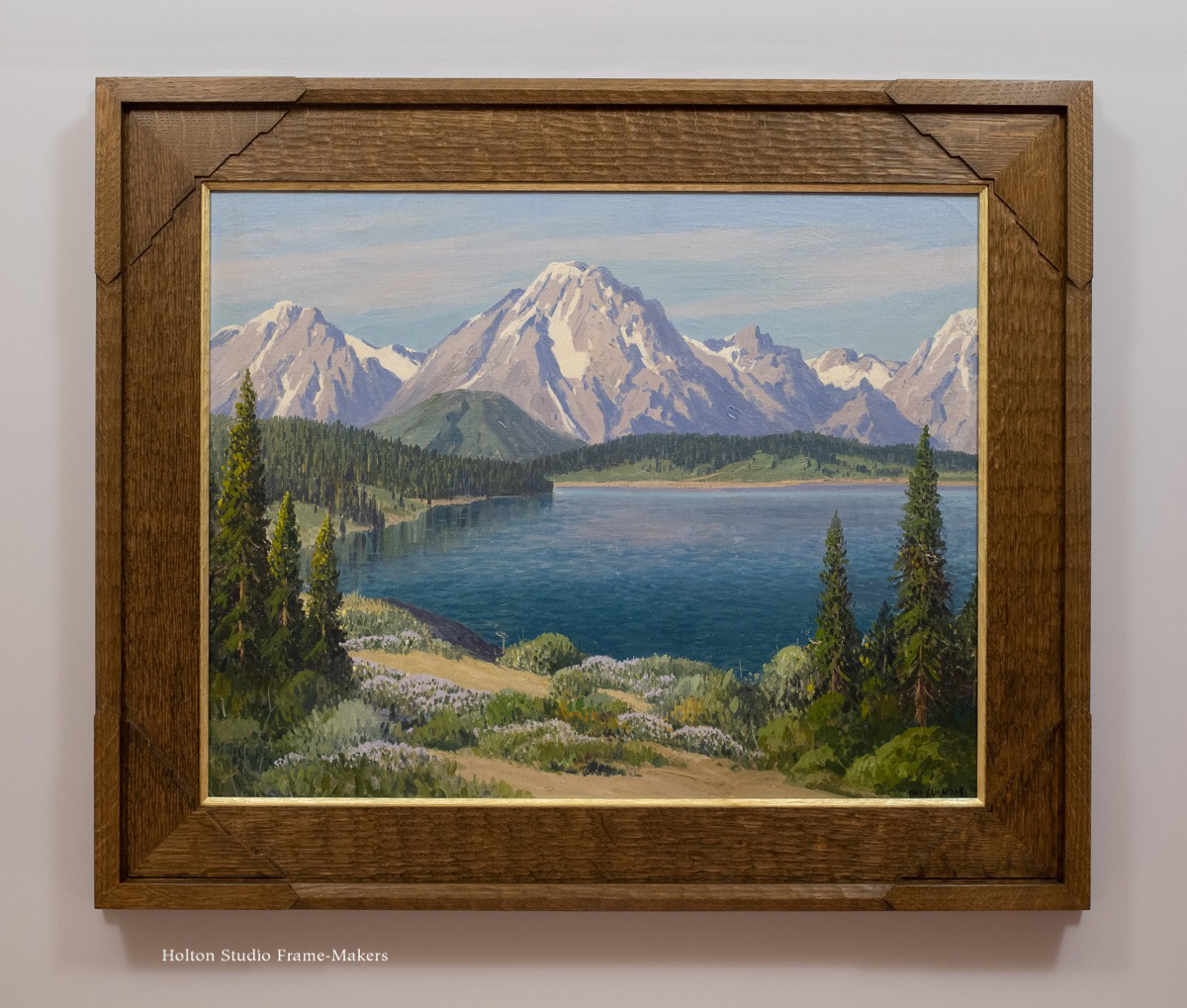
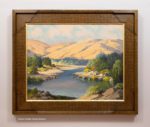
My last post featured a painting by Oakland landscape painter Carl Sammons (1883-1968), which was on display this past weekend in California Historical Design‘s booth at the National Arts and Crafts Conference at the Grove Park Inn. Carl Sammons paintingIt was actually one of a pair of 24″ x 30″ Sammonses from the 1920’s that we framed for California Historical Design. So this being no ordinary Tuesday but also “Twosday” (2/22/22), it seemed fitting to post the second of the pair. As you can see, the frame design for this one is similar in approach to the first, but different, each of the two frames carved with patterns adapted to their respective paintings—the peaked crown and zig zag pattern for the rugged mountains and the rounded crown and scalloped corners for the rolling hills. (This one below, showing the Russian River, is available here. The first one, shown at right, “Mt Moran—Jackson Lake—Teton Mountains, Wyoming,” is available here.)

Like the frame on the Mt Moran painting, this one is also a compound made by Trevor Davis in carved quartersawn white oak, 4″ wide, with a carved gilt liner.

Framing Carl Sammons—and Hanging at The Grove Park Inn

This weekend is the 35th Annual National Arts and Crafts Conference at The Grove Park Inn in Asheville, North Carolina, and our friend Gus Bostrom of California Historical Design in Alameda once again has a big, beautiful booth displaying antique furniture, pottery, metalwork—Carl Sammons paintingand a few notable paintings we framed for him, including this mountain scene by Carl Sammons (1883-1968). The 24″ x 30″ canvas, titled “Mt Moran—Jackson Lake—Teton Mountains, Wyoming,” is from the 1920’s. More on Gus’s site, here.

The compound mitered frame, made by Trevor Davis, is carved quartersawn white oak (Medieval Oak stain) with a pale gold liner. The outer cap molding has a peaked shape to echo the mountain peaks, but which is interrupted at the corners which are flat. The broad, carved inner flat molding nicely echoes the surface of the water. The corners of the flat are raised with a diagonal zig zag pattern.

This is one of a pair of 20″ x 24″ Sammons paintings Gus brought to us and which we framed in similar but different frames. Read about the second one in my next post.Carl Sammons painting

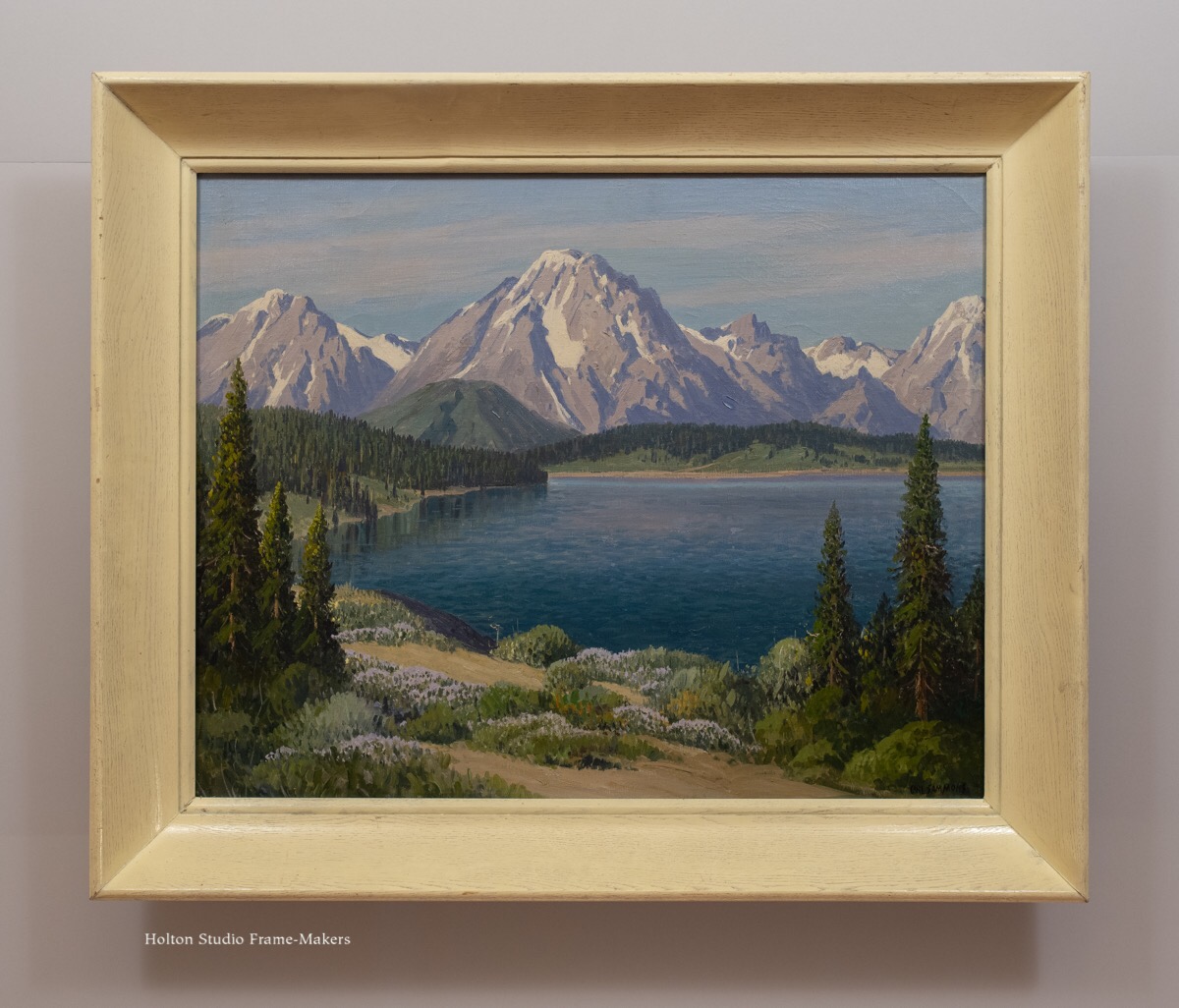
By the way, here’s the frame it came to us in:

Carl Sammons painting in white frame

Here are more pictures featuring our frames as part of California Historical Design’s display at the Arts and Crafts Conference.

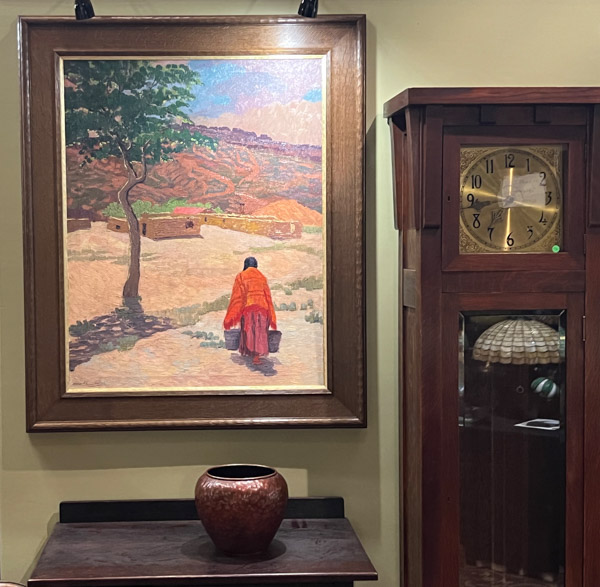
Laura Armer painting

This is Laura Adams Armer’s “Hopi Woman Oraibi Village,” 1929. (I posted on this one here.)

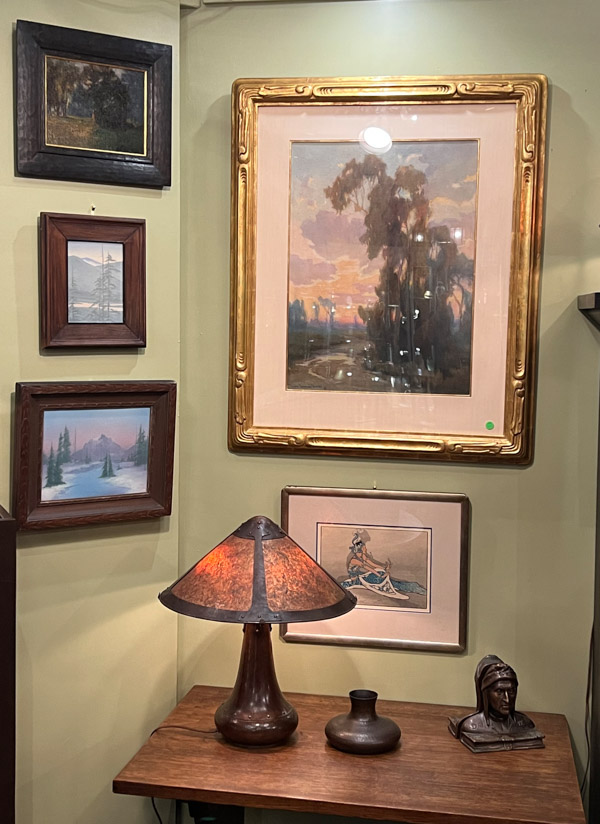
paintings displayed at Grove Park Inn

The one at the top left is a terrific Will Sparks from the 1910’s. (More here.)

two paintings

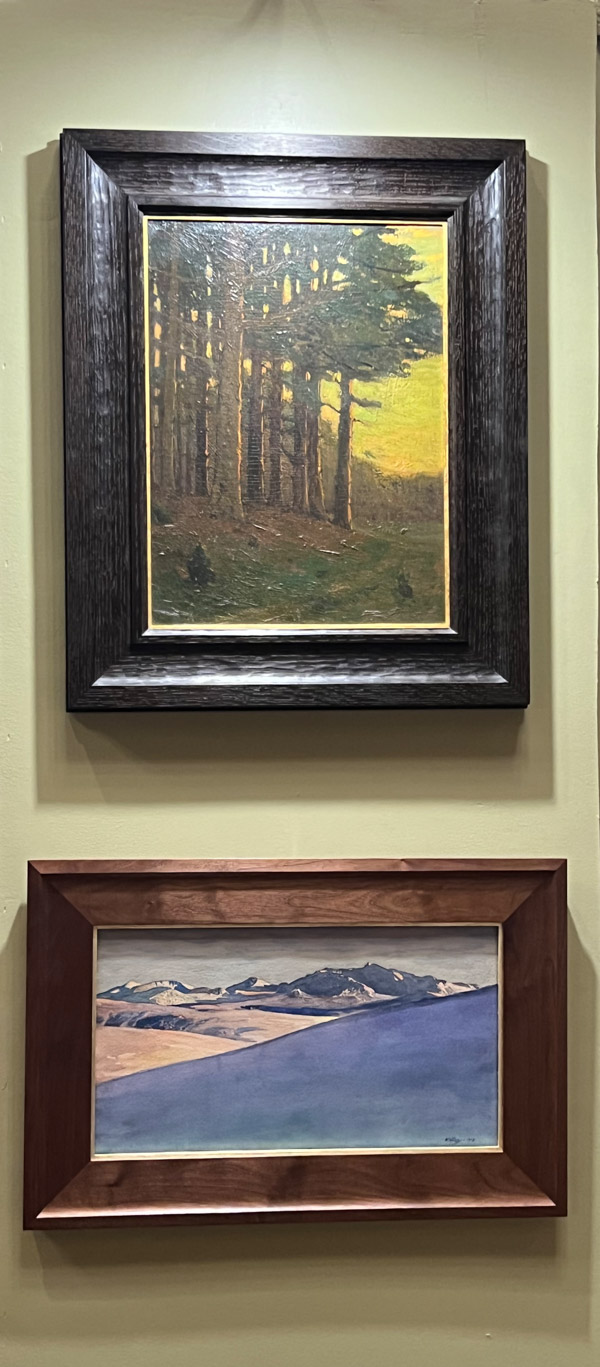
An oil painting by Charles Warren Eaton (1857-1937), “Entrance to the Woods, Bloomfield, NJ,” ca. 1910 (more here.), hangs above a 1918 watercolor of mountains in Sweden, by Gunnar Mauritz Widforss (more here).

California Historical Design’s website is ACStickley.com.

Have a great show, Gus!

Carl Sammons paintingGo to the next post to see the companion to the Sammons painting featured above.

Keep the Beast Happy: Framing Milivoj Ćeran’s “Jormungandr”

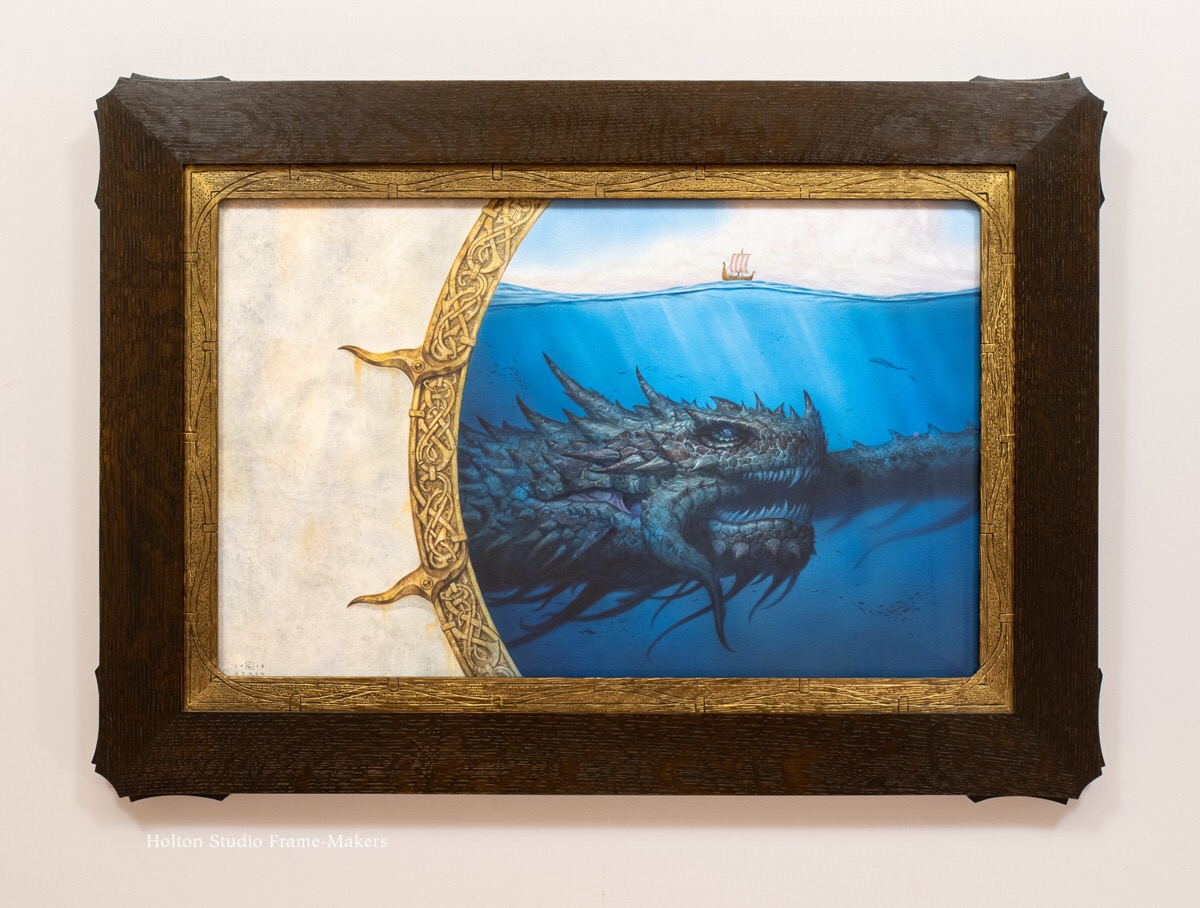
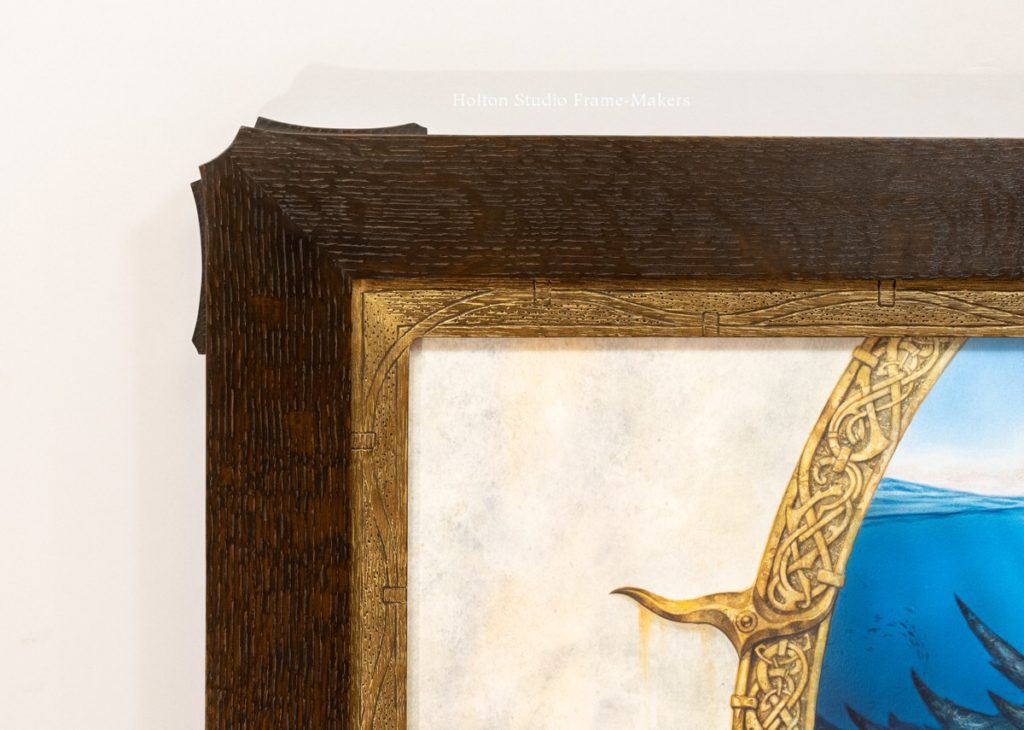
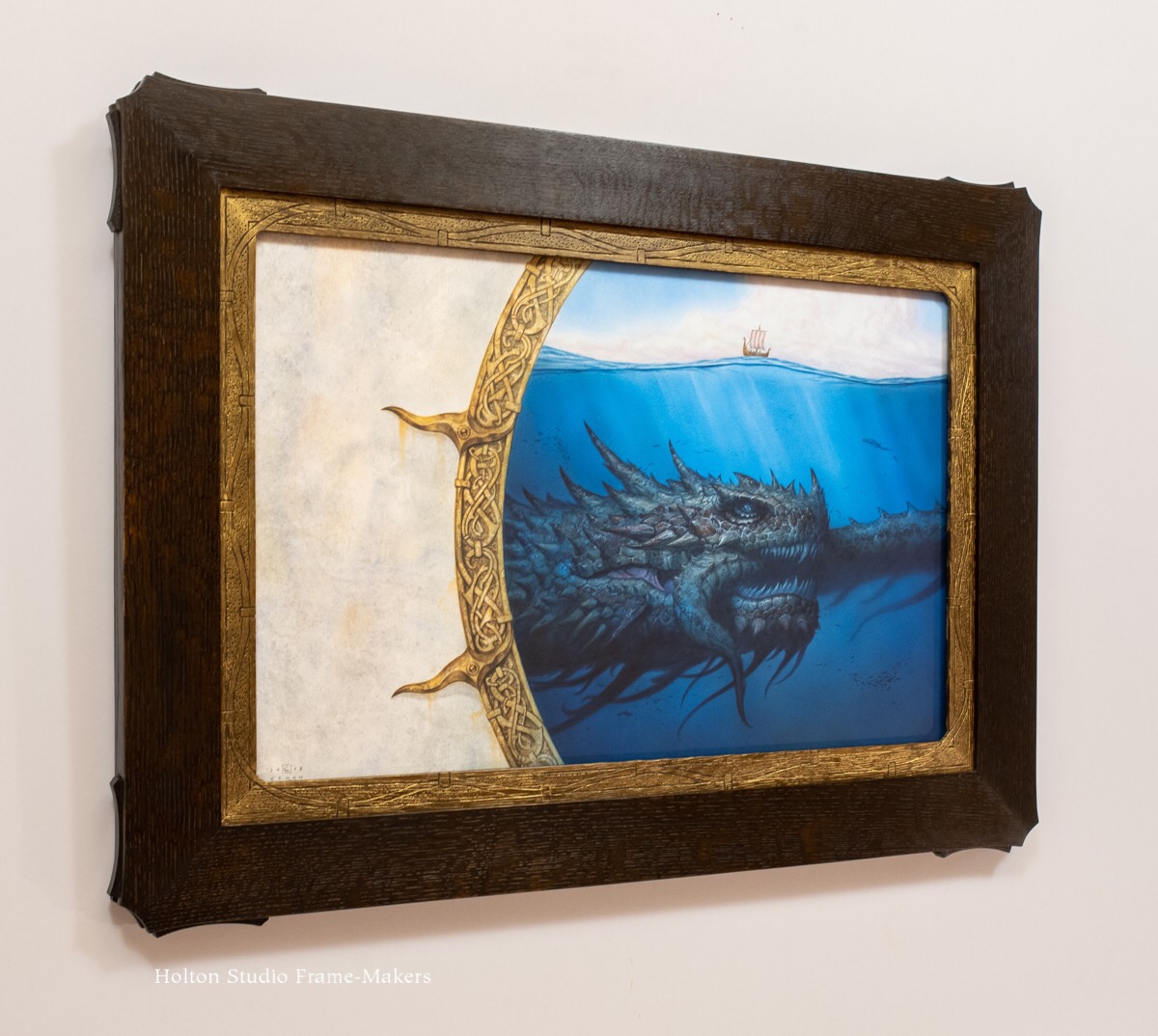
It’s hard to think of another realm today where human beings unleash our imaginations more than we do in science fiction. The Studio recently had the great privilege of framing a painting born of the extraordinary imagination of Croatian artist Milivoj Ćeran, 2018 winner of the European Science Fiction Society‘s Best Artist Award. Known as an illustrator for the massively popular trading card game, Magic: The Gathering, Ćeran is also the creator of “The Norse Mythology Art Book,” for which he painted “Jormungandr.” The story is that Jormungandr is a deep sea serpent who grew so large that he circled the globe and was able to bite his own tail.

M Ceran painting, Jormungandr

Milivoj Ćeran, “Jormungandr,” acrylic and airbrush on paper, 15″ x 23-1/2″.

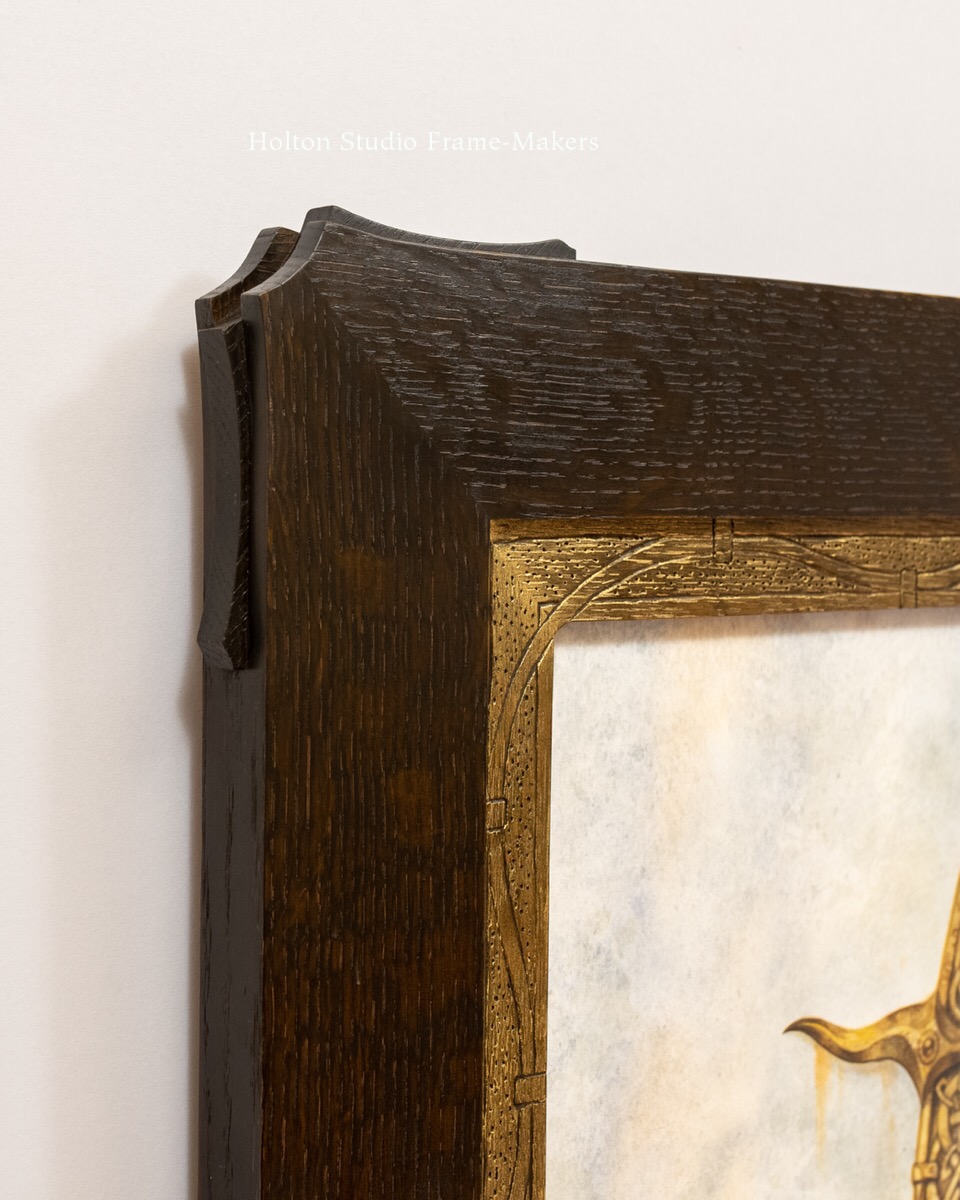
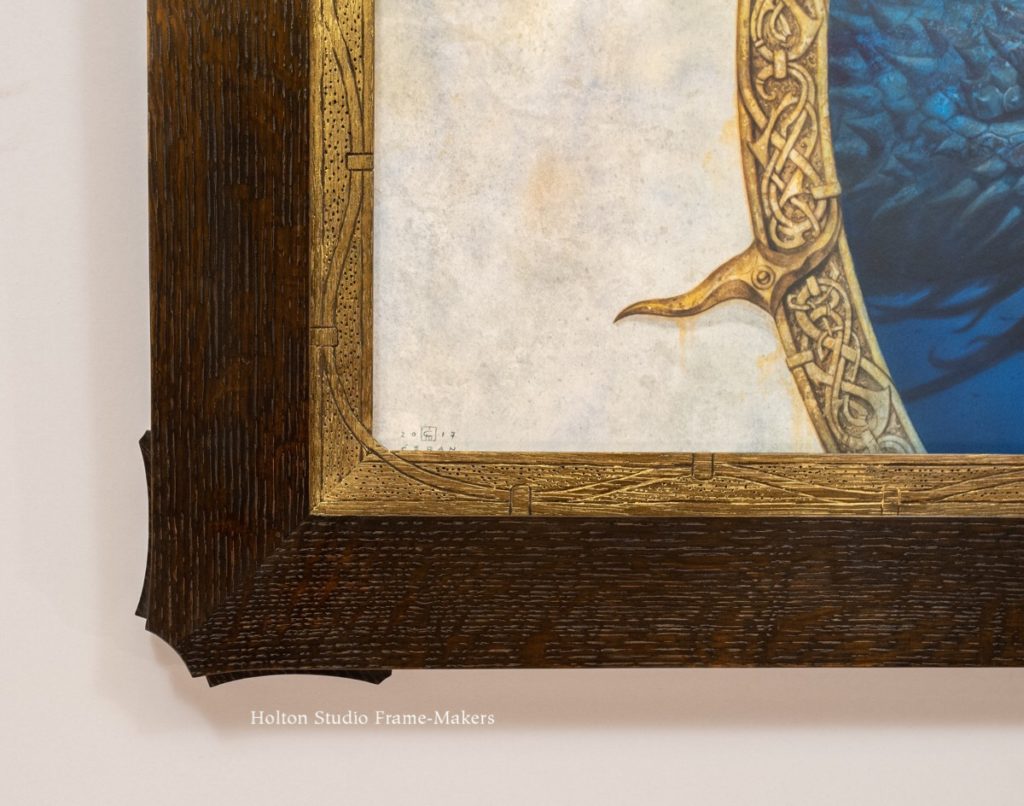
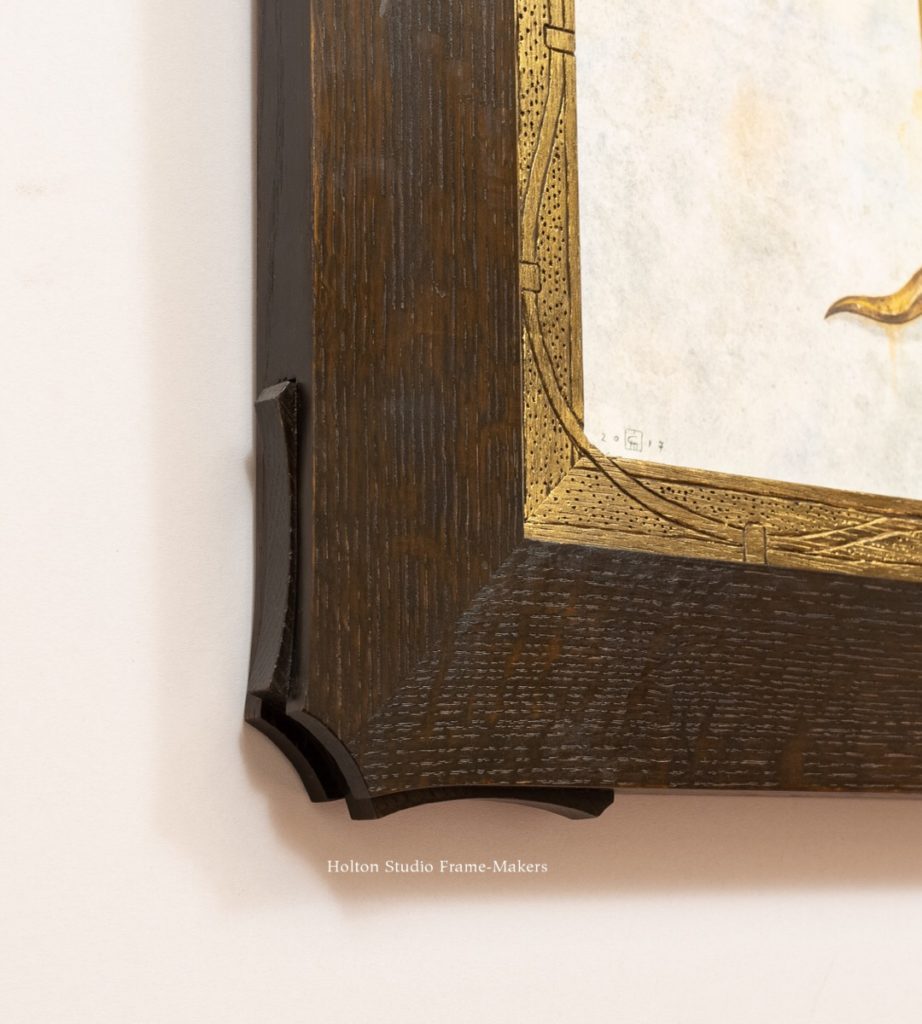
Frame detail for M Ceran painting, JormungandrSuch a work of imagination pushed my own creativity. I got a good nudge from the frame actually depicted in the painting: the decorative brass border around a ship’s porthole. (A picture is a window; sometimes it’s a porthole.) From that I came up with the carved 1″ wide bronze powder-rubbed liner. Attempting Ćeran’s masterful knot work would have been foolhardy, and too busy in any case. But a simplified pattern, a serpentine band quietly winding all the way around to resonate with the picture’s subject, felt right.The carving is flat rather than in relief, the pattern simply outlined with a v-shaped carving tool (v-tool) and the background stippled.

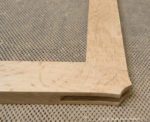
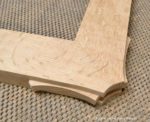
The main frame is a 2-1/2″ plain flat profile, but with corners articulated and decorated with a new way of using proud splines: instead of being proud all the way around the corner, the splines are partially recessed. The curves repeat those of the water line, while the slight flair and double points at the corners are echoed and amplified by the splines, the resulting composition of points playing off the spiny monster.

The whole frame is stained quartersawn white oak.

The customer and artist were both pleased. (“The frame is absolutely stunning!,” Mr. Ćeran wrote on a Facebook post with a photo of the piece.) But the crucial thing was to give the great serpent a distinguished, honorific setting that will keep the beast happy. Because, as the story has it, if Jormungandr lets go of his tail, that’s when Ragnarök happens. We can only imagine.

Picture Framing Magazine featured this piece as the Design of the Month in April 2023. More…

Frame detail for M Ceran painting, Jormungandr

Process—

Reveling in the Tradition: Framing Erik Tiemens for Beloved California VI

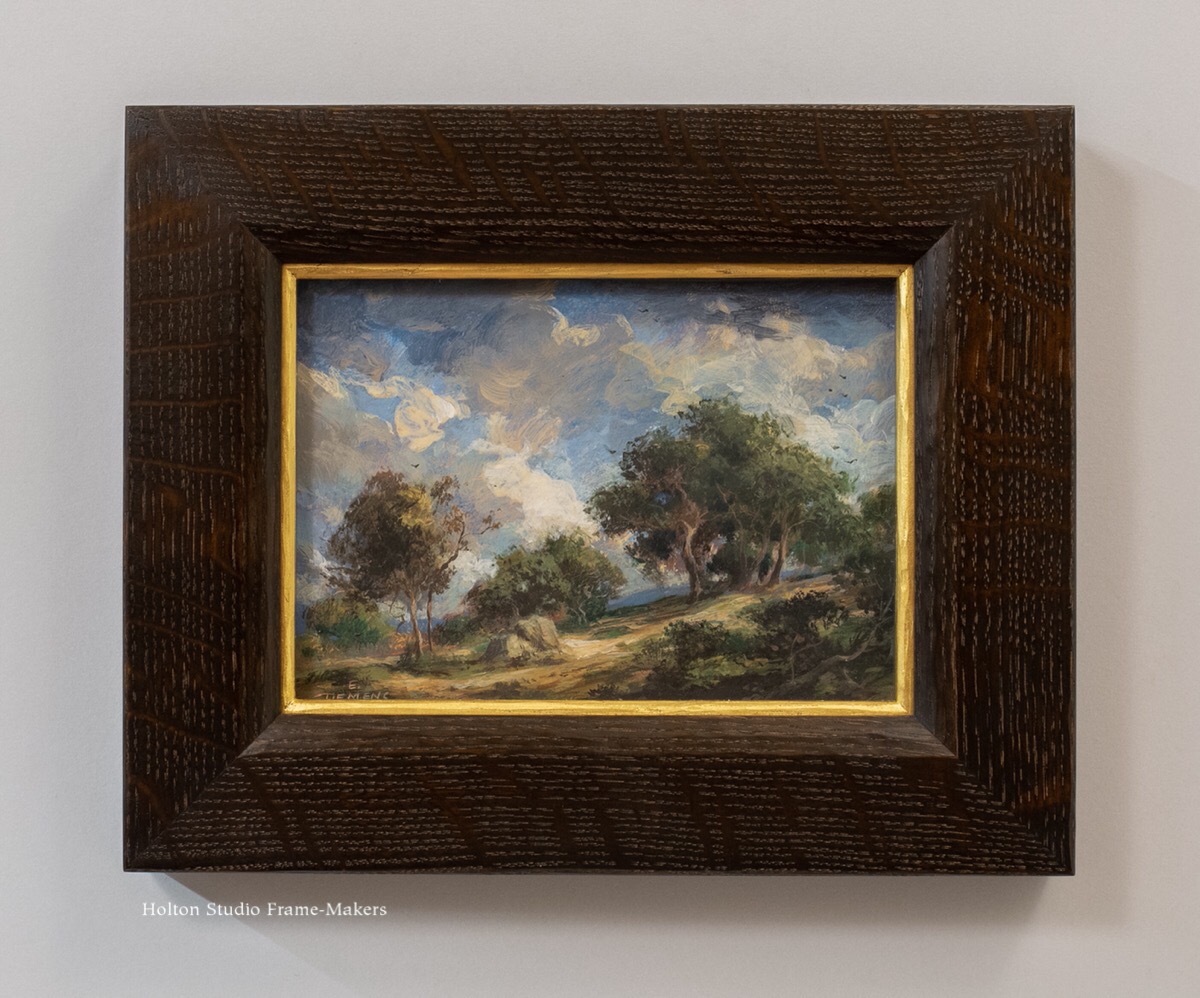
There’s something uniquely rewarding for us in framing Erik Tiemens‘s paintings. The first three here, brand new for Beloved California VI, we set in quartersawn white oak with Dark Medieval Oak stain and gilt slips.

Erik Tiemens

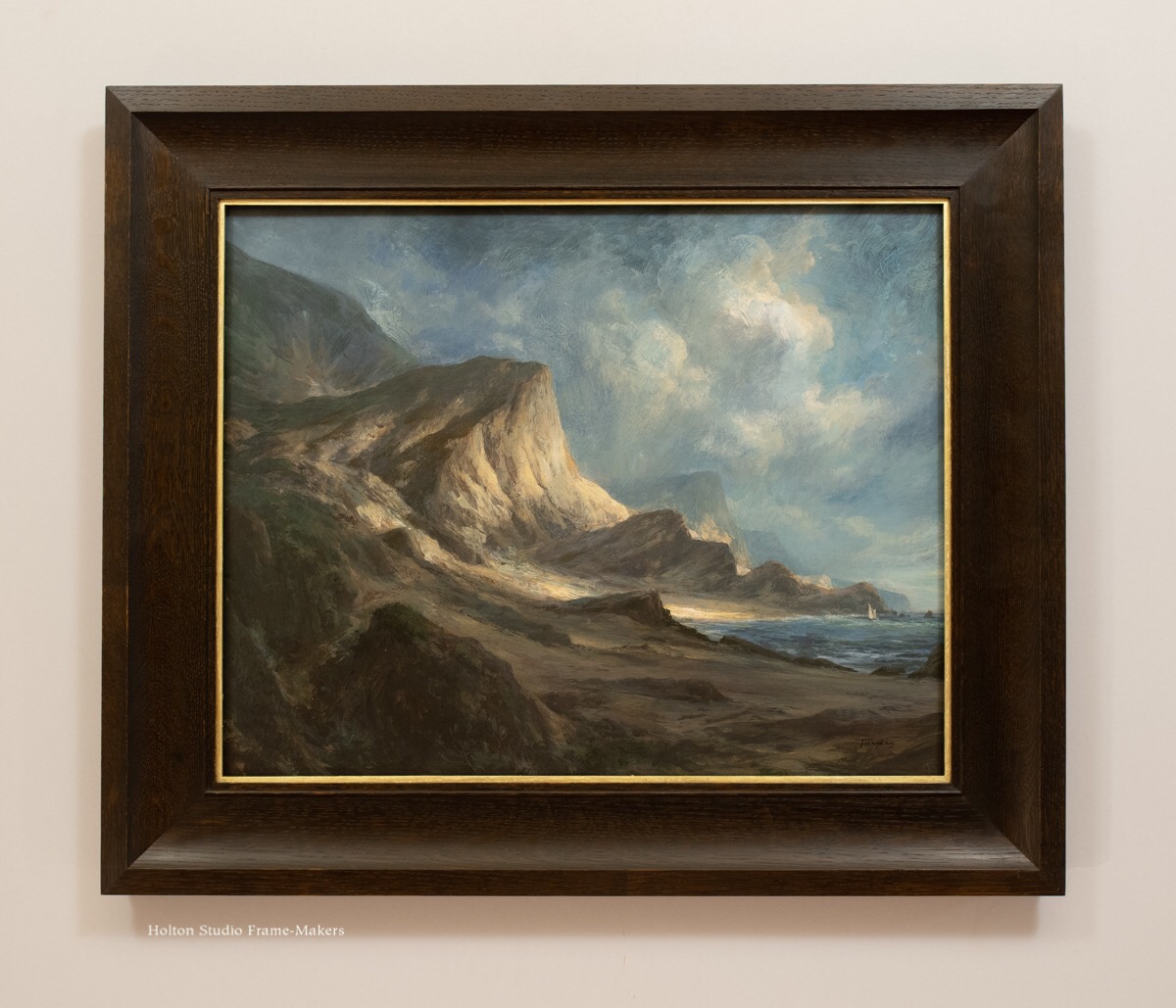
Erik Tiemens, “Cliffs Before the Farallons,” water-soluble wax paint on wood panel, 16″ x 20″.

Why are Erik’s paintings so rewarding to frame? For one thing, his depiction of form always offers something to inspire the shape of the profile. The artist loves to let his imagination play with clouds, the land, and its features—”Cliffs Before the Farallons” being no exception. (It was fun to let the dramatic sweeping coastal geology shape the frame into a nice scoop.) A vigorously creative conversation between his own native California and those landscapes of his artistic forebears in the genre gets filtered through Erik’s masterful rendering skills with which he so beautifully defines gradations.

Erik Tiemens painting

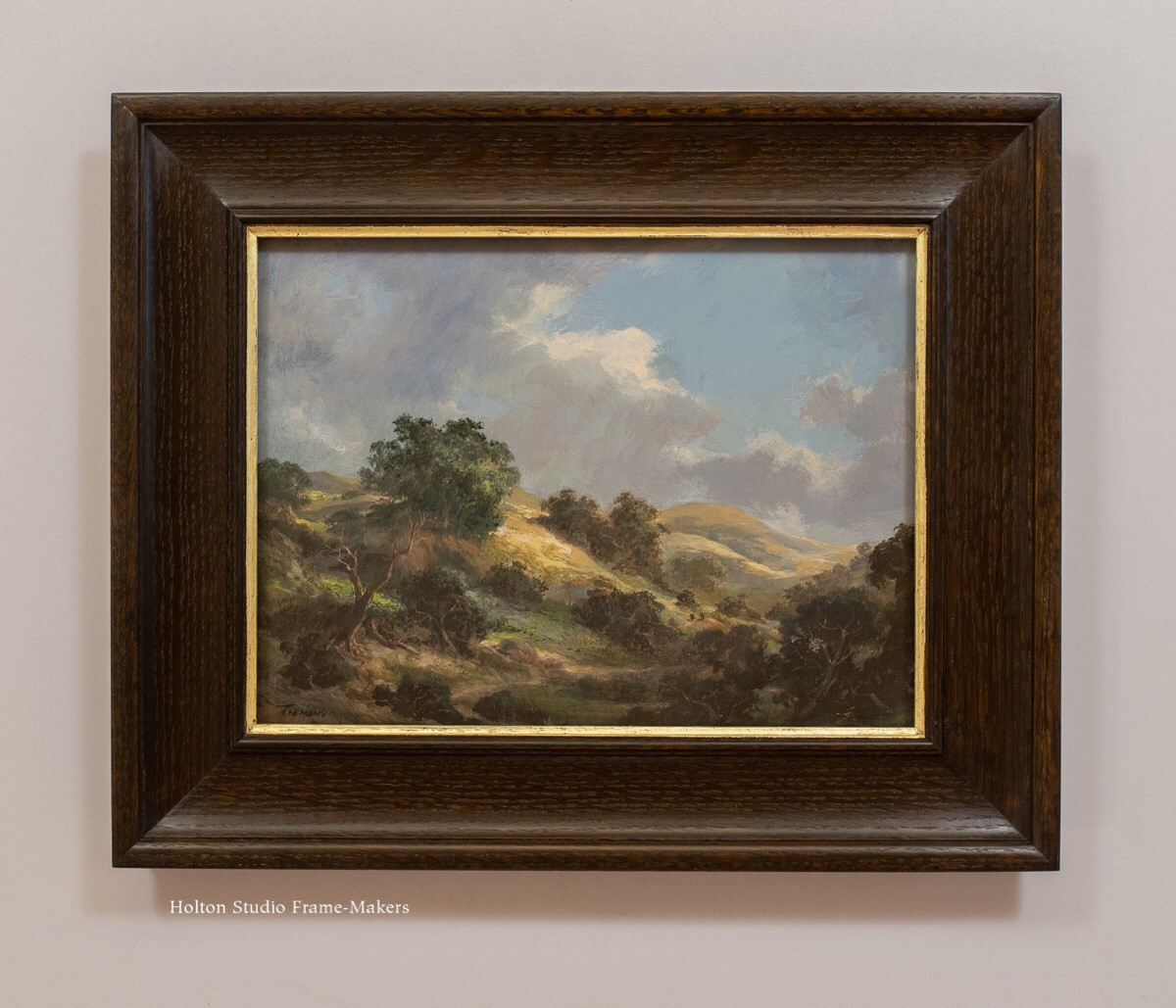
Erik Tiemens, “Gainsborough’s Path,” water-soluble wax paint on wood panel, 9″ x 12″.

And then there’s the painter’s exceptional ability to paint light that makes the complementary shadow effect of dark wood frames so satisfying to the eye.

There’s also the fact that he and I are so sympatico in regards to the whole understanding of tradition as something to which we belong, and as a great vital well that truly belongs to us all—a view that (contrary to what many seem to believe) is an immeasurable source of creative freedom.

While Erik’s work in the film industry has placed him on the cutting edge of technology, it’s the way the artist revels in art history that best explains his creative genius. That aspect is the focus of an excellent interview with Erik last month in the online art magazine Boldbrush. Below are a few excerpts, beginning with his earliest artistic influences.

Erik Tiemens painting

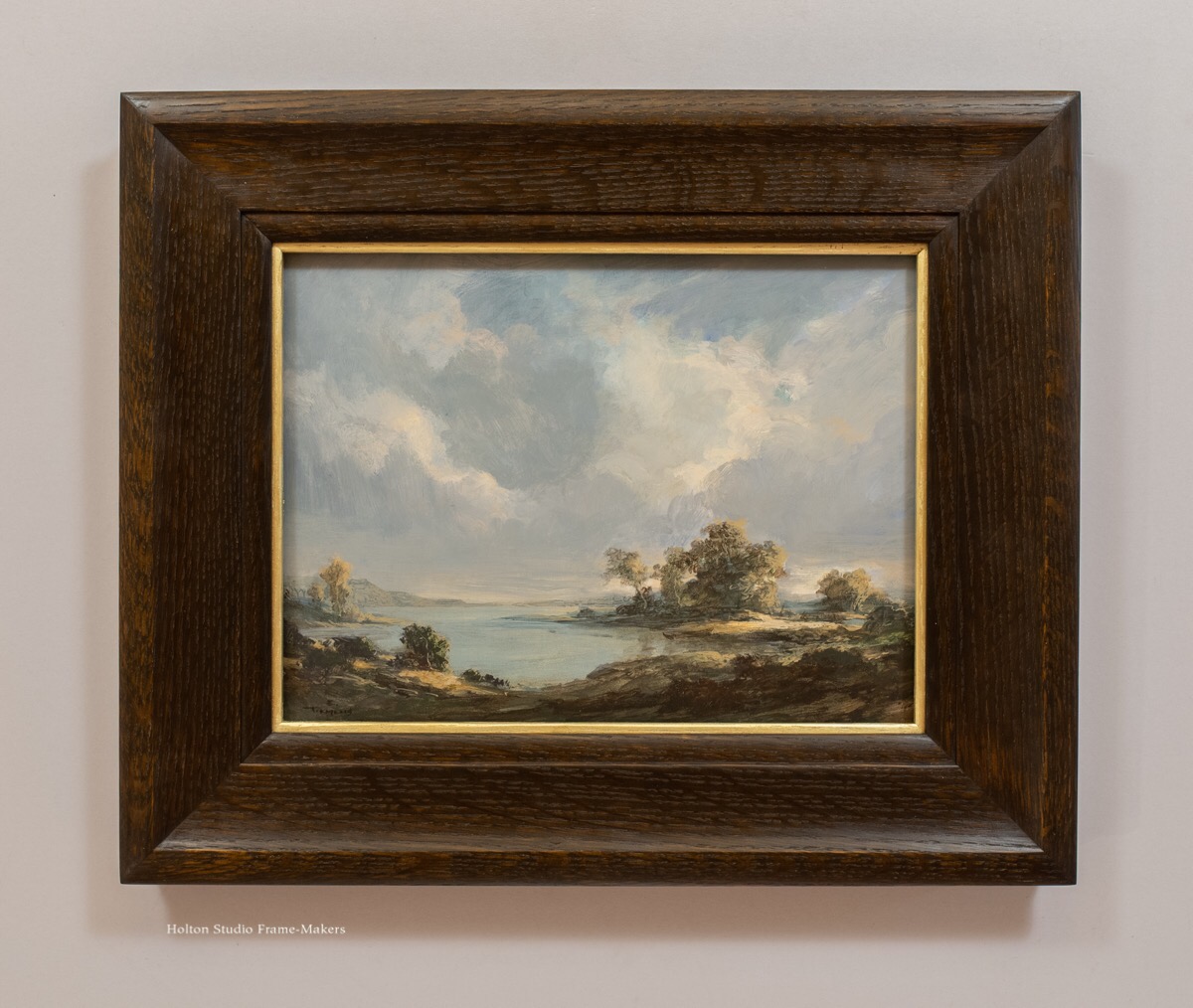
Erik Tiemens, “Lagoon of Tranquility,” water-soluble wax paint on wood panel, 9″ x 12″

“I was very fortunate to have a childhood surrounded by art and music… My mom was a ballerina, so I was constantly exposed to dance and classical music as a kid.

At one point she did flamenco dancing as well, so there was a wide variety of cultural influences. There’s something about the rhythms of elaborated concentration in Bach and Mozart that made me want to tap into creativity and make something that was just as beautiful, intuitive, and focused. My expression found itself in the visual arts rather than music, though – when I was seven, my family moved from Los Angeles to the Santa Cruz Mountains and I remember distinctly the change in the light from one place to the other, from the brilliant blown-out light of LA to the cool tree-dappled light of Redwood country. I remember the way the sun would reach over the valley – that strong awareness of light as a sense of place has stayed with me ever since.”

Erik Tiemens painting

Erik Tiemens, “Pastoral Spring,” water soluble encaustics on wood panel, 5″ x 7″.

Erik, like several of our artists (including Terry Miura who first told me about him), studied at Art Center College of Design, during which time he landed an internship at Disney doing animation layout.

While he enjoyed the work, during his time there he got to see the work of the background painters and realized that was what he really wanted to do. “I was going outside to do plein-air studies on my lunch breaks anyways, and I realized that the background painters were really just doing landscapes—I thought that was an awesome job, painting landscapes for your day job.”

It was just the first step in a stellar career in film and animation. And I do mean “stellar”: Erik went on to work for George Lucas’s Industrial Light and Magic, where he played a key artistic role in the making of several Star Wars movies.

But [Erik’s always] also wanted to paint as a fine artist, and over the years he has consistently maintained both traditional painting and digital concept art side-by-side as complementaries. “Painting for film design is a very similar skill set to plein-air; you have to work rapidly, catch the light, look at the big shapes and patterns. Over the years I’ve maintained a fairly rigorous plein-air painting practice – I paint outside every week – and I use the knowledge from these studies to inform my concept work as well as my studio landscapes.”
The influences Erik cites reveal him as an artist of enormous artistic appetite. Inspirations he lists include George Inness, Claude Lorraine, Richard Wilson, John Singer Sargent, Joaquin Sorolla, Anders Zorn…

The Impressionists, the Hudson River School, Turner, Constable – the list goes on and on. “In the past ten years, I’ve been going back to the old masters a lot. Van Ruisdael, Rembrandt, Meindert Hobbema. My father is from the Netherlands, so that curiosity to connect to the past is very personal in the case of the Dutch painters. I really love the play of light and dark that is traditional in the Dutch landscape – the clouds casting patterns of shadow on the landscape, the way the composition draws your eye in and through the piece. A few years ago I went to the Netherlands and spent ten days doing a deep dive into the Dutch landscape—hours at the Rijksmuseum, hours roaming the countryside and just geeking out over the way the light and the feel of the land is exactly the way the masters captured it in their work.”
Erik frequents art museums because, he says,

Erik Tiemens painting

Erik Tiemens, “Dance of the Clouds,” water soluble encaustics on wood panel, 5″ x 7″
“There’s the ‘You are what you eat’ aspect – as an artist you have to immerse yourself in good art in order to create good art! But aside from the aspect of learning technique and style, art history is so important to study because it’s the story of our humanity – every part of culture is filtered through an era’s artwork. I’ve been thinking a lot about the context of landscape painting in our current culture and climate. If you think about it, our national landscape is changing rapidly; the West Coast is increasingly dry and burning, while the East coast is becoming more tropical. In the context of climate change, landscapes become a very precious thing and as a painter I get to remind people of that fact.”

Precious indeed. Erik Tiemens perfectly expresses the spirit of Beloved California VI, running through December 30. Come see Erik’s paintings in person.

Read the whole Boldbrush interview, here…

Visit the artist’s page, here…

Learn more about Erik, including the water soluble encaustics he paints with...

“Test of Time”: Framing Kim Lordier for “Beloved California VI”

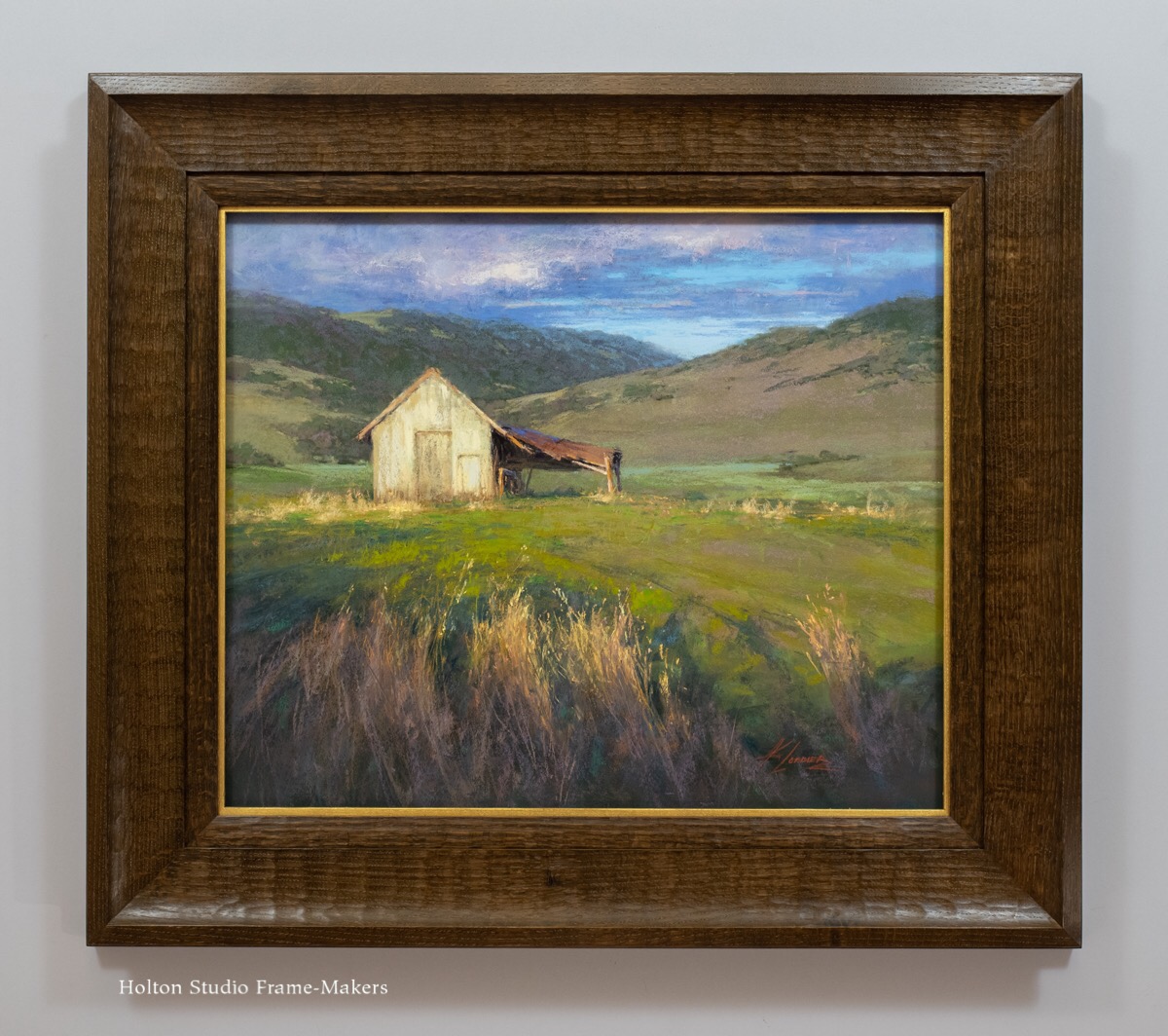
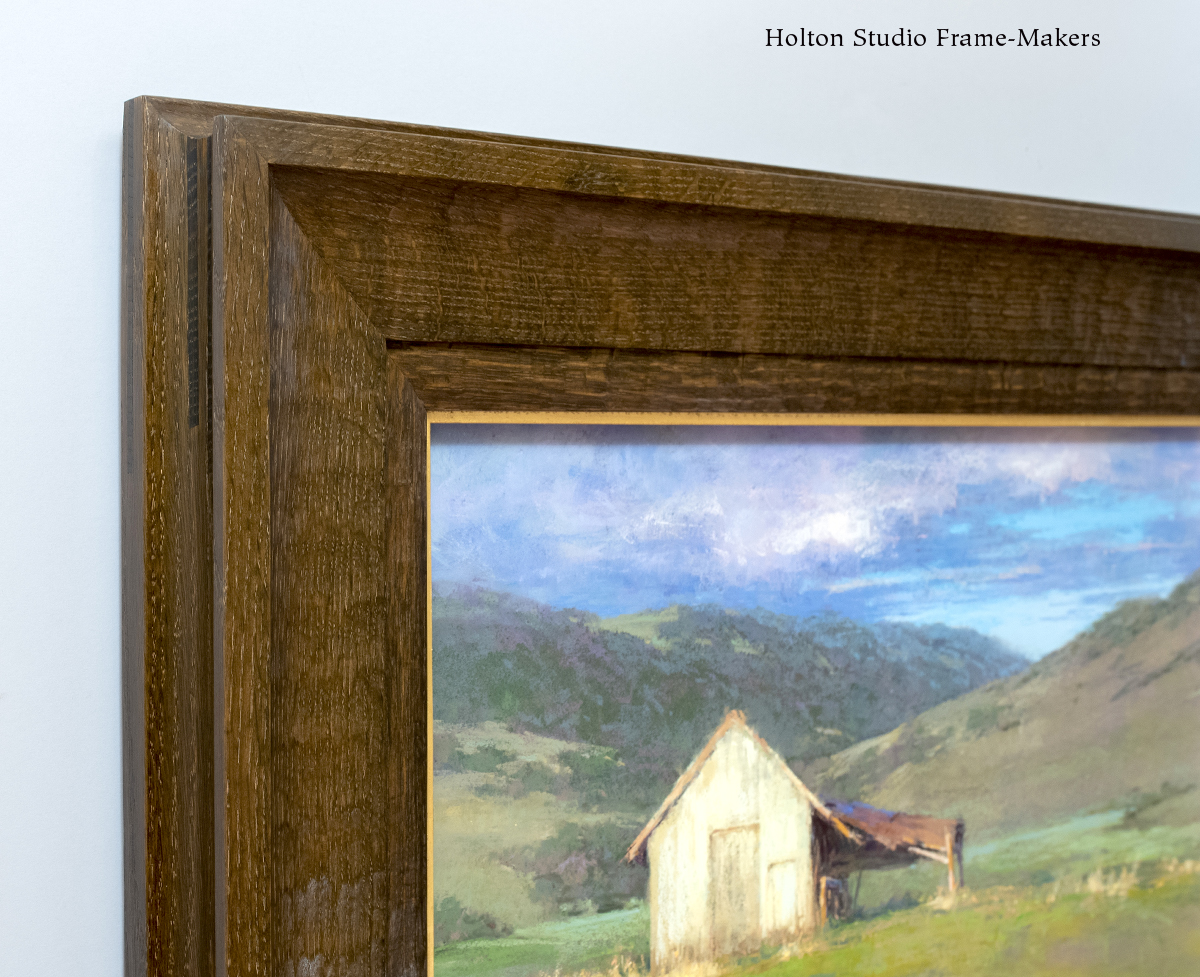
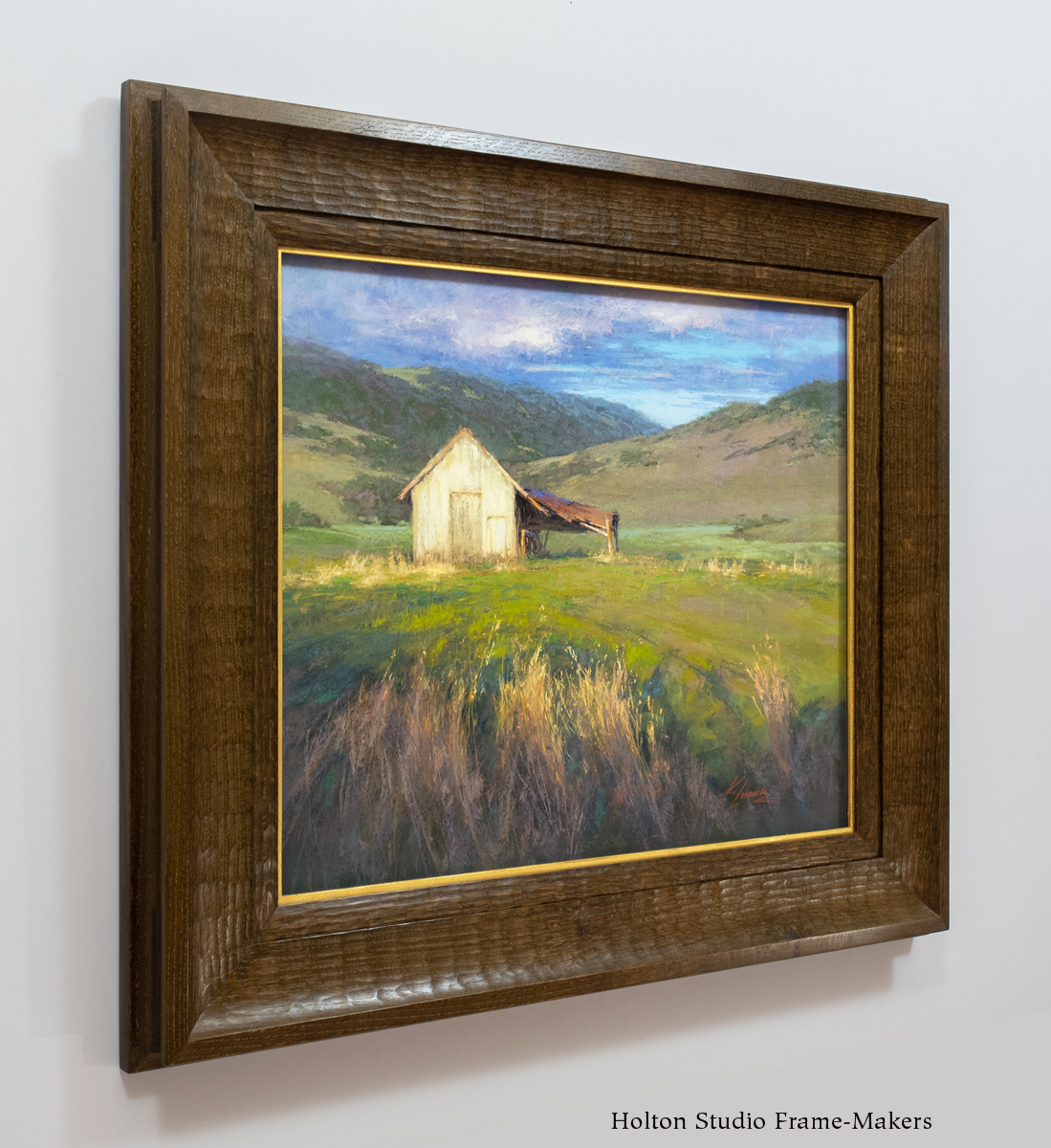
I could sing the praises of many aspects of Kim Lordier‘s 20″ x 24″ pastel “Test of Time,” beginning with the wonderful treatment of morning sunlight. But it’s the expertly rendered perspective that inspired this frame design—a surround to simply extend and amplify the force field Kim created to pull us into this iconic old California farm and its stories.Kim Lordier painting, "Test of Time"Perspective—artists since Maurice Denis (1870-1943) have rebelled against the rules of perspective and argued for painters to think of a painting as a flat surface on which to arrange shapes and colors. The idea, foundational to modernism, was often promoted in the name of artistic freedom. Fair enough. But it’s hard to think of anything more freeing—not only to the eye but to the mind and soul—than breaking through the walls, the confines, of a room by making windows. As works like “Test of Time” demonstrate, the power of perspective will always captivate us—an indispensable ingredient in the illusion of another world seen through the plain of the wall. Perspective both draws us in to that world and, reciprocally, brings that world to us.

Frame corner detailIn any case, a painting with powerful perspective is a blessing to the framer, who gets to complete the painter’s illusion with the architectural trim we expect to see around a window, and to deliver that imagined world seemingly beyond the wall into the reality of the viewer’s world.

The 4″ wide carved and stained quartersawn white oak frame made by Trevor Davis is a scoop with a complementary carved cushion element at the sight edge, finished off with a gilt slip. Like the frame for Richard Lindenberg’s “Sonoma Coast” in my last post, it has a deep back that coves out beyond the outside edge of the frame’s face.

Kim Lordier paintingFrom the fragrance of the dry grass in the foreground to the dreamy clouds and eternal blue sky over the Pacific Ocean beyond the horizon, Kim’s masterful perspective offers us transcendence. We’d be fools not to accept it.

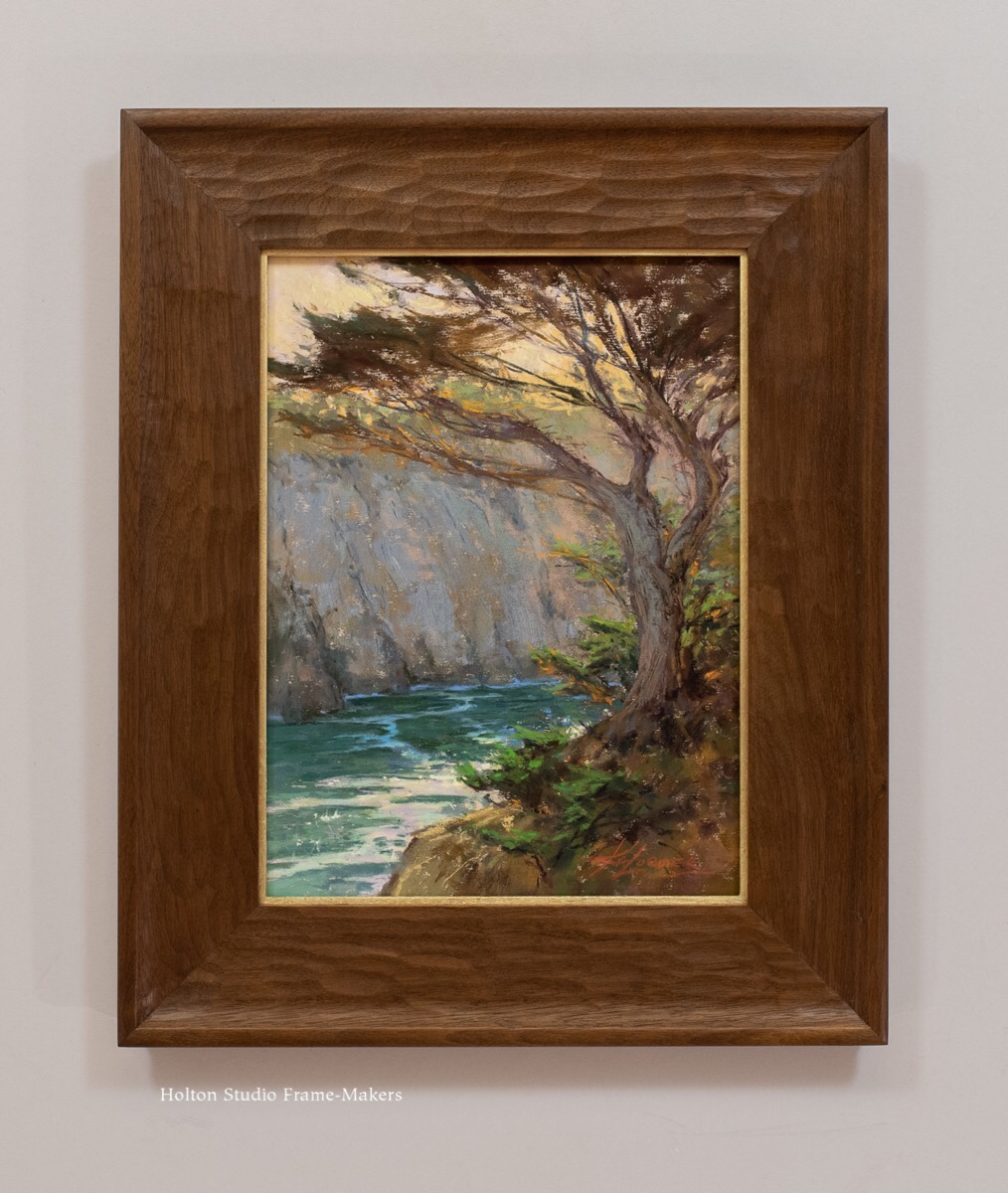
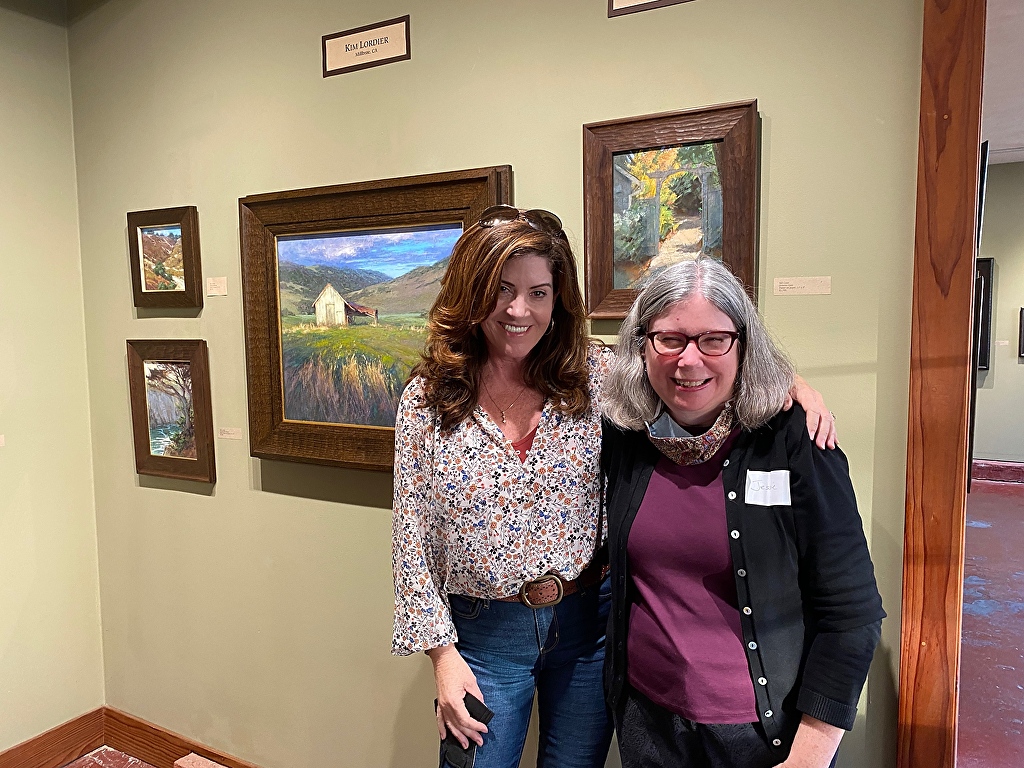
Come experience Kim Lordier‘s “Test of Time”—as well as her 12″ x 9” “Cypress Cove Dance,” at right—in “Beloved California VI: Twenty Painters with a Passion for Place.” Jessie did an excellent job hanging the show last week, and we had a terrific opening this past Saturday with much admiration expressed by attendees. I hope you’ll come see the exhibit. It’s on through the end of the year. (To view it and purchase work online, click here…)

Kim Lordier painting, "Test of Time"

Kim Lordier and Jessie Dunn-Gilbert

Kim Lordier and Jessie Dunn-Gilbert, Gallery Director, at the opening of Beloved California VI, with ”Test of Time” in the background.

Framing Richard Lindenberg for Beloved California VI (Opening Today!)

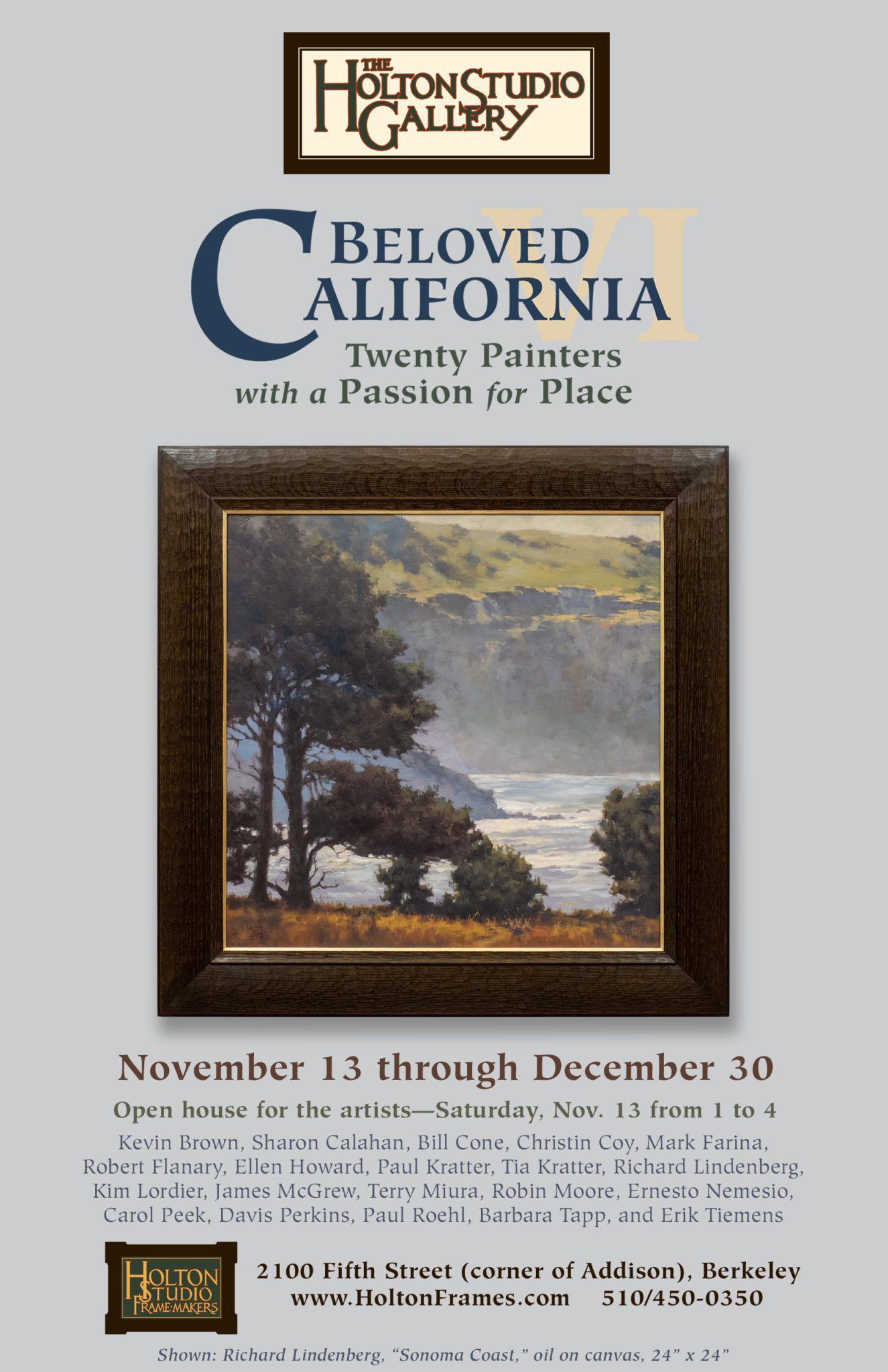
Our big annual all-gallery show opens today! Beloved California VI: Twenty Painters with a Passion for Place features more than 60 wonderful works by our entire roster of Northern California landscape painters. Nearly all the paintings are on view in the gallery for the first time.

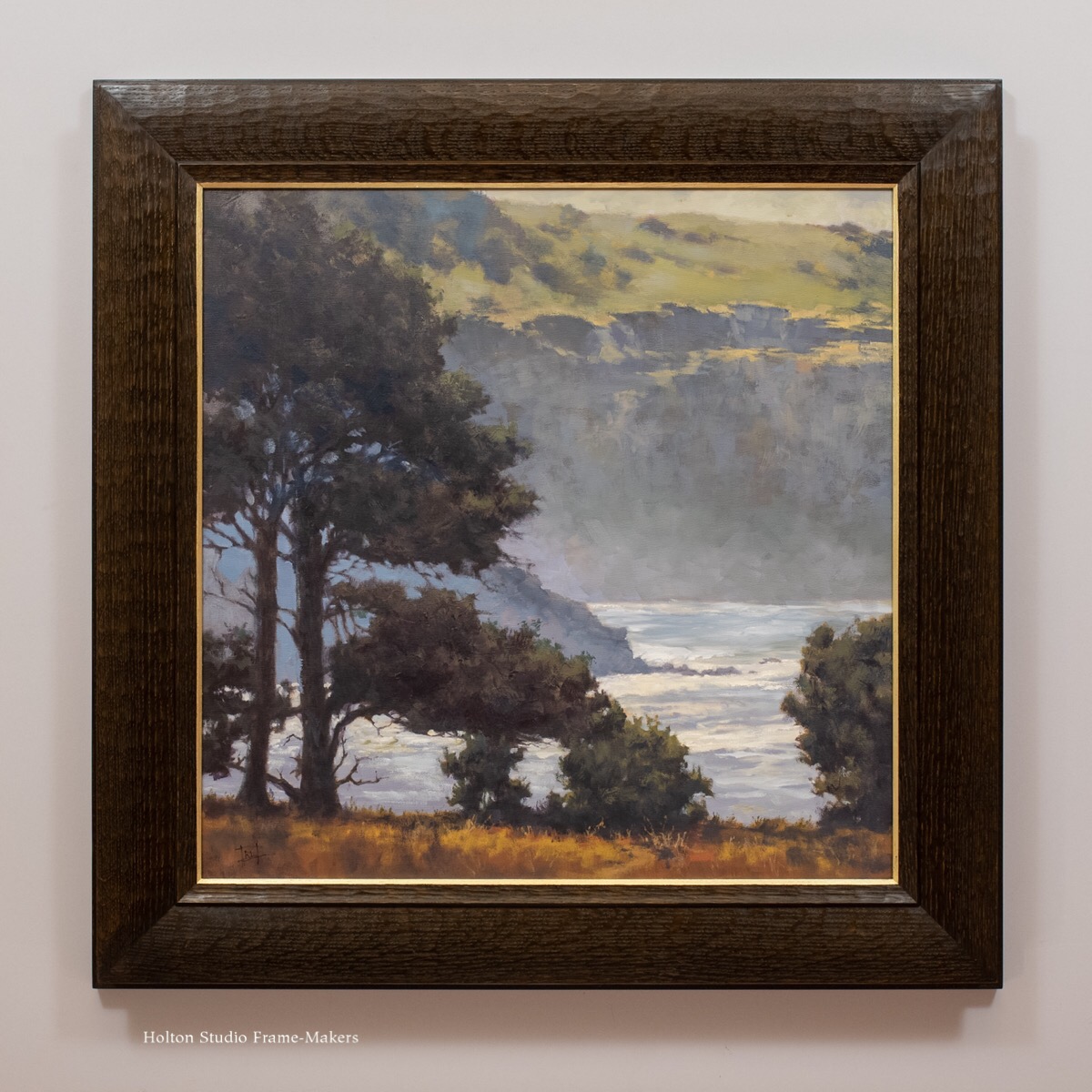
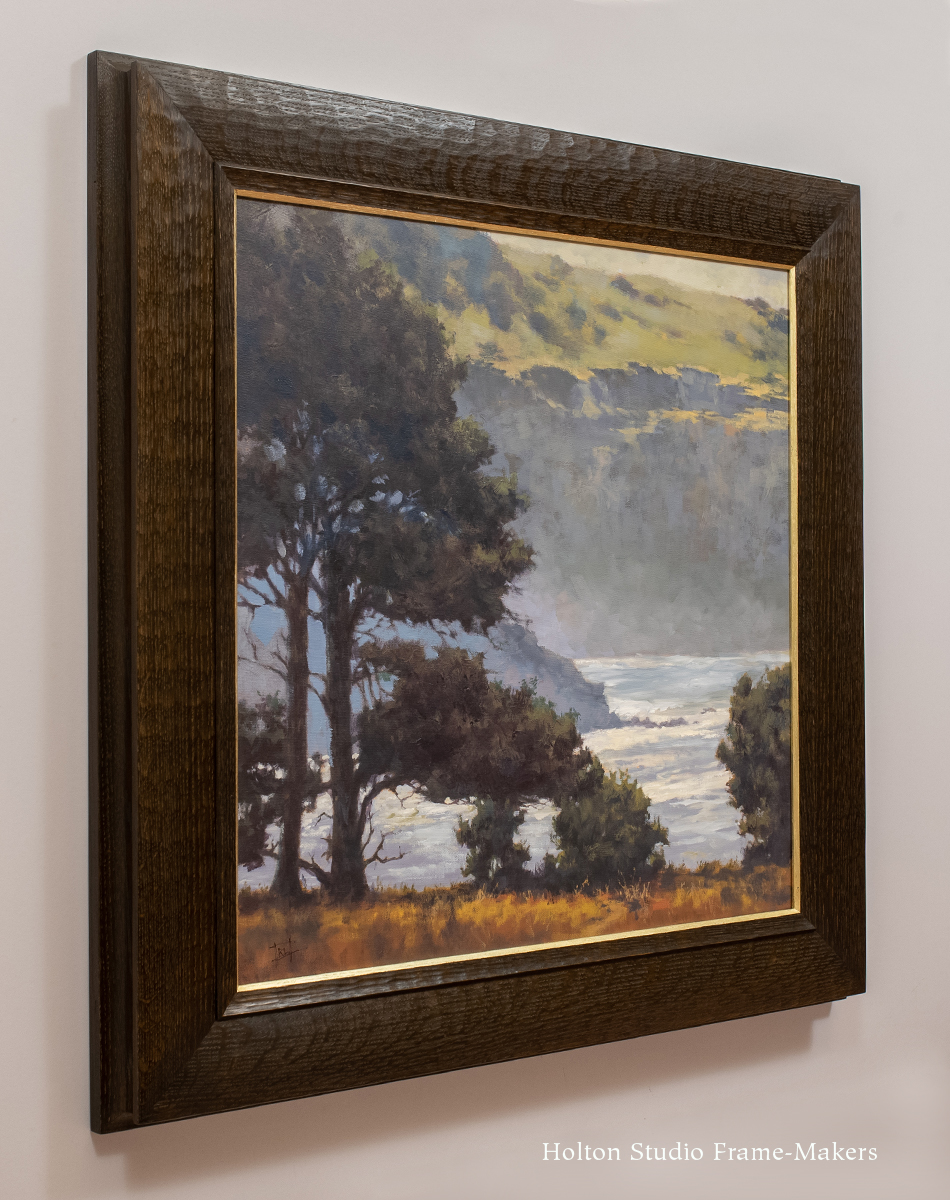
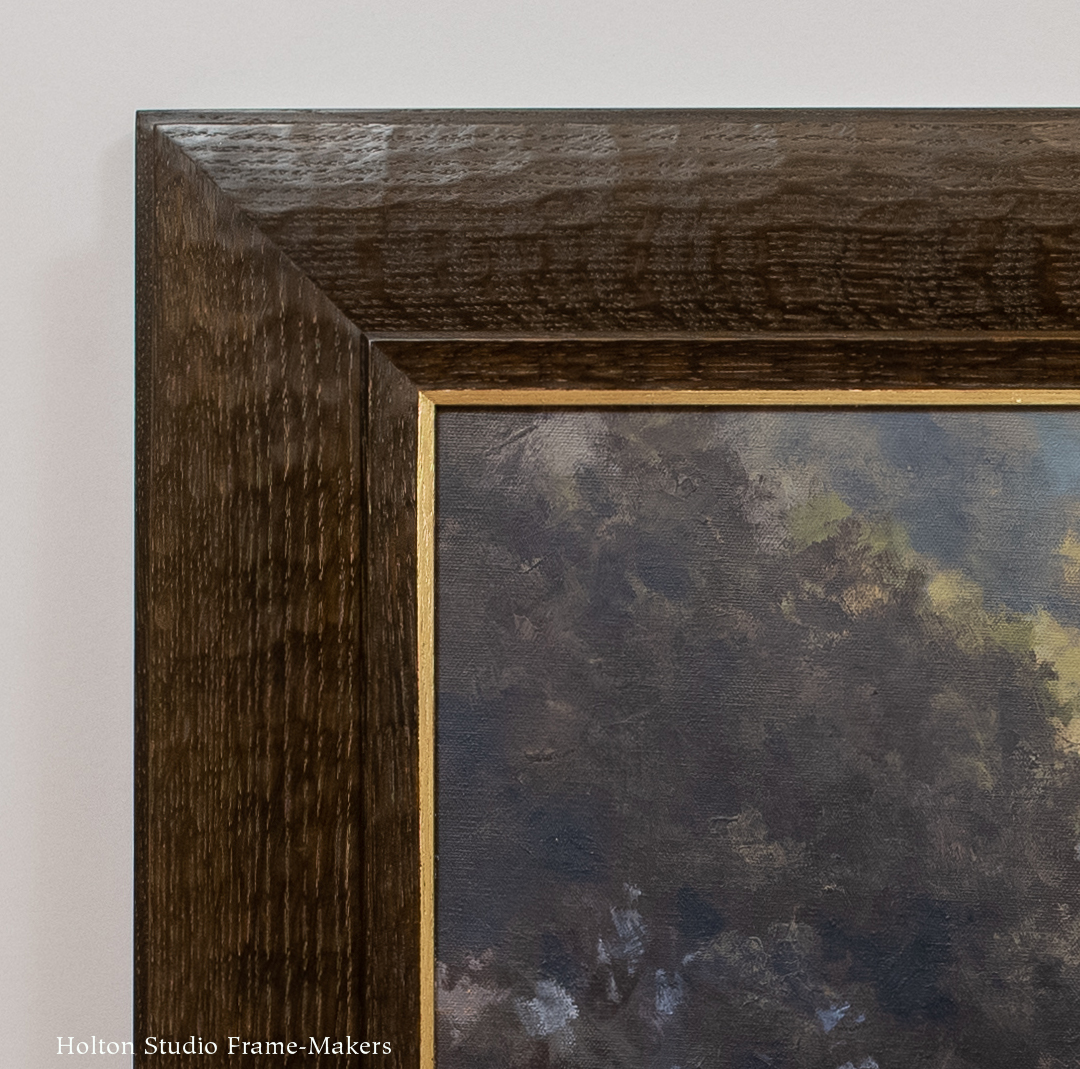
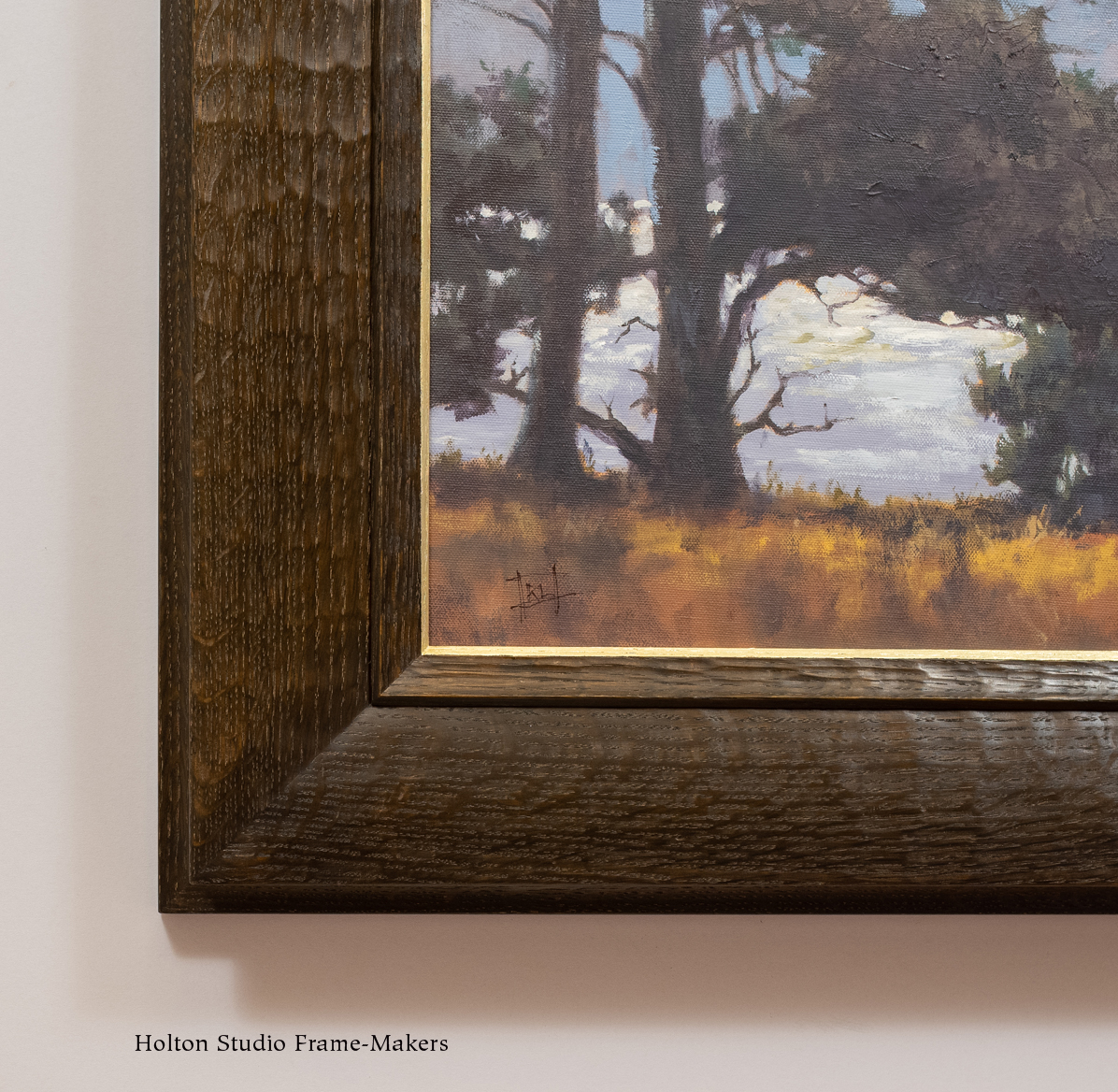
Poster for Beloved CaliforniaWith so many beautiful paintings to choose from, it wasn’t easy to decide which to put on the postcard and poster (at right) advertising the exhibition. But we finally settled on Richard Lindenberg‘s 24″ x 24″ painting “Sonoma Coast.” Its grandeur perfectly expresses the spirit of the exhibition. Only one little problem: it needed a frame that was up to that grandeur. So Trevor made this 4″ wide carved cushion complemented with a narrow low cove at the sight edge, and punctuated with a parcel gilt chamfer. The frame’s nice and deep, with an elegant cut in back that sweeps out beyond the outside edge of the face. The profile was designed to serve the rounded but rugged forms that Richard captured so beautifully.

Again, Beloved California VI opens today—the weatherman promises clear, sunny skies!—with an open house from 1 to 4. We hope you’ll come! (Masks and vaccines required. Number of guests allowed inside at one time limited to twenty.) Visit the Beloved California VI webpage to see the entire show, including several others by Richard Lindenberg.