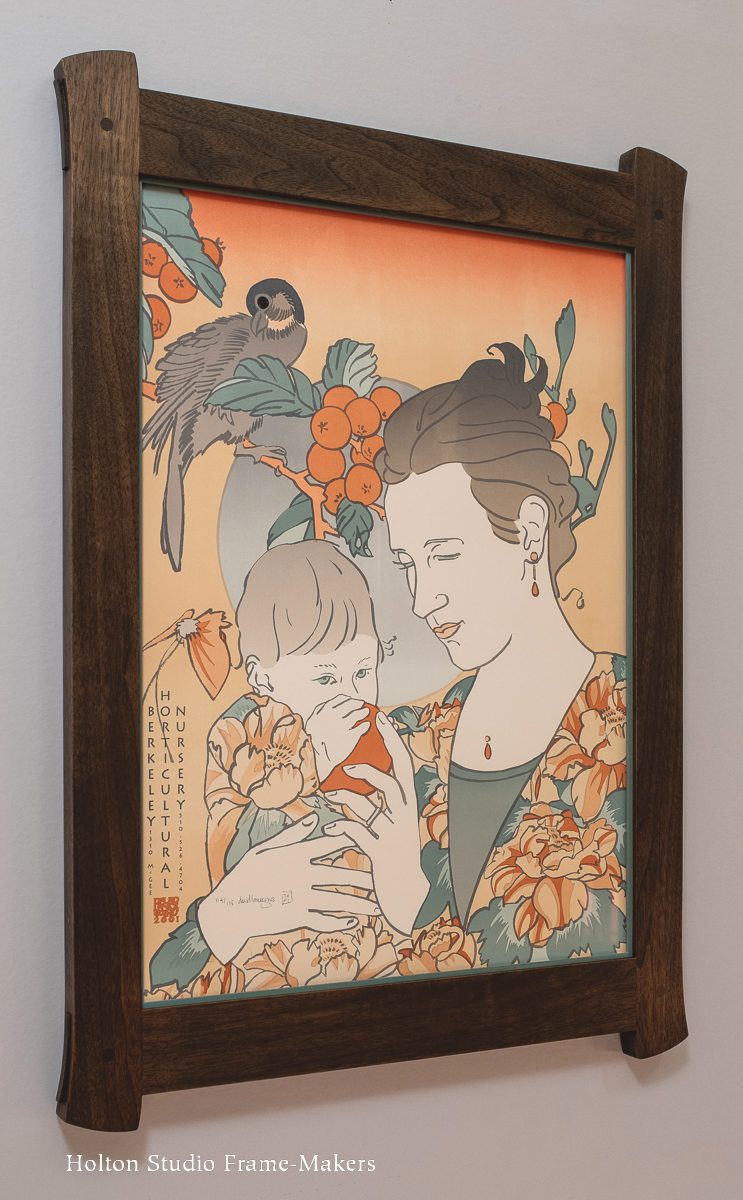
Tomorrow, Saturday, November 14 the Gallery will officially launch a very special relationship with the estate of a great American graphic designer and Berkeleyan. On that day we’ll open our exhibit “David Lance Goines: Posters and Prints” which will include a display of framed favorites as well as a large selection of the late artist’s posters available to purchase unframed (that is, ready to frame!). The framed pieces include this one Goines made in 2001 for Berkeley Horticultural Nursery.
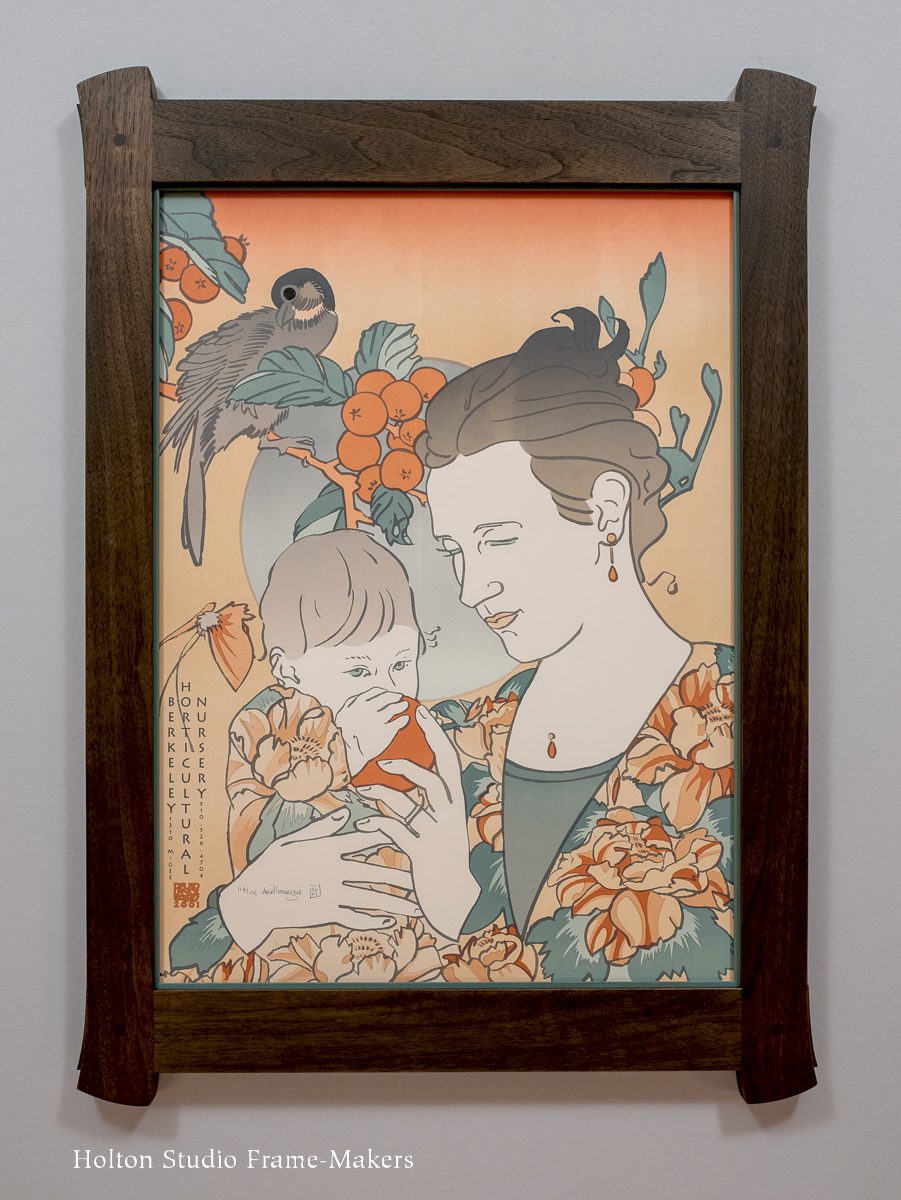

For Japanese prints, a favorite frame of ours is a narrow mortise and tenon Yoshida design we modify by shaping the ends of the mortised members with a sort of flair. Typically these are narrow in profile and used with mats. A good example is shown here on the famous Hiroshige print, “Sudden Shower Over Shin-Ohashi Bridge and Atake.” I adapted the design for the Berkeley Horticultural Nursery poster by making it much wider—it has 2″ wide sides and 2-1/2″ wide top and bottom members—and using it close (i.e., without a mat). Made of walnut and finished with a black linseed oil wax, the frame’s curves beautifully echo the print’s graceful lines. Inside the frame is a 1/8″ wide fillet painted to match the blue-green in the print.
The absence of border or margin in the poster is unusual for Goines’s work (more typical examples are on his studio wall behind the artist in the photo below). Framing close lets the picture frame have the effect of a window frame. The result is a more direct and compelling view of the image. It also connects rather than separates—unifies rather than divides the picture from its architectural setting.
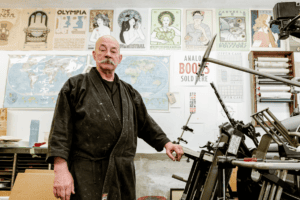
David Lance Goines (1945-2023)
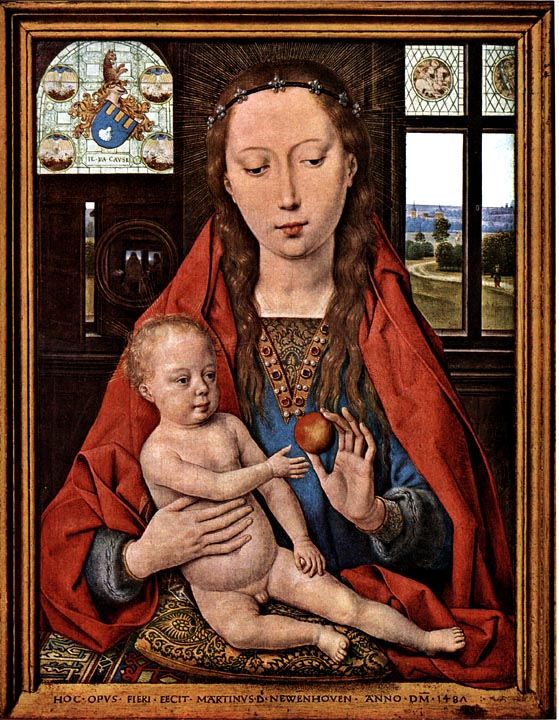
Hans Memling (ca. 1430–1494), “Virgin & Child”
A 2015 post I wrote about framing close included another picture of another loving mother introducing her child to apples—perhaps the ultimate image of mother love and an infant awakening to the world. By treating the picture frame as a window frame, Hans Memling fulfills his purpose of making the viewer feel the immediate presence of his holy figures. Here, the deliberate connection of the subject to its surrounding frame is made even more explicit by the virgin’s robe spilling onto the sill.
Ironic that it was a bite of the apple that gave us the knowledge to cultivate apples and much else besides—even as it got us expelled from the Garden of Eden. In that apple and that garden, humanity acquired its taste for the necessary knowledge to “dress and keep the Earth” and, in William Morris’s words, “to help in the work of creation.” Our work in the world, admittedly, has not gone entirely well. Perhaps that’s why the story has come to be known as “the fall.” Nevertheless, Memling’s 15th century icon of Christian faith makes you wonder if something’s been lost in the retelling. After all, with that first bite of an apple from the hand of mother love, we find our sustenance and join the world.
In commentary on his website, Goines said of his Berkeley Horticultural Nursery poster,
Francesca Angela Comacchio, dimpling infant, in posing with her mother Monique was introduced to her very first apple. Initially wary of the unfamiliar fruit, the child warmed to it when her mother took a bite, thus proving that it was safe and palatable. Francesca then gummed the crisp sweet Fuji to rags in a transport of delight, getting the most of it on herself, her mother and the floor. Francesca now has two teeth, likes apples and—when she thinks of it—demands them, gnawing the cool succulent flesh which miraculously becomes her own soft pinkness.
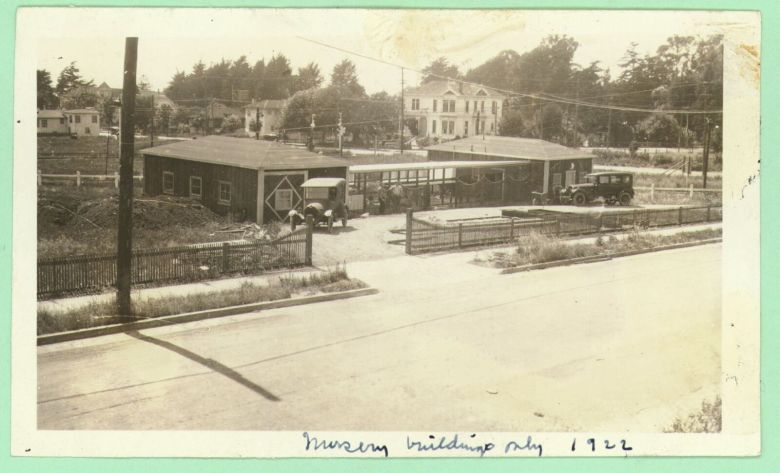
Berkeley Hort the year of it’s founding, 1922
Berkeley Hort (as it’s known locally) has been in the hands of the same family for over a century. That is to say, this business dedicated to helping Berkeleyans cultivate their gardens is itself a sustained project of care and cultivation—of parents handing down to their children not just the fruits of their labor but the fruits of knowledge and skill necessary to the work and delightful rewards of keeping things alive.
Goines’s posters promoted bicycle shops and booksellers, restaurants and vintners, architects and law firms, hospitals and schools, museums and theaters that make up the city’s web of culture and commerce. Likewise, Berkeley Hort helped create the city’s cultural face and fabric. In the nineteen-twenties, as Berkeley was being rapidly populated in large part by counter-cultural idealists like Charles Keeler, the nursery helped citizens cultivate the town’s gardens and with that, a local ethos. Keeler’s mentor, architect Bernard Maybeck, taught that “Hillside architecture is landscape gardening around a few rooms in case of rain.”
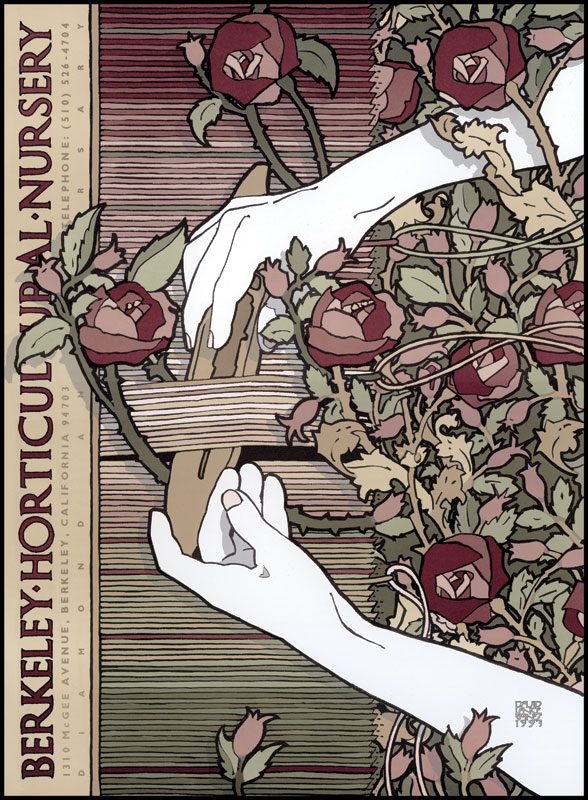 It was a deceptively practical expression of a profound vision and radical ethos. In the tradition of Emerson and Thoreau, John Ruskin and William Morris, Keeler and members of the Hillside Club viewed with trepidation the aggressively expansionist industrial age bent on conquering nature. Instead, Keeler and Maybeck urged fellow citizens to build with nature, to construct their homes and plant their yards in harmony with their hillside habitat (or, you might say, weave our own creation into nature’s creation, as Goines expressed the idea for Berkeley Hort’s 75th anniversary poster, at right). The “Simple Home” architectural ideal framed a simple life grounded on tending the land.
Years later, out of that older seedbed of Arts and Crafts ideals of the simple life and the simple home grew “The Art of Simple Food.” That’s the title of one of many cookbooks by Goines’s longtime friend and collaborator, Alice Waters.
In the late sixties, Goines and Waters produced an edition of small prints called “Thirty Recipes Suitable for Framing,” several of which will be displayed and available at our show. With the profits from that edition, Goines bought the small local press where he’d learned his trade, renaming it St Heironymus Press. About the same time, on the first commercial street at the foot of 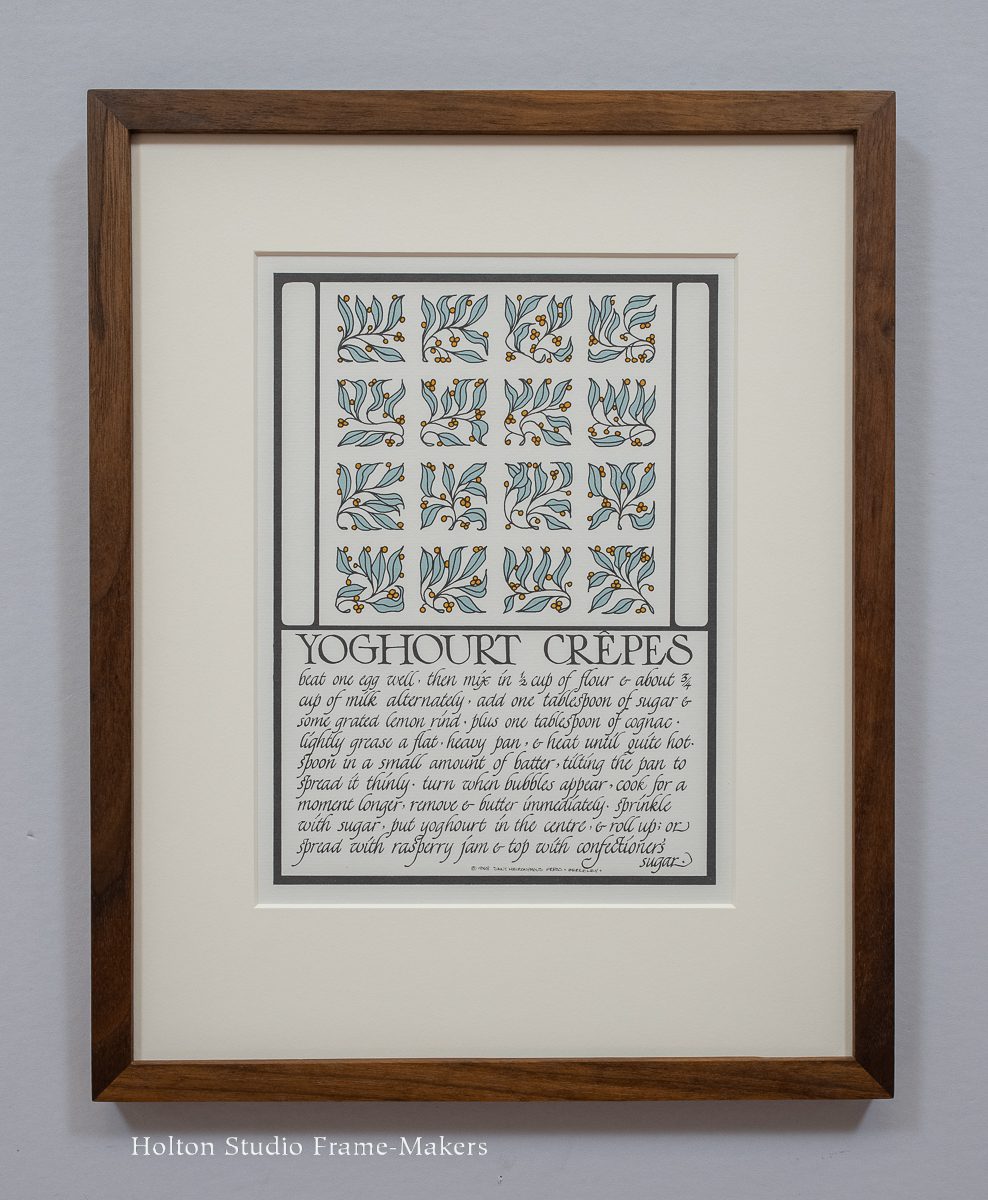 the hillside, Alice Waters opened her now legendary restaurant, Chez Panisse, in a simple Craftsman house lovingly remodeled in the neighborhood’s Arts and Crafts architectural vernacular. Every year for half a century, Goines faithfully commemorated the restaurant’s anniversary with a new poster, and in return, Alice fed him dinner at the restaurant nearly every night for a decade!
So it goes: the arts feed each other. Neither life nor any of its arts can thrive in isolation. Most arts are unimaginable separated from other arts. Waters and Chez Panisse, deeply invested in offering fresh local ingredients and in the farms and growers that provide them, have thrived on the inseparable relationship of the culinary and horticultural arts—as well as the dependence of a joyful and satisfying gathering on its architectural setting (to which I’m proud to have contributed frames and mirrors). Goines, meanwhile, grasped from the beginning the inseparability of the art of printing and the graphic arts. His poster designs grow naturally from the underlying crafts of letter press, block printing and lithography.
Goines also understood well that an individual artist does not thrive apart from the accumulated and inherited wealth of his or her art, but must tend its roots as a faithful steward. The New York Times’s obituary for Goines, quoted here, included this telling recollection by Richard Siebert, Goines’s studio partner:
…[F]or him it was an almost sacred obligation to pass the craft forward. There was a steady stream of apprentices coming through the shop, including me. After you reached a certain degree of proficiency, the apprenticeship would end.”
Mr. Goines always marked that moment with a ritual.
“He would shake your hand,” Mr. Seibert said, “and say rather solemnly, ‘You are shaking the hand that shook the hand that shook the hand of Johannes Gutenberg’” — making the point that every printer was connected to the generations of printers who preceded him or her, straight back to the inventor of the European printing press.
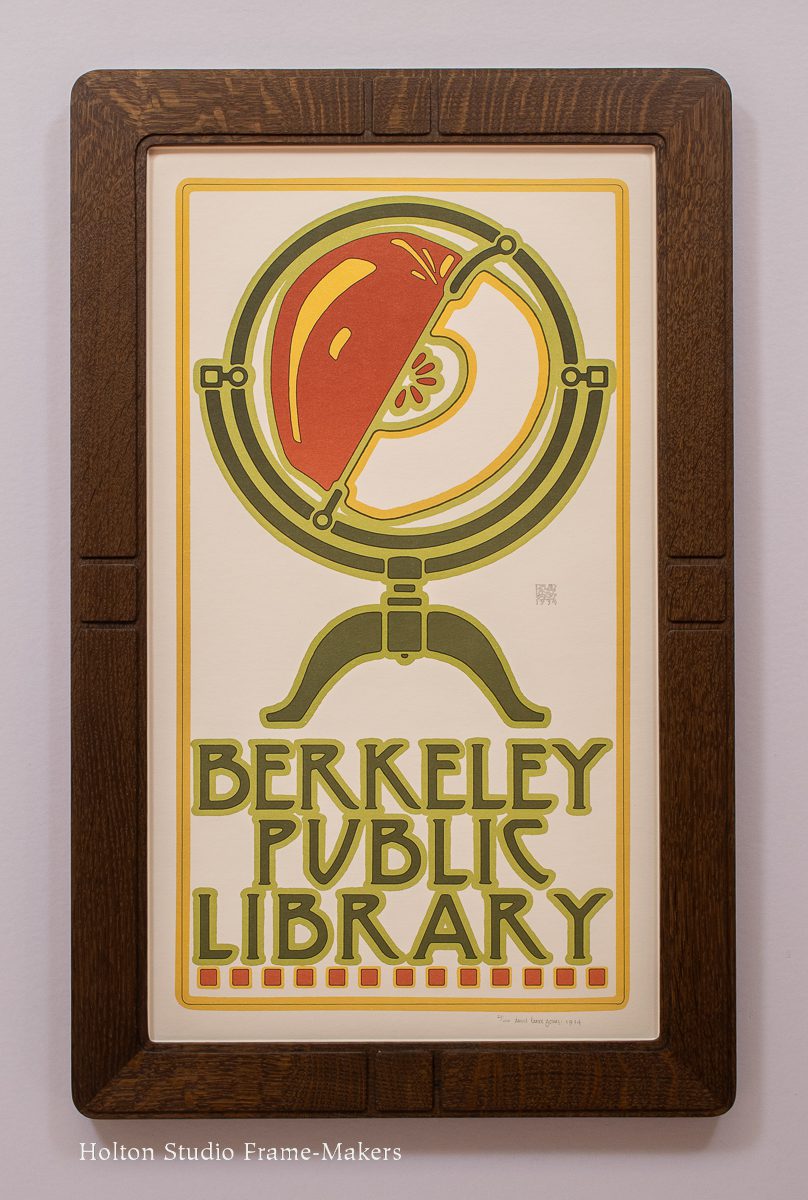
The apple of knowledge is also a theme in Goines’s poster for the Berkeley Public Library
The tradition of printmaking and graphic design is a great garden, and Goines freely wandered it like a child picking whatever caught his eye and his fancy. And like a child he seized upon it without any doubt that it was all rightfully his own—Etruscan pottery, Medieval woodcuts, the Gothic, the classical, the baroque, Wiener Werkstätte, Art Nouveau, Art Deco, and certainly Arts and Crafts sources appear. But Goines’s garden of inspiration was global and included Japan’s rich history of woodblock printing, as the Berkeley Hort poster demonstrates.
The purpose of culture is not, finally, to cultivate the arts but to steward the earth’s creation, and to cultivate human beings through learning and by improving our surroundings. In those years when Alice Waters was starting Chez Panisse, I was a student at the junior high school just a couple of blocks east of Berkeley Hort. By the time my daughter was attending that school—it was then Martin Luther King, Jr. Middle School—I was grateful that Waters had convinced the principal to tear up the asphalt that had covered what I’d known as the dreariest part of the campus and replaced it with fertile soil and verdant garden dubbed The Edible Schoolyard.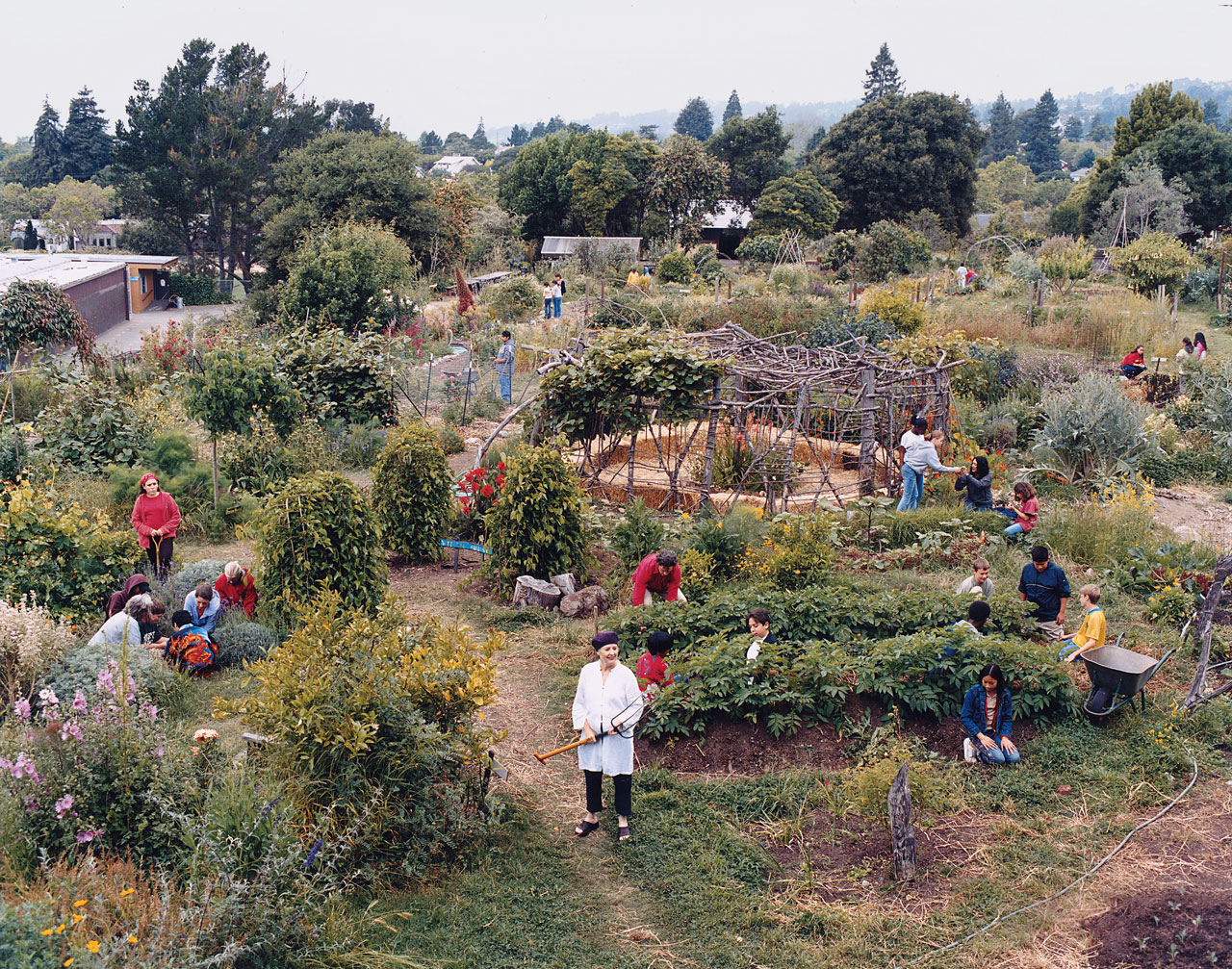
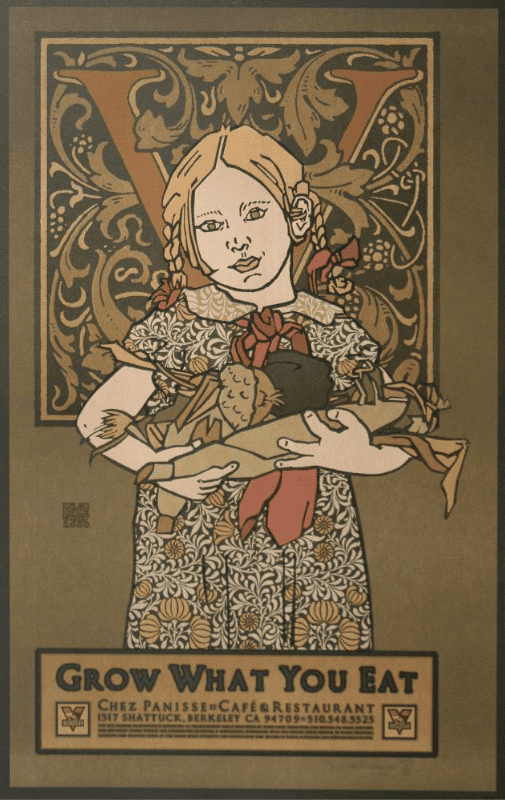
Goines’s 37th anniversary poster for Chez Panisse also promoted the Chez Panisse Foundation and its primary project, the Edible Schoolyard
Goines’s 37th anniversary poster for Waters promoted not just Chez Panisse but the Edible Schoolyard, helping garner public support and make it a model for school gardens throughout California and beyond. (The “V” harkens back to the Victory Gardens of World War II.) Like Maybeck’s vision for how architecture could reform our relationship to the world, Waters’s idea was a plainly practical one with vast implications. She recalled, “I had an inkling that a real change could take place—but I couldn’t have imagined the way in which a garden classroom, a kitchen classroom and a reimagined cafeteria could transform the public schools system.” Living the slogan, “Think globally, act locally,” and Wendell Berry’s advice to “think little,” Waters figured out a way to “get to students before they were indoctrinated by the pervasive fast food world around them.” She made a place for “a thousand sixth, seventh, and eighth graders…speaking twenty-two different languages at home” to work, cook and eat together. The Edible Schoolyard is now a magnet for educators from all over the world. From science to history to the arts, the school’s curriculum, like civilization itself, is interwoven with the life of the garden. “[T]he power of food can change people’s lives—for better or for worse. Food can enhance our communities, humanize our institutions, and help heal and replenish the besieged environment. Or food can destroy our health and our planet.”
Her friend David Goines agreed: we can use our arts either to join the world or to break it apart. Continuing his remarks on the Berkeley Hort poster, he wrote,
 “The food we’re raised with is the food we like all our lives long. Food we did not encounter at our mother’s knee is food toward which we harbor a mistrust, a real reluctance to regard as suitable for human consumption. Food is the great divider and uniter, a shorthand for the foreign and exotic: the Englishman is the Limey; the Frenchman the Frog; the German the Kraut. Religious dietary laws effectively prohibit exogamy: how can you possibly marry someone with whose family you cannot eat? Can an Orthodox Jew sit down in any comfort to a pork chop? Can an Englishman pop tasty grubs into his mouth with any relish? Would roast dog delight the heart of a Mohammedan? These things I tend to doubt.
“But we children of Eve can all, at least, agree on figs and apples, and that’s a start.”
“David Lance Goines: Posters and Prints” opens here at the Gallery tomorrow, Saturday, November 14 with a reception from 2-4 in the afternoon.
Join us!
—Tim Holton
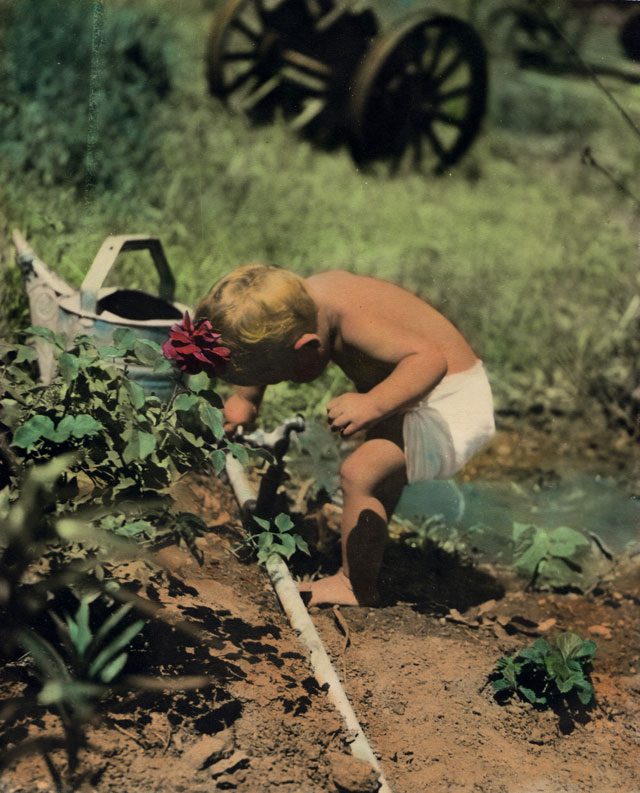
David Goines gardening, Cave Junction, Oregon, 1946