“A California Spring” Almost Sprung

Final preparations are being made for our show that’s opening at The Holton Studio Gallery on Saturday, “A California Spring.” We’ll be hosting a reception for the artists that day from 5 to 7, and invite one and all to join us. We’ve also just put up a page dedicated to the show, posting the paintings—some sixty works!—as we finish framing them. This is our biggest show ever, representing fourteen artists. Don’t miss it! Preview the show…

Check out Terry Miura’s blog post about the show. Thanks, Terry!

A few examples—

Terry Miura, "Almost Forgotten"

Terry Miura, “Almost Forgotten.” Oil on linen, 9″ x 13″.

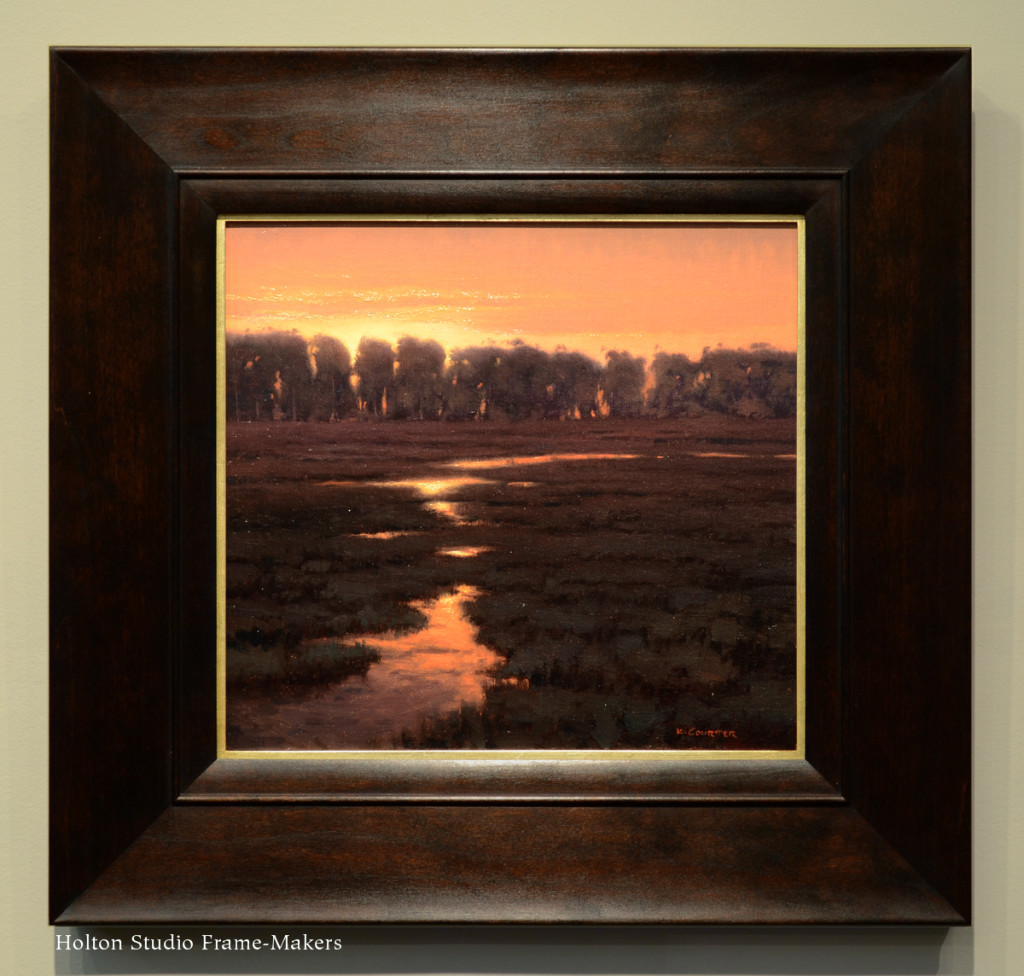
Kevin Courter, "Passages."

Kevin Courter, “Passages.” Oil on canvas, 9-3/4″ x 10-1/2″.

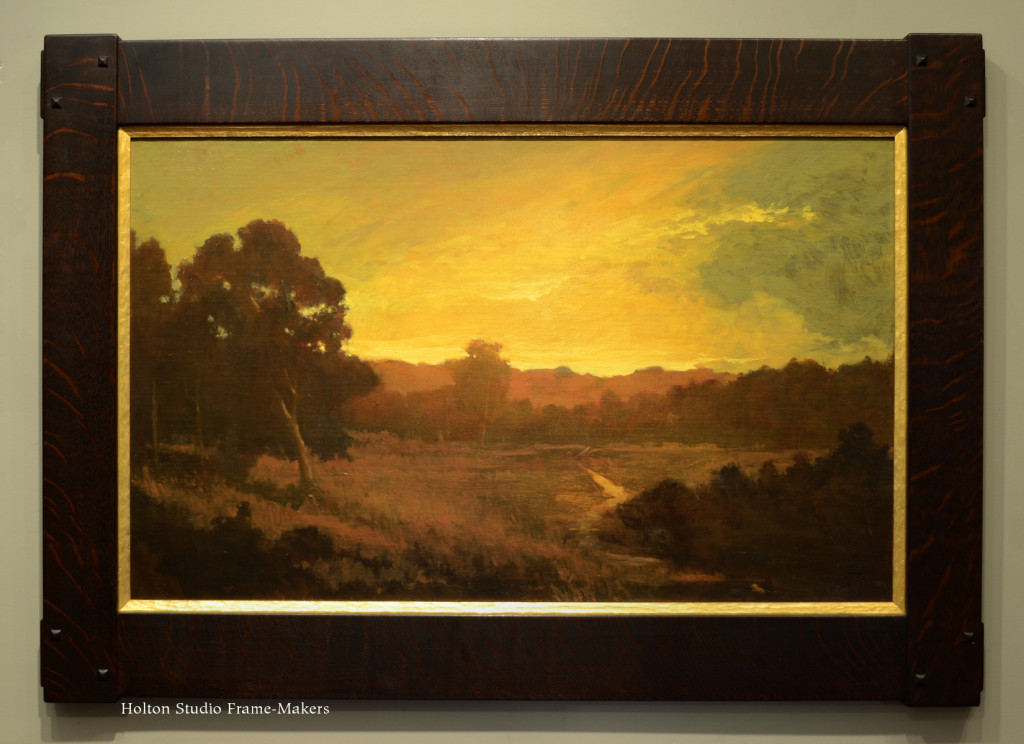
Paul Roehl, "Sunrise, Fremont"

Paul Roehl, “Sunrise, Fremont.” Oil on canvas, 22″ x 36″.

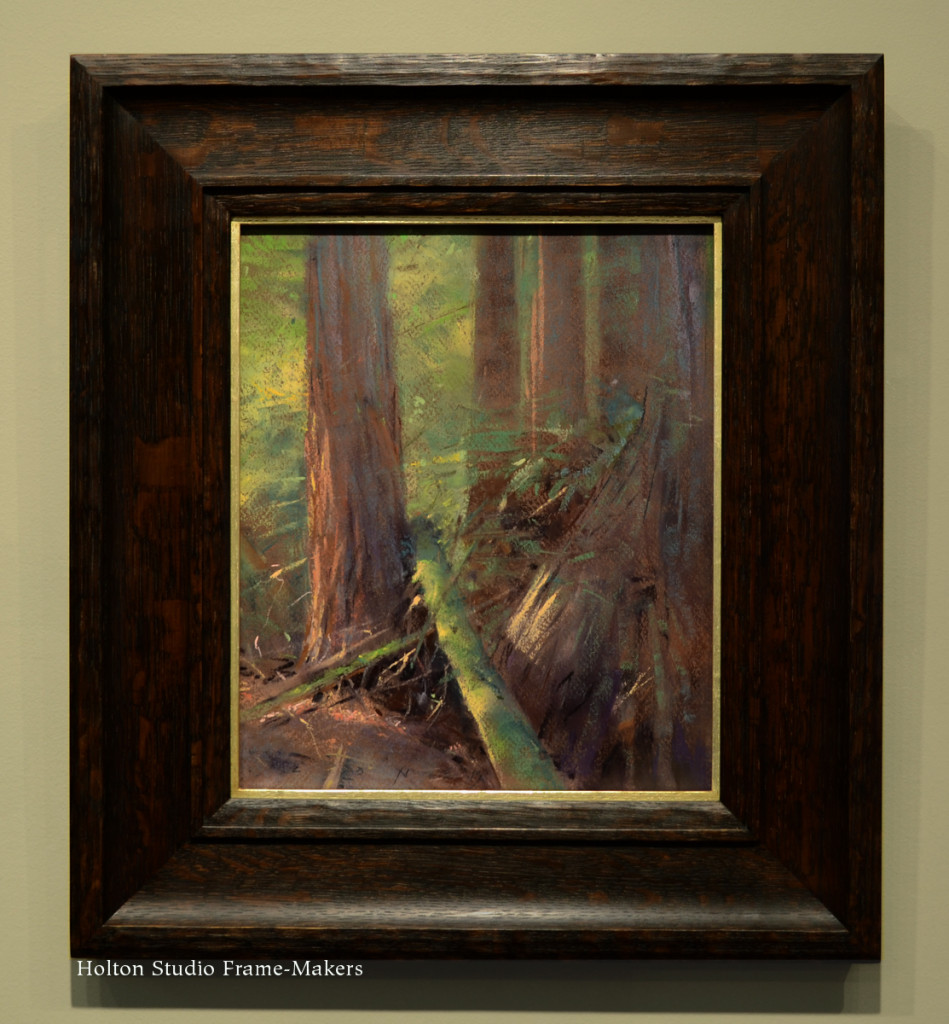
BCon-010-web1200

Bill Cone, “Fallen.” Pastel, 11-1/2″ x 9-1/2″.

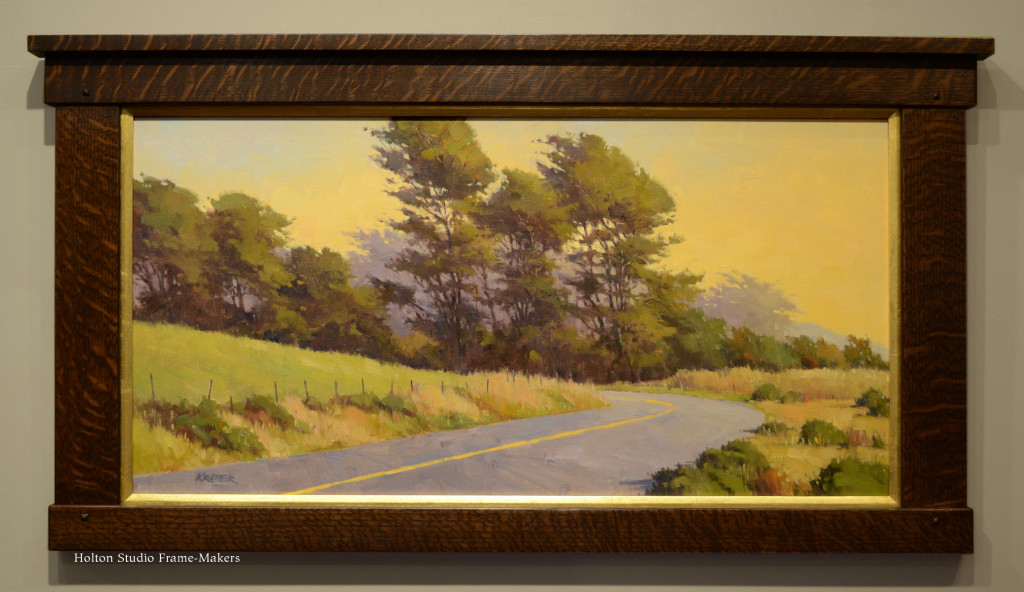
Paul Kratter, "Left Turn at the Pines"

Paul Kratter, “Left Turn at the Pines.” Oil on canvas, 15″ x 29″.

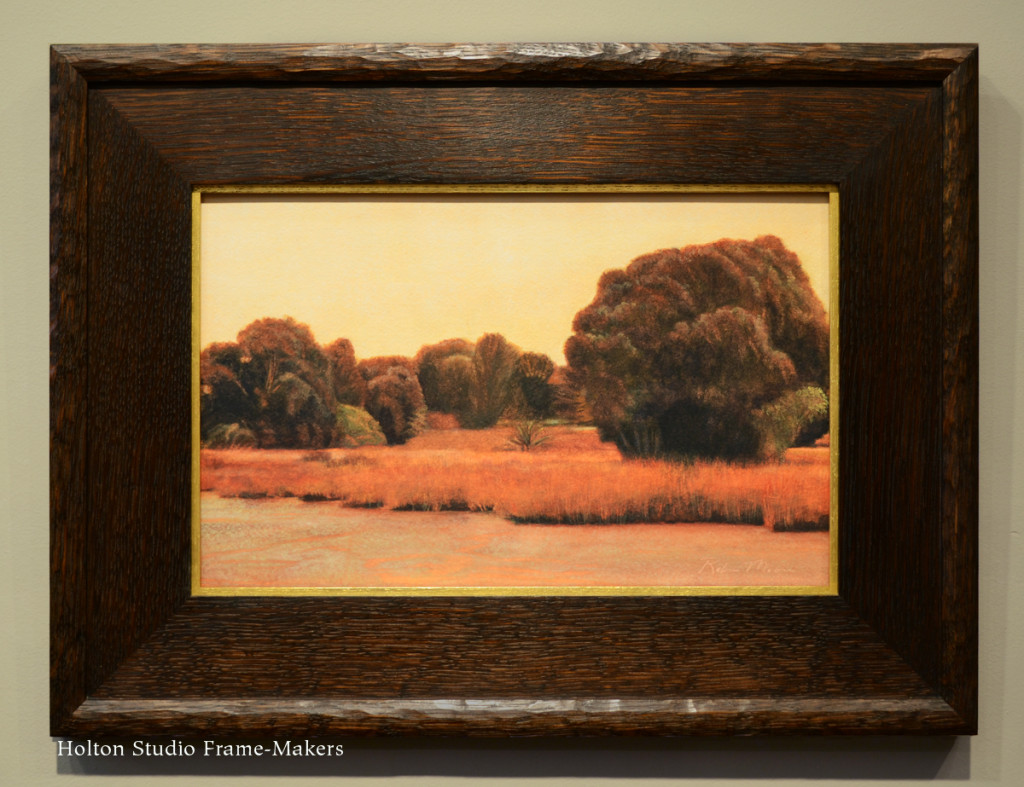
Robin Moore watercolor

Robin Moore, “Sunset at Flood Time – Martinez.” Watercolor, 8″ x 12-1/2″.

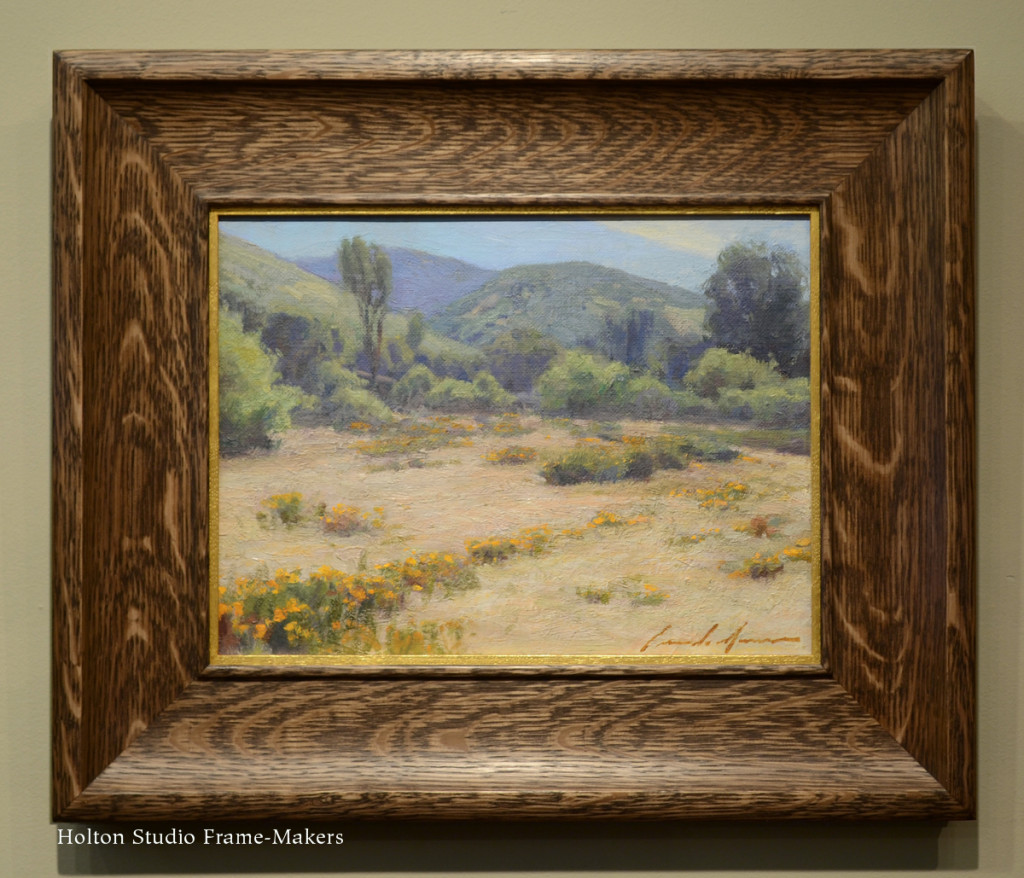
Ernesto Nemesio, "Pinnacles at Spring"

Ernesto Nemesio, “Pinnacles at Spring.” Oil on canvas, 9″ x 12″.

The Lasting Frame

“When we build, let us think that we build forever,” wrote Ruskin in The Seven Lamps of Architecture. We make in enduring form—stone, strong timbers, iron, and all durable materials—things we believe will endure in use and meaning. When we build for lasting quality, we build for posterity. Here’s more of the famous quote:

Trevor-joining-web600

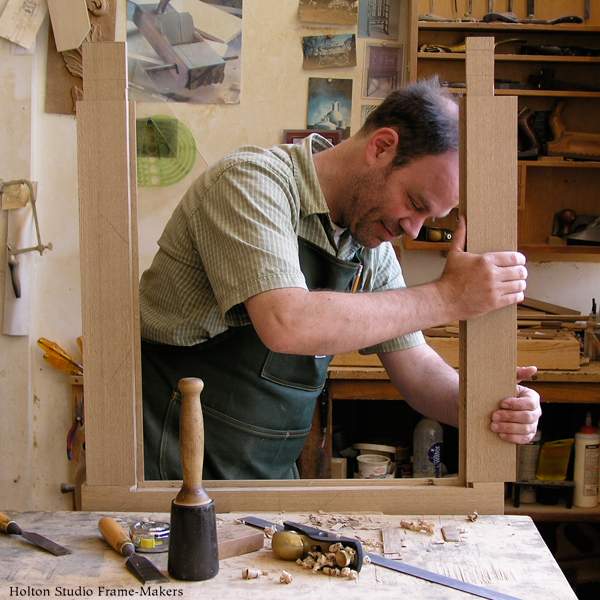
Trevor Davis joining a quartersawn oak mortise-and-tenon frame

Every human action gains in honor, in grace, in all true magnificence, by its regard to things that are to come. It is the far sight, the quiet and confident patience, that, above all other attributes, separate man from man, and near him to his Maker; and there is no action nor art, whose majesty we may not measure by this test. Therefore, when we build, let us think that we build for ever. Let it not be for present delight, nor for present use alone; let it be such work as our descendants will thank us for, and let us think, as we lay stone on stone, that a time is to come when those stones will be held sacred because our hands have touched them, and that men will say as they look upon the labor and wrought substance of them, “See! this our fathers did for us.”

—John Ruskin, The Seven Lamps of Architecture, “The Lamp of Memory”

A society that does not build to last must be asked, does it have any enduring and timeless values? Does it recognize any eternal laws? Does it acknowledge the universal?

Not only buildings but paintings—especially those made as murals to be thoroughly integral to buildings—have endured for centuries. When compared to the ephemeral and fleeting photographic image—both on paper and especially on a digital monitor screen—paint affords a fairly permanent record of an idea.

A picture frame in sound and solid and stable materials, soundly joined, carefully finished is an enduring protector and presenter of the enduring ideals that inspired the picture.

Enduring quality, no matter how simple in artistic expression, conveys immeasurably more than the slap-dash makeshift. It conveys a certainty that its purpose will endure. And much of the beauty we seek in the arts is simply in the integrity and quality of the work of art. This is in part what Keats meant when he wrote that “A thing of beauty is a joy forever.”

Ruskin-Chicago-Tribune-Bldg

The Ruskin quote inlaid on the lobby floor of the Chicago Tribune Building (Howells & Hood, 1923-25)

The Wooden Frame of Reverence

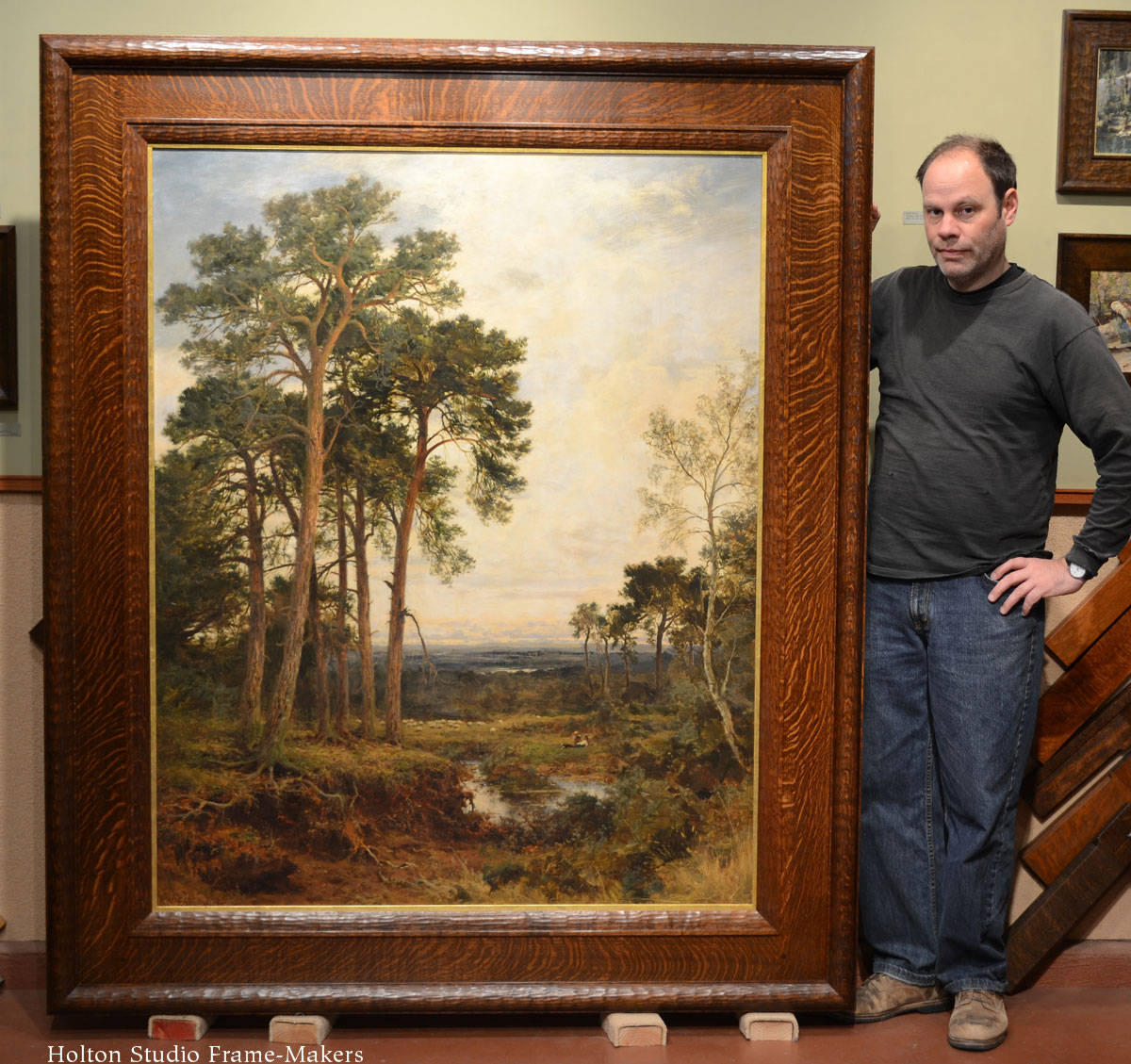
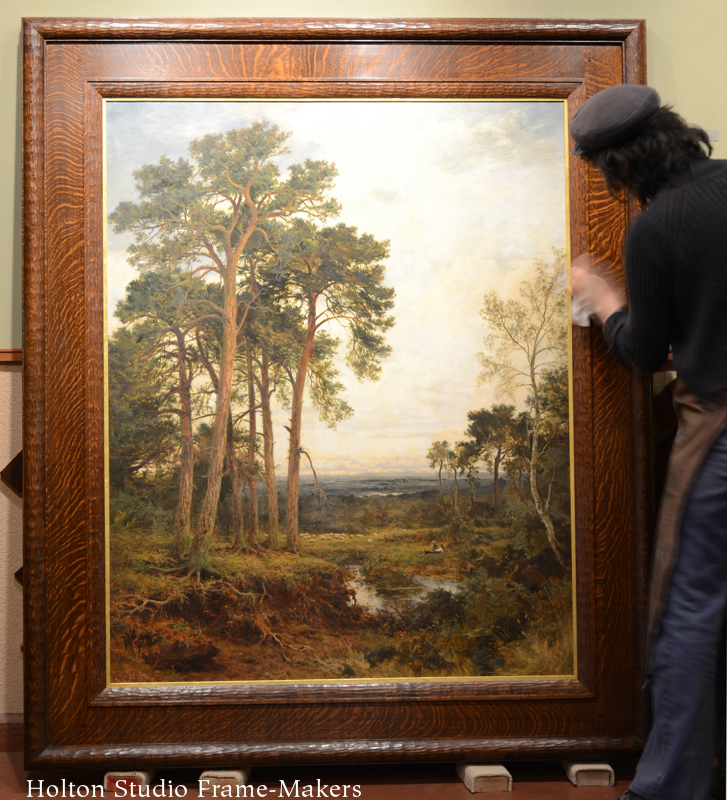
We recently framed this great painting by the 19th century British landscape painter Benjamin Williams Leader, which demonstrates the artist’s deeply felt reverence for the great frame of life that John Ruskin, the foremost pastor of the arts in Britain in Leader’s day, called “The Earth Veil” (Modern Painters, Vol. V)—what we would call, with considerably less poetry (because of lesser reverence?), the biosphere. Our work starts with the same reverence for nature and its materials—specifically, in our case, wood. Ruskin struck a profound chord with many here in America, including Wallace Nutting, who wrote, in his study Furniture of the Pilgrim Century, of “The Obligation to Materials”:

We have no right to misuse wood. We did not make it. We found it, like air, water and grass. The only possible manner of acquiring any rights over it is by putting the stamp of character upon it. The theologians tell us of sins, as if we were under obligation to a spiritual world alone. But sheer wickedness in the use of materials ought to cause even a materialist to shudder. Wood is one of the best things we have. Whether Grinling Gibbons puts his tool to it or we make a milking stool of it, men will measure us by the manner of our handling it.

Only people with a sense of reverence for materials can make good citizens. A man must use wood well, or he will mistreat his neighbors.

Ruskin and Nutting understood the primacy of our relationship to the earth and its materials, not least of all for our moral character, effecting profoundly not only how we treat the earth but our fellows. Our engagement with the earth’s materials also shapes our engagement with each other. Paintings made with this foundational reverence and understanding deserve frames made in the same spirit—a spirit of love for life, the earth and its immeasurably wonderful creatures, trees.

More on this piece…

Trevor Davis shown with the painting

Trevor Davis shown with the painting

.

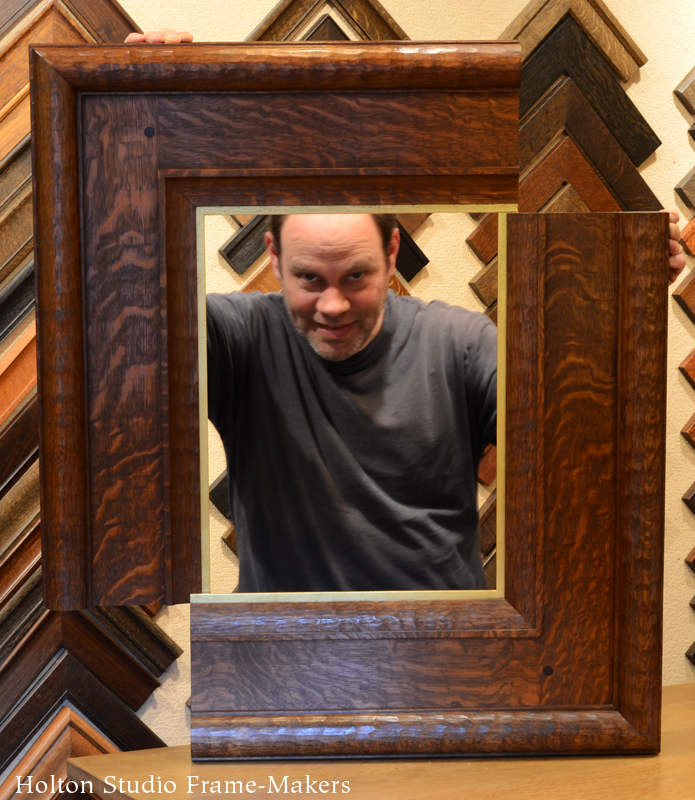
Trevor Davis with corner samples used to design the Leader frame. The lower right sample is the one we used.

Trevor Davis with corner samples used to design the Leader frame. The lower right sample is the one we used.

.

Eric Johnson giving the finish a final caring touch.

Eric Johnson giving the finish a final caring touch.


James McGrew Featured in Southwest Art Magazine

James McGrew, one of the artists we represent, is featured in the current issue of Southwest Art Magazine and being deservedly touted as an emerging artist. I love how he frames his objective as a painter: “I want the viewer to feel a sense of awe and wonder that helps people love and respect nature, which ultimately leads to stewardship beyond the park.”

Well said, James—and congratulations!

Read the article…

More on James McGrew…

William James and the Hand Crafted Frame of Youth

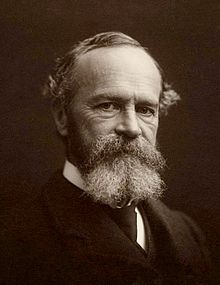
“It is by having hands that man is the most intelligent of animals,” according to the ancient Greek Anaxagoras. It follows that handcraft is indispensable to the education of our children—and that in a debased society education should lose its basis in hand craft. On these matters, one good person to follow is Doug Stowe who blogs at Wisdom of the Hands.  Yesterday’s post, “The Habit of Constructiveness,” included a quote from William James that frames the matter eloquently, and speaks not only to the crucial role of handcraft in education but to the fundamental framework we provide our children when we teach them to make things—or when we fail to do so. In 1899, in his Talks with Teachers on Psychology, James said,

220px-William_James_b1842cDuring the first seven or eight years of childhood the mind is most interested in the sensible properties of material things. Constructiveness is the instinct most active; and by the incessant hammering and sawing, and dressing and undressing dolls, putting of things together and taking them apart, the child not only trains the muscles to co-ordinate action, but accumulates a store of physical conceptions which are the basis of his knowledge of the material world through life. Object-teaching and manual training wisely extend the sphere of this order of acquisition. Clay, wood, metals, and the various kinds of tools are made to contribute to the store. A youth brought up with a sufficiently broad basis of this kind is always at home in the world. He stands within the pale. He is acquainted with Nature, and Nature in a certain sense is acquainted with him. Whereas the youth brought up alone at home, with no acquaintance with anything but the printed page, is always afflicted with a certain remoteness from the material facts of life, and a correlative insecurity of consciousness which make of him a kind of alien on the earth in which he ought to feel himself perfectly at home.

To frame our children’s lives “within the pale…acquainted with nature” rather than in the abstract realm of the printed page, “afflicted with a certain remoteness from the material facts of life,” is to secure them a life engaged with the earth itself—the greatest frame of life.

Read Doug Stowe’s blog entry…

Mahogany on Mahogany: Framing James Hamilton

The earliest independent paintings were made on solid wooden panels with the edges of the panels raised to frame the image. Frame and painted panel were one. Today such thoroughly unified presentations are rare among painters, but the ideal of harmony remains exemplary, and occasionally a painting on wooden panel will come in and present us, as makers of handcrafted hardwood frames, with the opportunity to achieve the unity of frame and panel that evokes some of the harmony and unified effect of the first paintings. Hamilton-Atlantic-City-Back-view-web800

This 1874 view of Atlantic City by the significant maritime painter James Hamilton (1819-1878) is just such an example. It’s painted on a mahogany panel, which is actually exposed at the bottom right portion of the painting. (At right is shown the back of the painting. The writing you might be able to just make out includes the signature and “March 1874,” and the inscription by the artist, “painted for WW Harkness.”) We made the frame—our No. 348.02—2-1/2″—in Honduran mahogany to match. A pale gold slip is added for emphasis.

Hamilton-in-348-4957-web1200b


James Hamilton (1819-1878), (view of Atlantic City), 1874. Oil on mahogany board, 12″ x 15″. Framed in No. 348.02, in Honduran mahogany (Chestnut stain) with pale gold mahogany liner.

Below is another Hamilton in a frame more typical of the day. Considered from the standpoint of aiming for harmony, the dark mahogany frame is considerably more suitable.H0016-L14044916

William Morris, Frame-Maker (for a Valentine)

“I was the master-mason of a church that was built more than six hundred years ago,” begins William Morris’s “Story of the Unknown Church”, his best piece of fiction from his Oxford years. Morris believed passionately in the continuity of history, in the past and its material and literary legacy as the root of art and life in the present—a form of real wealth on which civilization depends. This aspect of his thought is often misunderstood as merely sentimental and escapist “medievalism”. Morris, however, was deliberately not an escapist—although many of his cohorts had a hard time answering that charge. Indeed, he was very much engaged in his own day, and looked forward as well as back. And he regarded the arts of his day as gifts to endure, to inform and be enjoyed by posterity.
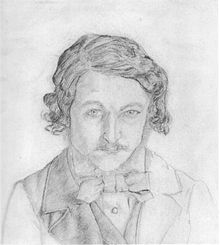
William Morris, self-portrait at age 22

William Morris, self-portrait at age 22

The story (read it here) is a great example of his fondness for imaginative time travel, as well as his romanticism, which Morris simply equated with humanity. It’s an outpouring of human feeling, of the human spirit—an outpouring of love—for not only history but architecture and for his fellow human beings. In this case his beloved are the sister of the narrator and his sister’s husband, the narrator’s best friend. Their tragic end prompts the mason-narrator to carve them a tomb as well as a “marble canopy,” and to thus spend his final years making a frame for his memorial to these lovers whom he so loved—a great valentine.

The quote goes to the solace that art provides labor—a key Morrisian argument (actually he was in the first great flush of discovery of this idea in the work of John Ruskin) for restoring the arts to their rightful place in our daily work, including that of masons, and thereby redeeming and rescuing ordinary laborers from the miserable working conditions of industrializing England. In this, Morris was one of our greatest thinkers about the place of art; so even though he, unlike Rosetti, Burne-Jones and his other PreRaphaelite pals, didn’t have much to say about picture frames (reasons for this I could go into another time), he was in the greatest sense a framer of the whole matter of art. And in this case, his ideals are directly expressed in the story of the making of a frame.

But my main reason for drawing attention to “The Story of the Unknown Church” here is that it also goes to the role of the frame as praise and celebration—extending and sustaining the entire purpose of works of art, and keeping the cherished memories they embody close to us. As Ruskin said, “All true art is praise.”

Is Morris a bit over the top here? Yes, but he’s not the only one to overdo this nonetheless sound purpose of the frame (the other option is a frame made with indifference). And we can—especially on this day—forgive the passions of youth in the throes of discovery of the power of art and love!

So here’s a little valentine—sent many years ago—from William Morris, frame-maker.

It was just beneath the westernmost arch of the nave, there I carved their tomb: I was a long time carving it; I did not think I should be so long at first, and I said, “I shall die when I have finished carving it,” thinking that would be a very short time. But so it happened after I had carved those two whom I loved, lying with clasped hands like husband and wife above their tomb, that I could not yet leave carving it; and so that I might be near them I became a monk, and used to sit in the choir and sing, thinking of the time when we should all be together again. And as I had time I used to go to the westernmost arch of the nave and work at the tomb that was there under the great, sweeping arch; and in process of time I raised a marble canopy that reached quite up to the top of the arch, and I painted it too as fair as I could, and carved it all about with many flowers and histories, and in them I carved the faces of those I had known on earth (for I was not as one on earth now, but seemed quite away out of the world). And as I carved, sometimes the monks and other people too would come and gaze, and watch how the flowers grew; and sometimes too as they gazed, they would weep for pity, knowing how all had been. So my life passed, and I lived in that Abbey for twenty years after he died, till one morning, quite early, when they came into the church for matins, they found me lying dead, with my chisel in my hand, underneath the last lily of the tomb.
The Frame of Natural Affection: Framing Alexander Max Koester (1864-1932)

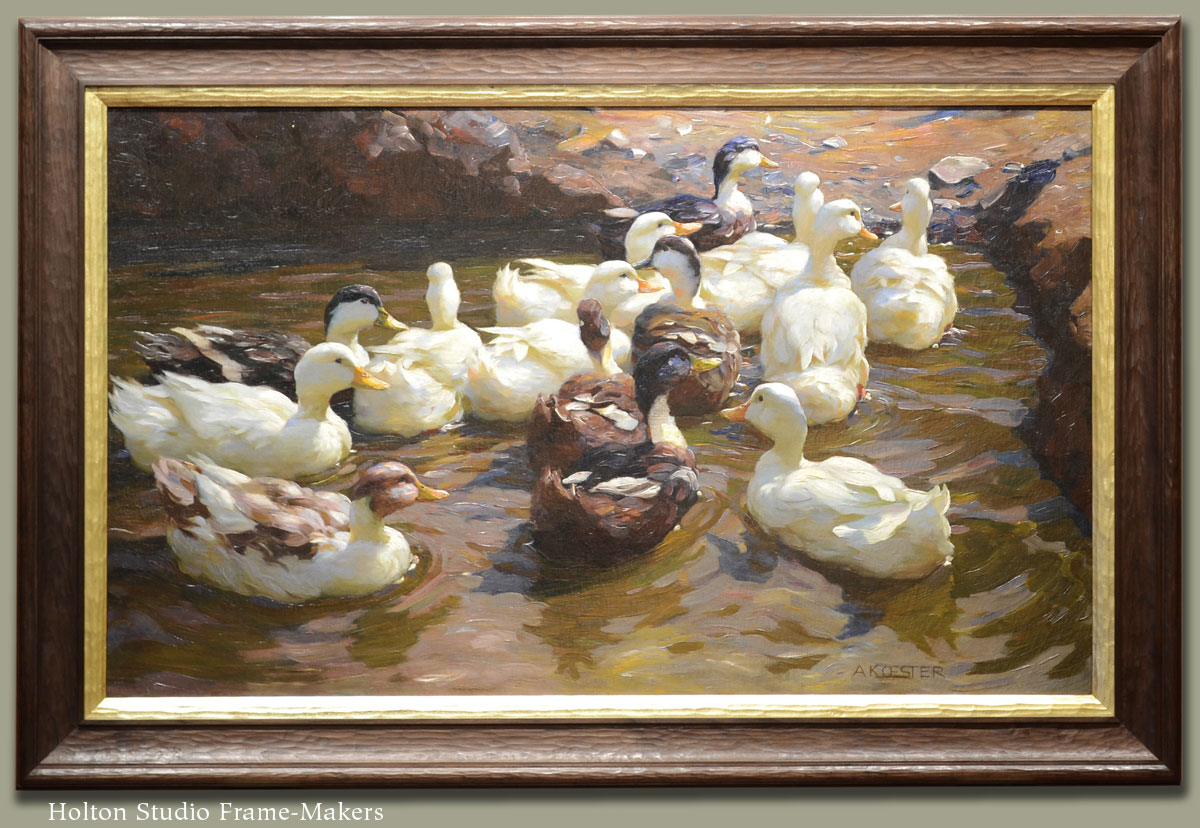
We just finished framing this exceptional and exemplary work by Alexander Max Koester, a leading Impressionist painter of the Munich school around the turn of the last century. “Ducks In a Pond,” (no date), oil on canvas, 31″ x 52″ is a beautiful example of his favorite subject. And I like that Koester rejected the colder view of nature that Impressionism generally took — a view, a frame on the world, relatively indifferent to the significance of subject matter, instead taking primarily a scientific, empirical approach to painting as pure observation of light translated to paint on canvas. Koester chose to maintain the frame of natural affection for the land and its creatures. The biography on AskArt says, “whereas his contemporaries in France, for example, might have reduced the birds to no more than dabs of paint, Koester…always gave them an endearing character and presence of their own.” A frame should always reflect the care and natural affection that inspire paintings—at least those uncorrupted by purely commercial motives and that remain true to the genuine mission of art—and are their whole reason for being.

Before re-framing

Before re-framing

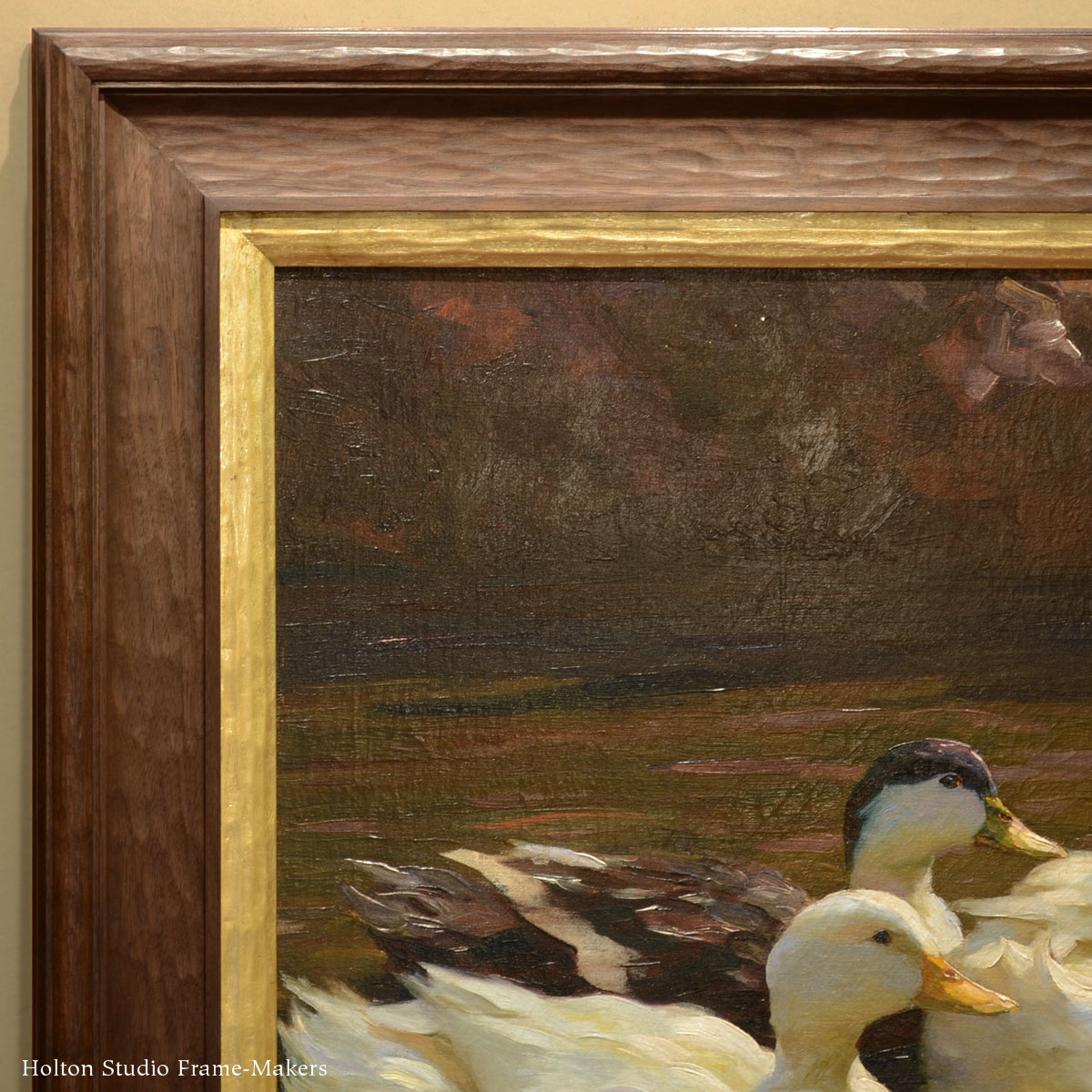
Framed by his love of nature, Koester’s “Ducks In a Pond” deserved a natural wood frame, alive to the beauty of the birds and their watery habitat—something better than the indifferent production gold frame it was in (at right). We used a carved compound scoop, No. 301 CV + Cap 811 CV in walnut at 3-1/2″ wide plus a 1″ wide carved walnut liner. The scoop form leading in to the painting enhances not only the perspective in the painting, but creates the effect of the banks of the pond (extending the visible banks) framing the life of the water birds. It also echoes the waves in the water, as does the carving, and works in complement to the fat outer bead and cushion form of the liner, which is oil-gilded in 18 karat pale gold leaf.

More on Koester…

About this frame…

Alexander Max Koester (Germany 1864 - 1932), "Ducks In a Pond," no date. Oil on canvas, 31" x 52".

Alexander Max Koester (Germany 1864 – 1932), “Ducks In a Pond,” no date. Oil on canvas, 31″ x 52″.

Corner detail

Corner detail